




A Practical Guide to BGE Rebates and Federal Tax Credits in AC Repair vs Replace

Why BGE Rebates and Federal Tax Credits Change the AC Repair vs Replace Decision in Maryland
Understanding how BGE rebates and federal tax credits factor into the AC repair vs replace decision could save you thousands of dollars — and it's something every Maryland homeowner should know before calling a technician or signing a contract.
Here's a quick answer to help you decide:
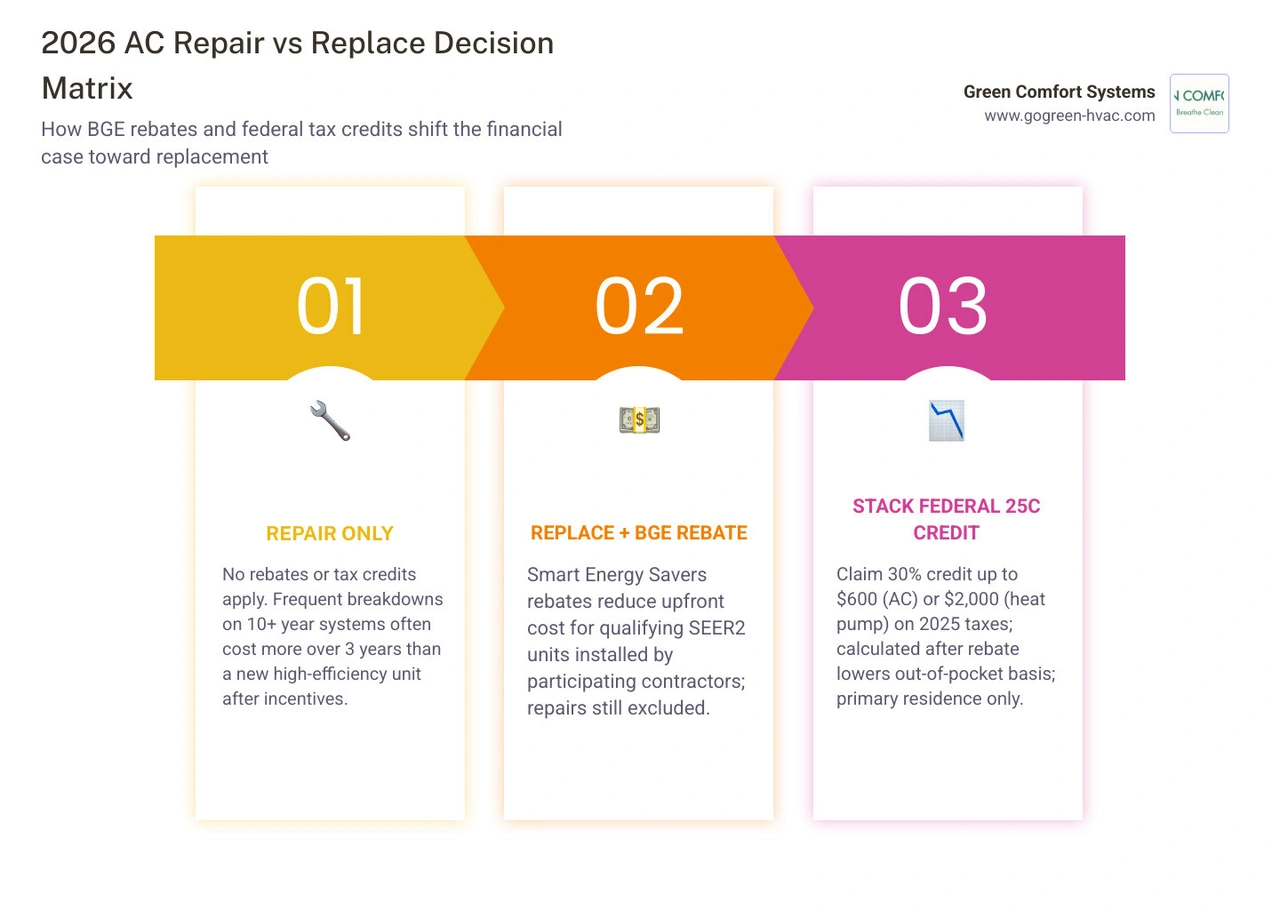
BGE rebates and federal tax credits lower the net cost of replacement significantly, often making a new high-efficiency system the smarter financial move over repeated repairs — especially for systems 10+ years old.
Key factors to consider right now:
- BGE Smart Energy Savers rebates are available for qualifying high-efficiency AC systems and heat pumps installed by a participating contractor
- Federal 25C tax credit covers 30% of installation costs — up to $600 for a central AC or up to $2,000 for a qualifying heat pump — but only through December 31, 2025 (claimed on your 2025 tax return)
- You can stack BGE rebates with federal tax credits, though federal credits are calculated on your out-of-pocket cost after rebates are applied
- Income-qualified households may access additional savings through EmPOWER Maryland programs, potentially covering a large share of project costs
- Repairs never qualify for these incentives — only new qualifying equipment installations do
- The older and less efficient your current system, the faster a new replacement pays for itself after incentives
If your system is aging, unreliable, or running on outdated refrigerant, the financial case for replacement is stronger right now than it may ever be again.
The Core Dilemma: When to Repair vs. Replace Your Maryland AC

Every summer, homeowners across central Maryland face the same stressful situation: the outdoor temperature is climbing, the indoor air is getting humid, and the air conditioner is blowing warm air or making a terrible rattling noise. When we arrive to diagnose the issue, the big question is always: "Should I fix this one more time, or is it finally time to replace it?"
Historically, homeowners used simple rules of thumb to make this choice. However, the modern financial landscape has changed. When evaluating AC Repair vs Replace Decision Factors, we must look at several critical technical and regulatory changes:
- The R-22 Refrigerant Phase-Out: If your air conditioner was installed before 2010, it likely runs on R-22 (Freon). Because the federal government phased out this ozone-depleting chemical, the remaining supply is extremely scarce and expensive. A simple leak repair on an R-22 system can quickly become a massive financial burden, making a repair highly impractical.
- System Lifespan: The typical central air conditioner in Maryland lasts between 10 and 15 years. In our coastal and humid climate — from Severna Park to Forest Hill — systems work hard during hot, sticky summer days. If your unit is past its tenth birthday, its internal components are already near the end of their reliable operational life.
- The Rule of 5,000: A classic industry calculation is to multiply the age of your system by the cost of the repair. If the result is greater than $5,000, replacement is generally recommended. For example, if a 12-year-old system needs a repair that costs $500, the score is 6,000 — signaling that replacement is the wiser financial move.
- Frequent Breakdowns: If you have had to call us for repairs more than once in the last two seasons, your system is sending you a clear warning. Repeated minor repairs add up quickly, yet they do nothing to improve your home's energy efficiency or lower your monthly BGE bills.
How BGE Rebates and Federal Tax Credits Factor into the AC Repair vs Replace Decision for Older Units
When we look closely at how BGE rebates and federal tax credits factor into the AC repair vs replace decision, the financial math shifts dramatically. If you only look at the upfront sticker price of a new system, a repair might seem like the cheaper way out. But when you factor in the immediate utility rebates, the substantial tax credits, and the ongoing monthly energy savings, replacement often becomes the more financially sound choice.
Older units typically operate at much lower efficiency levels, often rated at 10 to 13 SEER (Seasonal Energy Efficiency Ratio). Modern systems are designed under the stricter SEER2 guidelines, starting at 15.2 SEER2 and going much higher. By choosing to Choose Between AC Repair and Installation, you instantly slash your cooling-related electricity consumption.
Furthermore, older units suffer from declining operational reliability. A repaired older unit is still an old, inefficient unit that could break down again next month. A new system, backed by a manufacturer's warranty and our own professional installation guarantees, provides complete peace of mind through the hottest Maryland summers.
How BGE Rebates and Federal Tax Credits Factor into the AC Repair vs Replace Decision
To truly understand how these financial mechanisms work together, we need to look at both the local utility level and the federal level. By combining these programs, you create a "double-dip" savings effect that slashes the net cost of your new system.
When you decide on Upgrading Home with New AC Installation, you are not just buying a piece of metal; you are investing in an energy-efficiency upgrade that both the state of Maryland and the federal government want to subsidize. This is because high-efficiency systems reduce the strain on our local electrical grid and lower overall greenhouse gas emissions.
The federal incentives were greatly expanded under the Inflation Reduction Act, which established long-term tax credits for homeowners who make qualified energy-efficient improvements. At the same time, the EmPOWER Maryland initiative mandates that utilities like BGE offer robust rebate programs to help residential customers lower their energy consumption.
| Incentive Type | Qualified Equipment | Maximum Incentive Amount | Key Eligibility Requirement |
|---|---|---|---|
| Federal 25C Tax Credit | Air Source Heat Pump | Up to $2,000 (30% of cost) | Must meet CEE highest efficiency tiers |
| Federal 25C Tax Credit | Central Air Conditioner | Up to $600 (30% of cost) | SEER2 ≥ 16; EER2 ≥ 12 |
| BGE Smart Energy Rebate | High-Efficiency Heat Pump | Tiered by efficiency | Must be installed by Participating Contractor |
| BGE Smart Energy Rebate | High-Efficiency Central AC | Tiered by efficiency | Must be AHRI-matched system |
| EmPOWER MD / HPwES | Whole-Home Heat Pump Conversion | Up to $15,000 (covers up to 75%) | Requires home energy audit first |
Understanding BGE Smart Energy Savers Rebates in 2026
The BGE Smart Energy Savers Program offers excellent rebates for homeowners upgrading to high-efficiency cooling and heating systems. Funded through the EmPOWER Maryland initiative, these rebates are paid out directly to customers or applied as an instant discount on your installation invoice.
To qualify for these rebates, you must meet a few specific requirements:
- Use a Participating Contractor: You cannot simply hire any handyman or buy a unit online to install yourself. BGE requires that the system be sized, designed, and installed by an authorized participating contractor who understands the program's strict installation standards.
- Equipment Matching: The indoor coil, outdoor condenser, and furnace or air handler must be fully matched and certified by the Air-Conditioning, Heating, and Refrigeration Institute (AHRI).
- Submit within 90 Days: The rebate application and all supporting documentation, including the AHRI certificate and itemized invoice, must be submitted to BGE within 90 days of the installation date.
If you are looking for trusted AC Services Baltimore MD, working with an authorized contractor ensures that all BGE paperwork is handled correctly so you do not miss out on these substantial utility savings.
Leveraging the Federal 25C Energy Efficient Home Improvement Credit
The federal government provides a powerful incentive through the Section 25C Energy Efficient Home Improvement Credit. This non-refundable tax credit allows you to deduct 30% of the total cost of your new system directly from your federal income tax liability.
There are two primary caps to keep in mind under the 25C program:
- Central Air Conditioners: Qualified energy-efficient central AC units are eligible for a tax credit of 30% of the installation cost, up to a maximum of $600.
- Air Source Heat Pumps: Because heat pumps provide both highly efficient heating and cooling, they are incentivized at a much higher level. Qualifying heat pump installations are eligible for a tax credit of 30% of the project cost, up to a maximum of $2,000.
To claim this credit, you must file IRS Form 5695 (Residential Energy Credits) along with your annual federal tax return. It is important to note that this credit only applies to your primary residence — secondary vacation homes or rental properties generally do not qualify for the 25C credit.
Technical Standards and Efficiency Requirements for 2026 Incentives
You cannot simply install any off-the-shelf air conditioner and expect to receive thousands of dollars in rebates and tax credits. Both BGE and the IRS have established strict technical standards that the equipment must meet. These standards ensure that public incentive funds are only used for systems that deliver genuine, verified energy savings.
Before moving forward, it is essential to understand the modern efficiency metrics:
- SEER2 (Seasonal Energy Efficiency Ratio 2): This measures the cooling efficiency of your system over an entire season. The "2" indicates that the testing was done under updated, real-world duct pressure conditions implemented in 2023.
- EER2 (Energy Efficiency Ratio 2): This measures the cooling efficiency at a specific, high outdoor temperature (usually 95°F), representing how well your system performs on the hottest days of the summer.
- HSPF2 (Heating Seasonal Performance Factor 2): For heat pumps, this measures heating efficiency over the winter season.
To qualify for the federal tax credit, central air conditioners must generally meet or exceed 16 SEER2 and 12 EER2. Heat pumps must meet specific regional efficiency requirements established by the Consortium for Energy Efficiency (CEE), which typically align with the highest tiers of ENERGY STAR certification.
When reviewing the Top Considerations Before AC Installation, always ask your contractor for the official AHRI Certificate of Product Performance. This document lists the exact SEER2, EER2, and HSPF2 ratings for the specific outdoor and indoor equipment combination being installed in your home.
Stacking Incentives: How BGE Rebates and Federal Tax Credits Factor into the AC Repair vs Replace Decision
One of the most common questions we get from homeowners in Dundalk, Towson, and Ellicott City is: "Can I stack my BGE rebates with the federal tax credit?"
The answer is a resounding yes! Stacking these incentives is the ultimate way to drive down your out-of-pocket costs. However, you must follow the IRS rules for "basis adjustment" when calculating your tax savings.
Here is how the stacking process works step-by-step:
- Calculate the Gross Project Cost: This is the total cost of the equipment, labor, and permits.
- Subtract State and Utility Rebates First: If you receive an instant BGE rebate or a state electrification grant, you must subtract this amount from the gross project cost. This gives you your "net qualified expense."
- Apply the 30% Federal Tax Credit: Your 30% tax credit is calculated based on that net qualified expense, not the original gross price.
For example, if you convert your older fossil-fuel system to a high-efficiency electric heat pump, you might qualify for a substantial BGE or Home Performance with ENERGY STAR (HPwES) rebate. By subtracting that rebate from the project cost first, you find your remaining out-of-pocket cost, and then you take 30% of that remaining amount (up to the $2,000 cap) as your federal tax credit.
To make the transition even smoother, we recommend that you Prepare Home for AC Installation by addressing any duct leaks or insulation issues first. This ensures your new high-efficiency system performs at its absolute best and qualifies for maximum whole-home incentives. You can also stack these public incentives with seasonal manufacturer promotions for even deeper savings!
Income-Qualified Programs and Step-by-Step Claim Process
For many families, the upfront cost of a new HVAC system is a major hurdle, even with the promise of future tax credits. Fortunately, there are specialized programs designed to make high-efficiency upgrades accessible to everyone, regardless of household income.
When you work with us, we guide you through the entire process so you know exactly What to Expect During AC Installation. From the initial home energy assessment to the final system test, we make sure every step is documented properly. Understanding the Key Steps AC Installation Process helps ensure that you meet all utility and government criteria to secure your financial incentives.
Income-Eligible Programs: HEEHRA and EmPOWER Maryland Layering
The High-Efficiency Electric Home Rebate Act (HEEHRA), integrated with Maryland's state-level EmPOWER programs, provides massive point-of-sale discounts for low-to-moderate-income (LMI) households. Unlike tax credits, which you have to wait until the following spring to claim, these rebates are applied instantly at the time of purchase.
Eligibility is determined by your household's Area Median Income (AMI):
- Under 80% AMI: Households earning less than 80% of the local median income can qualify for rebates covering 100% of the project cost for a new heat pump, up to a maximum cap.
- 80% to 150% AMI: Moderate-income households earning between 80% and 150% of the AMI can qualify for rebates covering 50% of the project cost.
By layering these federal electrification grants with EmPOWER Maryland's income-qualified programs, eligible families in communities like Halethorpe, Middle River, and Glen Burnie can often replace an old, broken AC with a state-of-the-art heat pump system for little to no out-of-pocket cost.
Documentation and Contractor Requirements for Maryland Homeowners
To ensure your rebate and tax credit claims go through smoothly without any delays, you must keep meticulous records and follow a strict checklist:
- Hire a Licensed, Participating HVAC Contractor: Your system must be installed by a licensed Maryland Master HVAC contractor who is registered with the BGE Smart Energy Savers network.
- Keep the Itemized Invoice: The invoice must clearly list the installation date, the physical address of your home, and the exact model and serial numbers for both the indoor and outdoor units.
- Obtain the AHRI Certificate: Ask your technician for the AHRI Certificate of Product Performance matching your exact system configuration.
- Save the Manufacturer Certification Statement: This document proves the equipment meets the efficiency standards required for the federal 25C tax credit.
- Verify local permits: Ensure your contractor pulls the required local mechanical and electrical permits. BGE and local inspectors occasionally perform random quality-assurance inspections on rebated installations.
BGE rebates must be submitted within 90 days of installation, so do not let the paperwork sit on your desk!
Frequently Asked Questions About HVAC Incentives in Maryland
Can I claim federal tax credits for AC repairs or maintenance?
No. Federal tax credits under Section 25C and BGE Smart Energy Savers rebates are strictly reserved for the purchase and installation of new, qualified energy-efficient equipment. General repairs, leak patches, annual tune-ups, and replacement parts (such as a new fan motor or compressor on an old unit) do not qualify for any tax credits or utility rebates.
However, keeping up with regular maintenance is still highly beneficial. Regular cleanings protect your system's efficiency and help prevent the need for costly emergency repairs down the road.
Do BGE rebates and federal tax credits apply to second homes or new construction?
The rules differ slightly between the programs:
- Federal 25C Tax Credit: This credit is strictly limited to existing homes used as your primary residence. It cannot be claimed for rental properties, second homes, or new construction projects (which fall under different builder tax incentives like Section 45L).
- BGE Rebates: BGE rebates are tied directly to active residential electric accounts. As long as the property is an active BGE residential customer, it can qualify for equipment rebates, though certain whole-home programs like Home Performance with ENERGY STAR are designed specifically for existing retrofits rather than new builds.
What is the typical payback period for a high-efficiency AC replacement in Maryland?
The payback period typically ranges between 3 and 7 years, depending on the efficiency of the system you choose, your household energy habits, and how many incentives you qualify for.
By upgrading an old 10 SEER unit to a modern high-efficiency heat pump or AC, you can cut your cooling-related energy bills significantly. When you stack a BGE rebate with a $2,000 federal tax credit, the initial investment is greatly reduced, allowing your monthly energy savings to pay off the net cost of the system incredibly fast.
Conclusion
Deciding whether to repair or replace a failing air conditioner is a major decision for any homeowner. But when you look at how BGE rebates and federal tax credits factor into the AC repair vs replace decision, the path forward often becomes much clearer. Upgrading to a modern, high-efficiency system not only protects you from the stress of summer breakdowns but also puts thousands of dollars back in your pocket through stacked incentives and lower monthly energy bills.
At Green Comfort Systems, we are proud to serve homeowners throughout Rosedale, MD, and our surrounding communities, including:
- Catonsville, MD
- Dundalk, MD
- Ellicott City, MD
- Forest Hill, MD
- Glen Burnie, MD
- Halethorpe, MD
- Joppa, MD
- Middle River, MD
- Perry Hall, MD
- Rosedale, MD
- Severna Park, MD
- Towson, MD
We do things differently. As part of our commitment to eco-friendly operations, we partner with One Tree Planted to plant trees for our projects, helping restore our environment while we restore your indoor comfort. Plus, with our Green Guardian Club maintenance plan, we help keep your new system running at peak efficiency for years to come, protecting your investment and your energy savings.
Ready to find out exactly how much you can save on a new comfort system? We are here to help you navigate your options, maximize your rebates, and make the best choice for your home.
Choose Between AC Repair and Installation with Green Comfort Systems today, and let us help you build a cooler, more efficient home!
Book Expert Service Or Contact Us
Other Blogs


Get Financing Today
Get the comfort you deserve, without the financial stress.

Latest Blogs
Troubleshooting Your October Heating Startup in Rosedale: What's Normal and What's Not
Home Maintenance Tips and Troubleshooting: Answering Your Fall Heating Startup FAQs
Understanding the Senior HVAC Initiative & Fall Heating Startups: Common Questions Answered
