





All About Average Lifespan of Central Air Conditioner in Hot Humid Maryland

How Long Does a Central AC Actually Last in Maryland's Heat and Humidity?
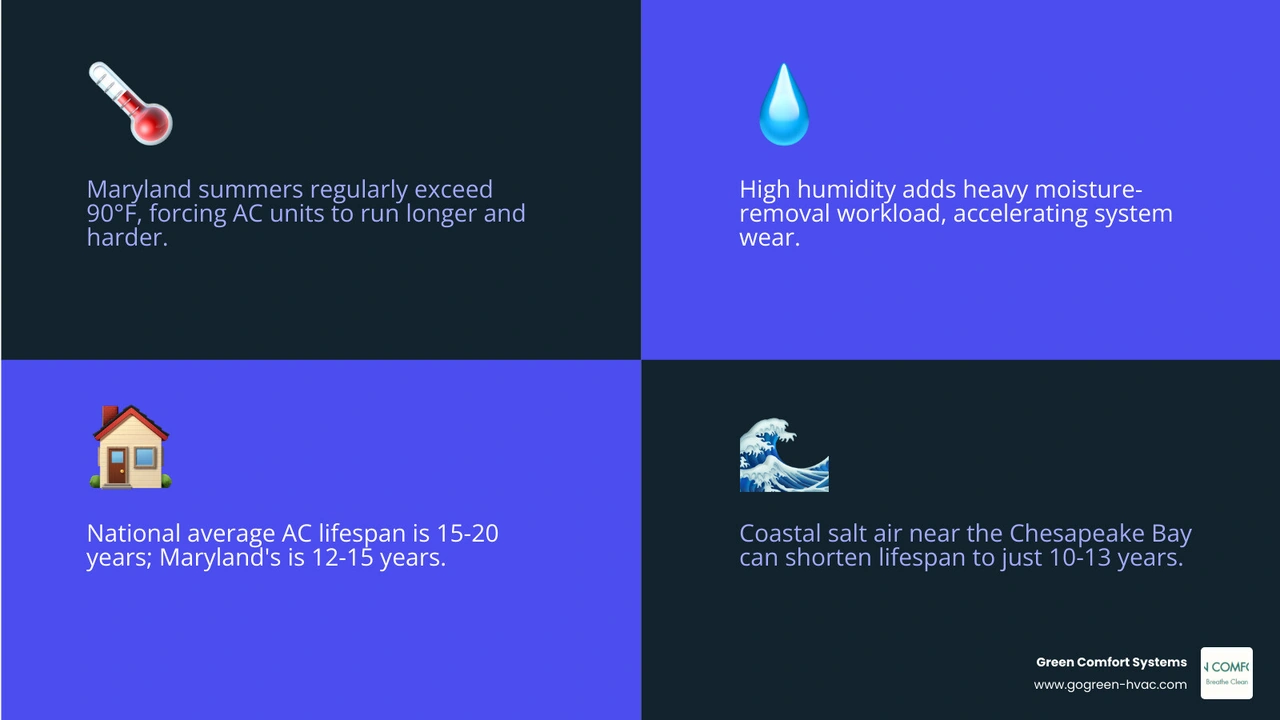
The average lifespan of a central air conditioner in a hot humid Maryland climate is shorter than most homeowners expect. While national averages point to 15-20 years, Maryland's combination of high humidity, long cooling seasons, and coastal salt air means most systems here realistically last 12-15 years — and sometimes less near the Chesapeake Bay.
Here's a quick breakdown of what to expect:
| Location/Condition | Estimated AC Lifespan |
|---|---|
| National average (well-maintained) | 15-20 years |
| Maryland inland (standard maintenance) | 12-15 years |
| Maryland coastal/Chesapeake Bay area | 10-13 years |
| Any location (no maintenance) | 10-12 years |
If your system is 12 years or older and you live in the Baltimore metro or surrounding areas like Rosedale, it's time to start paying close attention.
Maryland sits in a humid subtropical climate zone. Summers regularly push past 90°F with humidity levels that force your AC to work overtime — not just cooling the air, but pulling heavy moisture out of it. That extra workload adds up fast. A system here can accumulate the same mechanical wear in 12 years that a unit in a drier, milder climate might take 18 years to reach.
The good news is that understanding these local factors puts you ahead of most homeowners. Knowing where your system stands means you can plan ahead instead of scrambling during a July heatwave.
What is the Average Lifespan of a Central Air Conditioner in a Hot Humid Maryland Climate?

When we talk about the average lifespan of a central air conditioner in a hot humid Maryland climate, we have to look beyond the manufacturer's ideal estimates. On paper, a central air conditioner is engineered to last up to two decades. However, real-world conditions in communities like Ellicott City, Dundalk, and Glen Burnie dictate a very different timeline.
In our region, an air conditioner does not enjoy a gentle life. The local climate subjects outdoor condenser units to intense thermal stress, rapid temperature swings, and relentless humidity. Because our summers are both hot and incredibly damp, a central AC unit must run longer and harder to maintain a comfortable indoor temperature. If you need professional support to keep your system running smoothly through these intense seasons, our team offers comprehensive AC Services in Maryland to help maximize your unit's functional years.
National Averages vs. the Average Lifespan of a Central Air Conditioner in a Hot Humid Maryland Climate
Nationally, a well-maintained central air conditioner can easily cruise past its 15th birthday and occasionally push toward 20 years in milder, drier climates. But in Maryland, the practical median service life drops to roughly 12 to 15 years for inland installations—and can plummet to 8 to 12 years for coastal properties directly exposed to the brackish, salty air of the Chesapeake Bay.
To put this in perspective, let's look at how regional climate loads and system configurations alter these lifespans:
| System Type & Region | National Average Lifespan | Maryland Average Lifespan | Key Climate Stressors |
|---|---|---|---|
| Central Split AC (Inland) | 15-20 Years | 12-15 Years | High summer humidity, heavy latent cooling load |
| Central Split AC (Coastal/Bay) | 12-15 Years | 8-12 Years | Salt air corrosion, high humidity, wind-blown debris |
| Air-Source Heat Pump | 15 Years | 10-12 Years | Dual-season operation (heating & cooling), reversing valve wear |
| Ductless Mini-Split | 15-20 Years | 12-16 Years | Individual zone cycling, localized moisture management |
In locations like Baltimore, Towson, and Catonsville, our humid subtropical climate features summers that demand near-continuous operation. This localized thermal stress accelerates mechanical wear on the compressor and fan motor, making a 15-year-old Maryland AC unit equivalent in "mechanical miles" to a 20-year-old unit in a more temperate state.
How System Type Affects the Average Lifespan of a Central Air Conditioner in a Hot Humid Maryland Climate
The mechanical design of your cooling system plays a massive role in how gracefully it ages in Maryland.
- Central Split Systems: These traditional systems separate the indoor evaporator coil from the outdoor compressor and condenser. Because the outdoor unit is only active during the late spring and summer months, it enjoys a winter hibernation. This seasonal break helps a standard split system maintain a slightly longer lifespan (12-15 years) than dual-season equipment.
- Air-Source Heat Pumps: Heat pumps are incredibly popular in Maryland towns like Severna Park and Perry Hall because they provide both heating and cooling. However, because they run year-round, they accumulate twice the operational hours. This dual-season load means the reversing valve, compressor, and outdoor fan motor experience continuous wear, lowering the typical Maryland heat pump lifespan to 10-12 years.
- Ductless Mini-Splits: Mini-splits are highly efficient and avoid the thermal losses associated with traditional ductwork. Because they utilize variable-speed inverter compressors, they can run continuously at lower speeds to manage humidity. This reduces the mechanical shock of frequent on/off cycling, often allowing well-maintained mini-splits to last 12-16 years in our climate.
Understanding how your specific system functions can help you choose the right replacement when the time comes. For a deeper dive into how compressor designs influence system wear, check out our guide on Variable Speed vs Two Stage vs Single Stage Systems.
Climate Stressors: Why Maryland’s Weather Accelerates AC Wear
Our local weather is notoriously tough on mechanical equipment. To understand why the average lifespan of a central air conditioner in a hot humid Maryland climate is shorter than the national average, we have to look at the physics of air conditioning in high-humidity environments.
An air conditioner's job is twofold: it must lower the air temperature (sensible cooling) and remove excess moisture from the air (latent cooling). In Maryland, the latent cooling load is massive.
High Humidity and Latent Cooling Demands
When relative humidity levels routinely hover above 70% during July and August in areas like Halethorpe and Middle River, your AC must work incredibly hard to condense water vapor out of the air. This process occurs at the indoor evaporator coil, where moisture clings to the metal fins and drains away.
This continuous condensation cycle means your system runs much longer cycles to achieve the thermostat's target temperature. If your system is improperly sized or struggling with airflow, this heavy moisture load can lead to ice formation on the coils, water leaks, or severe system strain. Furthermore, if a system is oversized, it may cool the home too quickly without running long enough to remove moisture. This results in a damp, clammy indoor environment and causes the system to turn on and off rapidly. To learn more about how this destructive cycle damages your compressor, read about AC Short Cycling Issues.
Coastal Salt Air and Corrosion Risks
For our neighbors living closer to the water in Dundalk, Severna Park, or near the marshes of Essex, salt air corrosion is a major threat. Salt-laden moisture traveling inland from the Chesapeake Bay settling on your outdoor condenser unit acts as a corrosive catalyst.
As the salt air coats the delicate aluminum fins and copper tubing of your condenser coil, it initiates galvanic corrosion. This process weakens the metal, causing the fins to crumble and reducing the unit's ability to shed heat. Over time, this degradation leads to pinhole leaks in the refrigerant lines, which can permanently damage the compressor. For those dealing with these specific coastal issues, our guide on troubleshooting AC Refrigerant Leaks in Essex provides valuable insights into protecting your system.
Warning Signs Your Maryland AC is Nearing End-of-Life
No one wants to wake up to a sweltering house on a humid August morning. Fortunately, your central air conditioner will usually drop several hints that its operational journey is coming to an end. Recognizing these red flags early allows you to plan a replacement on your own terms rather than during an emergency.
If your system is starting to blow lukewarm air or struggles to keep up with the summer heat, you should start by reading our troubleshooting checklist on AC Not Cooling to rule out minor, fixable issues.
Frequent Breakdowns and Performance Issues
As an air conditioner enters its final years, individual components begin to fail in rapid succession. You might find yourself replacing a capacitor one month, a fan motor the next, and then dealing with electrical issues shortly after.
Keep an ear out for unusual sounds coming from your indoor or outdoor units. Squealing, grinding, or clicking noises are clear indicators of mechanical distress. If you notice your system clicking repeatedly without starting, consult our guide on AC Making Clicking Sounds. Additionally, if your outdoor unit is drawing too much electrical current due to a failing compressor, it can cause electrical issues in your home. If this is happening to you, find out why AC circuit breaker keeps tripping to protect your home's electrical panel.
Rising Energy Bills and Efficiency Loss
By the time a central air conditioner reaches its 10th to 12th year in Maryland, its operating efficiency has degraded significantly. On average, an unmaintained AC unit can lose 20% to 30% of its original SEER (Seasonal Energy Efficiency Ratio) rating over its lifespan. This means a system that started as a 13 SEER unit may perform like an 8 or 9 SEER unit in its golden years.
This efficiency loss shows up directly on your monthly BGE or local utility bills. If your energy costs are skyrocketing despite similar usage habits, your compressor is likely working much harder than it should to provide the same amount of cooling. Additionally, a failing system often struggles with humidity control, leading to musty, stale indoor air. If you are experiencing unpleasant smells coming from your vents, read our advice on how to deal with AC Odors.
Repair vs. Replace: Making the Right Decision for Your Home
Determining whether to invest in another repair or move forward with a complete system replacement is one of the most common dilemmas Maryland homeowners face. To make an informed decision, it helps to look at the situation through a structured framework.
When you are ready to explore your options, our guide on Replacing Your AC System can walk you through the process. It is also critical to ensure that your new system is perfectly matched to your home's square footage and layout; you can learn more about this by reading about Choosing the Right AC Size.
The Rule of 5,000 and Age Inflection Points
To remove the guesswork from the repair-versus-replace debate, HVAC professionals often use a simple mathematical formula known as the Rule of 5,000.
If the resulting score is greater than 5,000, replacement is generally the more sensible, cost-effective choice. If the score is under 5,000, repairing the unit is usually a viable path forward.
Let’s look at two real-world examples:
- Scenario A (Repair): You have an 8-year-old system in Towson that needs a $400 repair.
8 x 400 = 3,200. Since 3,200 is well below 5,000, repairing the unit is highly recommended. - Scenario B (Replace): You have a 14-year-old system in Glen Burnie that needs a $600 compressor repair.
14 x 600 = 8,400. Because 8,400 far exceeds the 5,000 threshold, investing that money into a new, efficient system is the smarter financial move.
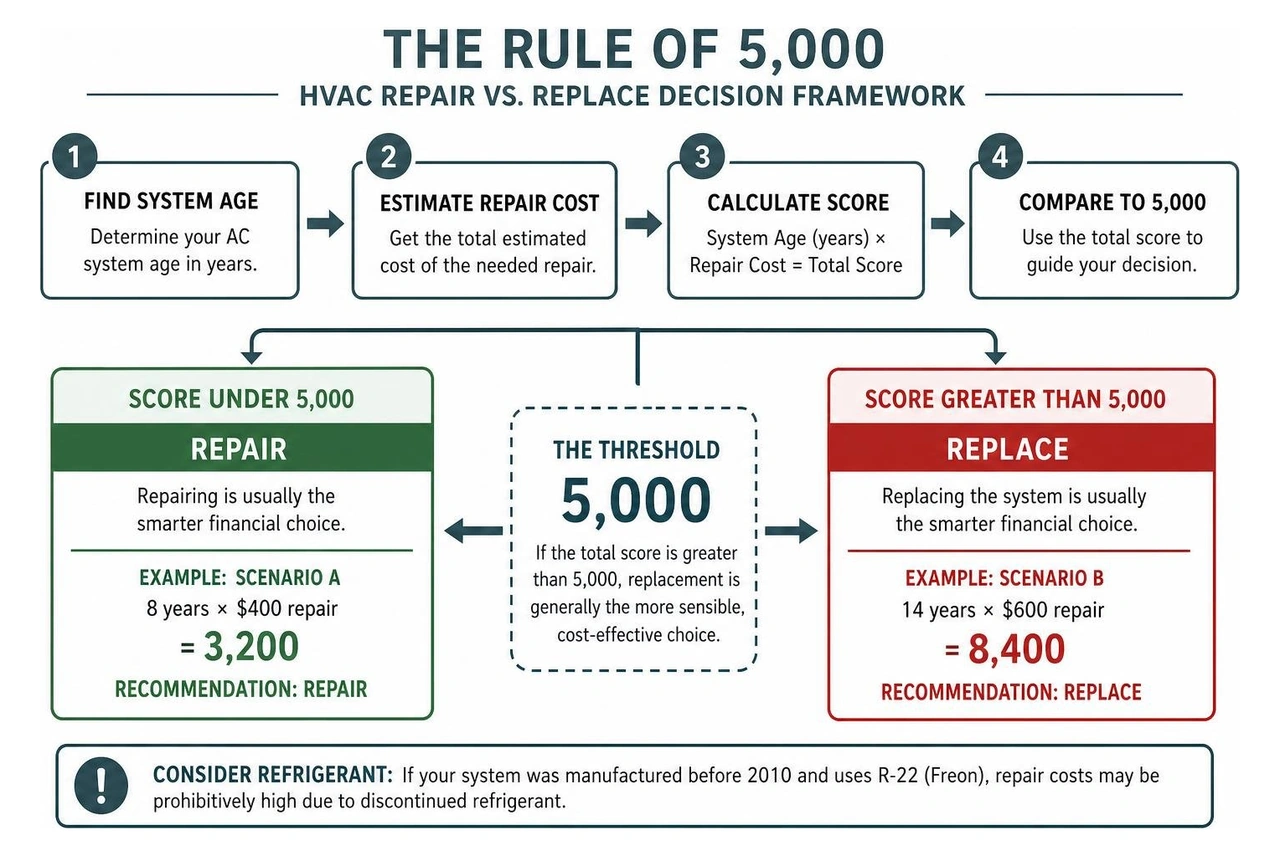
Another major factor is the type of refrigerant your system uses. If your AC was manufactured before 2010, it likely runs on R-22 (Freon). The EPA completely phased out the production and import of R-22. As a result, sourcing this refrigerant for repairs has become incredibly expensive, often making even minor leak repairs on older systems financially impractical.
Local Building Codes and Efficiency Standards
If you decide to replace your system, it is important to know that you cannot simply install the exact same model you bought 15 years ago. The Department of Energy (DOE) periodically updates regional minimum efficiency standards.
As of the latest regulatory updates, Maryland homeowners are subject to the 15 SEER2 minimum efficiency standard for split-system air conditioners. SEER2 is a modern testing standard that more accurately reflects real-world duct pressure and operating conditions. Upgrading to a 15 SEER2 or higher system ensures compliance with local building codes, significantly lowers your energy consumption, and may qualify you for local utility rebates through programs like EmPOWER Maryland. For a comprehensive overview of what to expect on installation day, read our guide on What to Expect During AC Installation.
Frequently Asked Questions About Maryland AC Lifespans
How long does an AC unit last in Maryland without maintenance?
Without regular maintenance, a central air conditioner's lifespan in Maryland is typically reduced to just 10 to 12 years. Neglecting annual service leads to dirty condenser coils, clogged condensate drains, and restricted airflow from old filters. This forces the compressor to run at higher temperatures and pressures, causing premature mechanical failure years before a well-maintained unit would fail. To protect your investment, read about the HVAC Preventative Maintenance Benefits.
Does a new central air conditioner increase home value in Maryland?
Yes, a new central air conditioner is a major selling point for Maryland home buyers. During a home inspection in areas like Catonsville or Towson, an AC unit that is over 12 to 15 years old is almost always flagged as a near-term replacement item. This often leads to buyers negotiating for closing credits. Installing a modern, energy-efficient system eliminates this hurdle, enhances your home's marketability, and provides buyers with peace of mind.
What SEER2 rating is required for new AC installations in Maryland?
In Maryland, the current Department of Energy regional standard requires all new split-system central air conditioners to meet a minimum rating of 15 SEER2 (which is roughly equivalent to the old 14.3 SEER rating under previous testing methods). Opting for an even higher SEER2 rating can yield substantial long-term utility savings and reduce your home's carbon footprint.
Conclusion
Managing the average lifespan of a central air conditioner in a hot humid Maryland climate requires a blend of proactive care, local awareness, and timely decision-making. While our hot summers and heavy humidity will always test your system's limits, regular maintenance can help you get the maximum possible years of reliable comfort out of your investment.
At Green Comfort Systems, based right here in Rosedale, MD, we are dedicated to keeping our community cool while protecting the environment. Through our partnership with One Tree Planted, we plant trees to offset our operational footprint, bringing an eco-friendly approach to home comfort.
To help you stay ahead of system wear and avoid unexpected breakdowns, we invite you to join our Green Guardian Club. As a member, you will receive scheduled seasonal tune-ups, priority service, and exclusive discounts, ensuring your system is always ready for whatever Maryland's weather throws our way.
Whether you need a seasonal checkup, a critical repair, or are ready to explore a high-efficiency replacement, we are here to help. Contact us today to schedule your professional AC Services in Baltimore MD and experience the difference of truly green comfort.
Book Expert Service Or Contact Us
Other Blogs


Get Financing Today
Get the comfort you deserve, without the financial stress.

Latest Blogs
Diagnosing a Blower Motor Failure When Your Furnace Runs but Produces No Air
The Anatomy of a Fast Towson Furnace Repair: How We Diagnose Ignitor Failures
Clearing the Air: How We Handle Lingering Musty Odors During Your October Heating Startup
