





Do You Need a Permit for a Mini Split in Maryland?

Maryland Requires a Permit to Install a Mini Split — Here's What Homeowners Need to Know
If you're wondering do you need a permit to install a mini split in Maryland, the short answer is: yes, in almost every case you do.
Maryland's HVAC permit and code compliance framework governs every stage of mechanical system installation across residential and commercial buildings. A mini-split is treated as three regulated systems in one — mechanical, electrical, and building envelope penetration — which means skipping the permit process isn't really an option.
Here's a quick summary of when a permit is required:
- New mini-split installation — Permit required in virtually all Maryland jurisdictions
- Multi-zone system installation — Permit required
- Like-for-like equipment replacement — May be exempt in some counties, but not all
- Indoor head replacement only — Often exempt, but confirm with your local building department
- DIY pre-charged kit installation — Permit still required; electrical work must be done by a licensed professional
Maryland uses a dual-track permitting structure, with state oversight through the Department of Housing and Community Development (DHCD) and local administration handled by each of the state's 23 counties and Baltimore City. That means the exact process, timeline, and documentation requirements can vary depending on where your home is located.
In the sections below, we'll walk you through exactly what's required — county by county — so you know what to expect before any work begins.
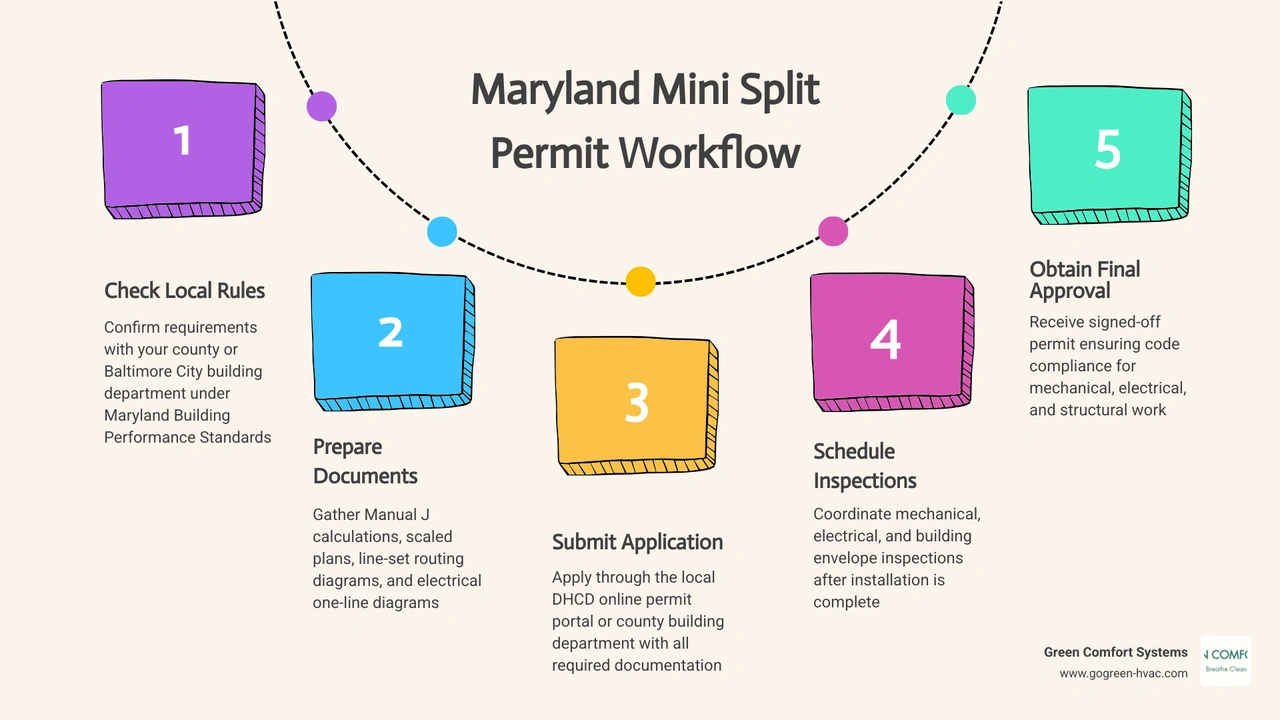
Do You Need a Permit to Install a Mini Split in Maryland?
To understand why a permit is necessary, we have to look at how Maryland regulates building and mechanical work. Under the Maryland Building Performance Standards (MBPS), any project that involves structural, electrical, or mechanical modifications requires formal city or county oversight.
When you install a Mini Split for Home use, you aren't just plugging in a portable appliance. You are making permanent changes to your property:
- Mechanical Systems: You are adding a brand-new heating and cooling system governed by the International Mechanical Code (IMC) or International Residential Code (IRC).
- Electrical Systems: Mini-splits require a dedicated 240V circuit, an outdoor electrical disconnect switch, and proper breaker sizing. This falls squarely under NFPA 70 (the National Electrical Code).
- Building Envelope Penetration: A technician must drill a 3-inch hole through your home’s exterior wall to route the refrigerant lines, electrical control wiring, and condensate drain line. This hole must be properly sleeved, sealed, and insulated to prevent moisture intrusion, pests, and drafts.
Because of these intersecting systems, local building departments require mechanical and electrical permits to verify that the installation is safe and compliant with current codes.
Maryland County and City HVAC Permit Requirements
Because Maryland relies on local jurisdictions to enforce the building codes, the specific rules can change depending on where you live. Whether you are seeking Mini Split Services in the heart of Baltimore or a quiet neighborhood in Ellicott City, you must follow the local building department's processes.
Let’s look at how the permitting landscape is structured across our primary service areas:
| Jurisdiction | Mechanical Permit Required? | Separate Electrical Permit Required? | Licensing Authority |
|---|---|---|---|
| Baltimore City | Yes, via DHCD | Yes | Baltimore City DHCD |
| Baltimore County | Yes, via Department of Permits | Yes | Baltimore County |
| Howard County | Yes, via Department of Inspections | Yes | Howard County |
| Anne Arundel County | Yes, via Department of Inspections | Yes | Anne Arundel County & State |
| Harford County | Yes, via Department of Inspections | Yes | Harford County |
If you want to understand how this process flows from the moment you decide to install a system to the final inspection, here is a helpful breakdown of the steps:
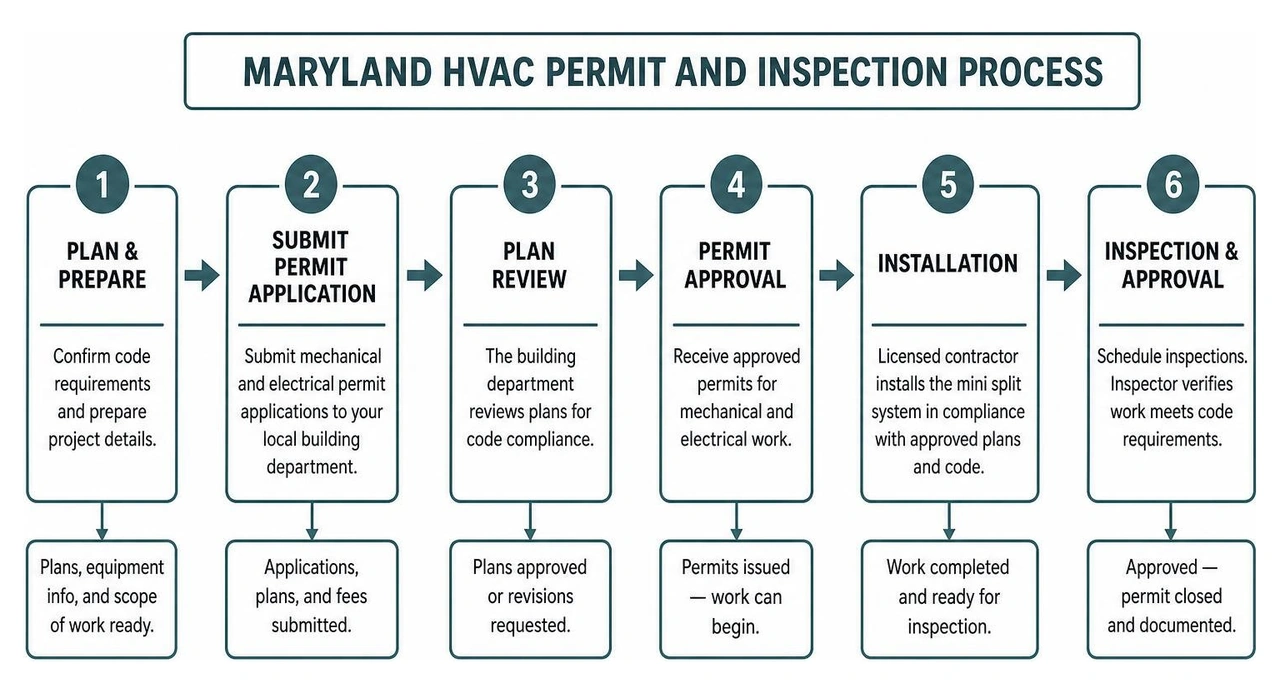
Local Regulations: Do You Need a Permit to Install a Mini Split in Maryland Counties?
Each local building department has its own quirks and local amendments to the International Residential Code.
- Baltimore County (Towson, Dundalk, Perry Hall, Middle River, Halethorpe, Catonsville, Rosedale): If you are scheduling a Mini Split Installation Towson, you must obtain a mechanical permit through the Baltimore County online permit portal. Baltimore County requires a mechanical permit when ductwork is being installed in a dwelling that does not have ductwork, or when additional mechanical work is being completed.
- Howard County (Ellicott City): Howard County requires detailed mechanical permit applications for all residential HVAC work. This includes submitting scaled plans and Manual J load calculations to prove the system is properly sized for the space.
- Anne Arundel County (Severna Park, Glen Burnie): Anne Arundel County has strict licensing laws. To perform HVAC work here, contractors must hold both a Maryland State HVACR license and an Anne Arundel County HVACR license.
- Harford County (Joppa, Forest Hill): Harford County requires permits for all new mechanical equipment installations. The county reviews equipment specifications to ensure they meet local energy efficiency guidelines.
Historic Districts and CHAP Requirements in Baltimore
If you live in one of Baltimore’s historic neighborhoods, such as Fells Point, Federal Hill, Canton, or any area regulated by the Commission for Historical and Architectural Preservation (CHAP), you face an extra layer of permitting.
You can find more details on our specific local coverage on our Locations page, but here is the run-down for historic properties:
CHAP is deeply concerned with preserving the visual integrity of historic brick rowhouses. Because mini-splits are incredibly popular in these homes—which often lack the space for traditional ductwork—CHAP has established clear guidelines for installation:
- Line-Set Routing: You cannot run plastic line-set covers down the front facade of a historic building. Line-sets must be routed through the rear of the property or painted to match the surrounding masonry.
- Exterior Unit Placement: Outdoor condenser units must be placed where they are least visible from the public right-of-way. This often means placing them on a rear patio, alleyway, or even a flat roof, provided the structure can support it.
- Certificate of Approval: Before you can secure a mechanical permit from Baltimore City’s DHCD, you must first obtain a CHAP Certificate of Approval. Installing a system without this approval can lead to severe fines and a stop-work order.
The HVAC Permit Application and Inspection Process
Applying for an HVAC permit in Maryland is a detailed process that requires professional preparation. Local building departments do not simply hand out permits; they require documentation to prove the system will be safe, efficient, and sized correctly for your home.
When we apply for a permit for your Mini Split Installation, we must prepare and submit several key documents:
- Manual J Load Calculations: This calculation determines the exact heating and cooling loads of the rooms where the mini-split heads will be installed. Sizing a system correctly prevents short-cycling, high energy bills, and premature equipment wear.
- Scaled Floor Plans: A drawing showing the layout of the rooms, windows, doors, and where the indoor heads and outdoor condenser will be placed.
- Line-Set and Condensate Routing Details: A plan showing exactly how the refrigerant lines and drain lines will run through the home and where they will exit.
- Manufacturer Specification Sheets: Documentation proving the equipment is listed by a nationally recognized testing laboratory (like UL or ETL) and meets local energy codes.
Once the permit is approved and issued, the physical installation can begin. After the installation is complete, the local municipality requires inspections.
Typically, this involves a rough mechanical/electrical inspection (if walls are open) and a final inspection. During the final inspection, a county or city inspector will visit your home to verify that the electrical disconnect is properly placed, the line-sets are safely insulated and sealed, the outdoor unit meets local setback rules, and the condensate drains away from the foundation.
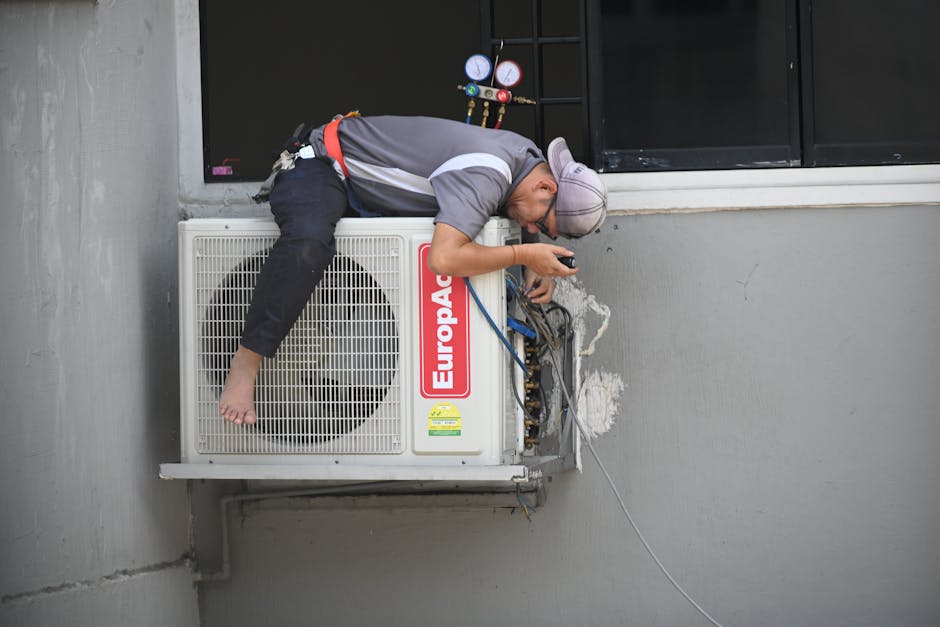
Contractor vs. DIY: Do You Need a Permit to Install a Mini Split in Maryland Yourself?
It is incredibly tempting to purchase a pre-charged DIY mini-split kit online and try to install it yourself over a weekend. However, doing so in Maryland is highly risky and often illegal.
Under Maryland law—specifically Chapter 386 (House Bill 1162), which went into effect in late 2025—it is illegal for retailers to knowingly sell HVAC equipment to unlicensed individuals unless they qualify for very narrow homeowner exemptions. Furthermore, even if a homeowner is legally permitted to pull a "homeowner's permit" to work on their own primary, single-family residence, they must still:
- Pass a written or oral exam in some jurisdictions to prove they understand the building codes.
- Perform all physical work themselves (they cannot hire an unlicensed handyman to do it).
- Handle refrigerants legally, which is nearly impossible without EPA Section 608 certification. Under the Clean Air Act, it is a federal offense to open or modify a refrigerant circuit without this certification.
Hiring a licensed Maryland Home Improvement Commission (MHIC) contractor who also holds a valid Master HVACR license ensures that the permit is pulled correctly, the work is fully insured, and the manufacturer’s warranty remains valid.
Maryland Energy Codes and Efficiency Standards
Maryland is a forward-thinking state when it comes to energy conservation. The state adopted the 2021 International Energy Conservation Code (IECC) as its residential energy standard.
Because Maryland is located in the Northern climate region, all newly installed split-system heat pumps and air conditioners must meet strict minimum efficiency ratings. While standard split systems must meet a minimum of 13 SEER2, modern inverter-driven mini-splits easily surpass this, frequently achieving ratings between 18 and 30+ SEER2.
By pulling a permit, you ensure that your system complies with these strict energy standards, which also makes you eligible for local utility rebates through the EmPOWER Maryland program (offered by utilities like BGE).
Risks of Installing a Mini-Split Without a Permit
Some homeowners ask, "If the outdoor unit is hidden in my backyard, who will ever know if I didn't get a permit?"
While it might seem easy to bypass the local building department, installing a mini-split without a permit carries major risks:
- Safety Hazards: Improperly sized electrical wires or poorly placed disconnect switches can lead to electrical fires or shocks. Poorly sealed wall penetrations can cause water leaks, leading to structural rot and mold behind your drywall.
- Insurance Denials: If an unpermitted HVAC system causes an electrical fire or water damage, your homeowner's insurance company has the right to deny your claim entirely.
- Fines and Stop-Work Orders: If a local code enforcement officer spots an unpermitted outdoor condenser, they can issue a stop-work order, level significant fines, and force you to remove the system or pay double for retroactive permitting.
- Home Sale Complications: When you sell your home in Maryland, you must fill out a property disclosure form. If you fail to disclose unpermitted work, you can be held legally liable. If home inspectors or buyers discover unpermitted HVAC systems, they can demand that you have the system permitted, inspected, or completely removed before closing.
To protect your home's value and keep your system running safely, regular Mini Split Maintenance and initial permitted installation are essential.
Frequently Asked Questions About Maryland Mini-Split Permits
We get many questions from local homeowners about how permits work. Here are some of the most common questions we hear:
Are there any permit exemptions for mini-split replacements in Maryland?
In some Maryland counties, a "like-for-like" replacement of an existing system may be exempt from a mechanical permit, provided no electrical lines or refrigerant pipe routes are altered. However, a brand-new mini-split installation where no system previously existed is never exempt. Replacing just an indoor wall head on an existing, permitted line-set may qualify as minor service work, but you should always verify this with your local building department first.
How long does the HVAC permit review process take in Maryland?
The timeline depends heavily on the jurisdiction. For online applications in Baltimore County or Howard County, standard residential mechanical permits are usually processed within 2 to 4 weeks. If your property is in a historic Baltimore district and requires CHAP review, you should plan for an additional 1 to 2 weeks to secure the necessary approvals.
Do I need a separate electrical permit for a mini-split installation?
Yes. In almost all Maryland jurisdictions, a mechanical permit does not cover the high-voltage electrical work. A separate electrical permit must be pulled by a licensed Master Electrician to install the dedicated 240V circuit, run the conduit, and mount the outdoor electrical disconnect switch.
Conclusion
Getting a permit for your mini-split installation isn't just about following the law—it's about protecting your home, your family, and your investment.
At Green Comfort Systems, based in Rosedale, MD, we take the stress out of the entire process. Our expert team handles every single step of the permitting and installation process for you, ensuring your new system is completely compliant with all Maryland state and local codes.
We are proud to serve communities across Catonsville, Dundalk, Ellicott City, Forest Hill, Glen Burnie, Halethorpe, Joppa, Middle River, Perry Hall, Rosedale, Severna Park, and Towson. As part of our commitment to our local environment, we operate with a strong eco-friendly focus. Through our partnership with One Tree Planted, we plant a tree for every major service we perform. Plus, we help you keep your system running at peak performance year after year through our Green Guardian Club maintenance plan.
Ready to upgrade your home comfort the right way? Check out our Services Overview to see how we can help, or visit our Green Comfort Systems Ductless Mini Splits page to schedule your professional, fully permitted installation today!
Book Expert Service Or Contact Us
Other Blogs


Get Financing Today
Get the comfort you deserve, without the financial stress.

Latest Blogs
Clearing the Air: How We Handle Lingering Musty Odors During Your October Heating Startup
Furnace Maintenance Tips: Troubleshooting the First October Startup
Troubleshooting Your October Heating Startup in Rosedale: What's Normal and What's Not
