





Diagnosing Banging Ductwork vs. Failing Furnace Inducers in Jessup Homes

The October Heating-Startup Scare in Jessup
When you walk over to the thermostat in your Jessup home, switch it to 'heat' for the very first time this October, and wait, you expect a quiet, steady rush of warm air. But instead, a loud, jarring bang echoes through the hallway. If you are experiencing that sudden anxiety, you are not alone. Operating as a family-owned business since 2016, our team at Green Comfort Systems knows exactly how unsettling this can be. In fact, diagnosing banging ductwork vs. failing furnace inducers in Jessup homes is one of the most common challenges we see during the annual mid-fall heating-startup window. That startling noise immediately forces a critical decision: is your heating system just stretching its metal legs, or are you listening to a mechanical failure that requires immediate professional attention?
Understanding the difference between harmless thermal expansion and a dangerous motor failure can save you from unnecessary panic—and protect your home from a mid-winter breakdown. If you need immediate assistance with your system, exploring professional HVAC Services is the safest way to get an accurate diagnosis.
The Sequence of Furnace Operations: Timing Your Noises
To accurately troubleshoot the sounds your heating system makes, we always tell our Rosedale and Jessup customers that they first need to understand how it operates. A modern furnace does not simply turn everything on all at once. When your thermostat calls for heat, the system follows a strict, non-negotiable sequence of operations. This step-by-step process is designed with safety in mind, ensuring that dangerous combustion gases are properly managed before any flames are ignited.
Because different components activate at different times, our technicians often advise homeowners to use a stopwatch or their own careful observation to narrow down the culprit. A noise that happens the very second you adjust the thermostat points to an entirely different problem than a noise that occurs three minutes later.
Step 1: The Inducer Motor Engages
The very first thing that happens when your thermostat clicks is the activation of the draft inducer motor. This small but vital fan sits inside the furnace cabinet. Its job is to clear out any residual gases from the heat exchanger and establish a steady, safe draft up through the exhaust flue.
• Instant activation: The inducer motor turns on immediately upon a call for heat.
• Safety verification: A pressure switch monitors the inducer. If the inducer is not pulling enough air, the furnace will refuse to ignite.
• Diagnostic clue: If you hear grinding, whining, or rattling the exact moment the heating cycle begins—long before you feel any warm air—we almost always find that the inducer motor is the primary suspect.
Step 2: Ignition and Blower Activation
Once the inducer motor establishes a safe draft, the control board allows the ignition sequence to proceed. The ignitor glows, the gas valve opens, and the burners light to warm up the heat exchanger.
• Delayed fan start: The main blower fan—the large motor that actually pushes air through your home's vents—does not turn on immediately. It waits until the heat exchanger is sufficiently warm so it doesn't blast you with cold air.
• Thermal changes begin: Once the main blower kicks on, a massive volume of hot air is suddenly forced into the cold ductwork resting in your walls, basement, or attic.
• Diagnostic clue: If your system runs quietly for the first few minutes, and you only hear a loud bang or pop after the warm air starts flowing from the vents, our field experience shows the issue is almost certainly related to your ductwork.
Decoding Ductwork Noises: The Harmless 'Oil-Canning' Pop
During our October pre-winter inspections, if a homeowner reports a distinct, singular metallic pop or bang shortly after the warm air begins to flow, we typically reassure them that they are experiencing a phenomenon known as "oil-canning." While this sound can be incredibly loud and startling—sometimes sounding like someone struck the side of your house with a rubber mallet—it is generally a harmless side effect of basic physics.
The mechanics of thermal expansion: Your home's ductwork is constructed from thin, rigid sheet metal. When the furnace sits idle, this metal takes on the ambient temperature of its surroundings. Maryland's autumn climate features sudden evening temperature drops, maximizing the temperature differential between cold ambient ductwork and the sudden rush of heated air. This makes these popping sounds especially prevalent in Jessup homes during October.
When 120-degree air suddenly hits that cold, rigid metal, the material rapidly expands. The flat surfaces of rectangular ductwork will physically bow outward under the combination of thermal expansion and the sudden change in air pressure. This sudden bowing creates the loud "pop." When the heating cycle ends and the metal cools, you may hear a second, slightly quieter pop as the metal contracts back to its original shape.
What you can do about it: While oil-canning rarely requires emergency repair, it can be annoying. We recommend a few easy ways to address it:
• Check your airflow: A severely clogged air filter can increase the pressure inside your system, exacerbating the popping sound. Always ensure your filter is clean.
• Keep vents open: Closing too many supply registers in unused rooms forces air back into the main trunks, increasing pressure. Keep at least 80% of your home's vents fully open.
• Acoustic dampening: If a specific section of exposed ductwork in an unfinished basement is the culprit, our HVAC professionals can sometimes reinforce the metal or add acoustic insulation to minimize the flex.
Identifying Inducer Motor Failure: Grinding, Whining, and Rattling
Unlike the harmless pop of expanding metal, sounds originating from the draft inducer motor are serious warnings that we stress should never be ignored. The inducer is a critical safety device. If it fails, your furnace loses its ability to safely vent carbon monoxide and other dangerous combustion byproducts out of your home.
The acoustic signature of failure: A failing inducer motor rarely makes a single popping sound. Instead, our technicians routinely note that it produces continuous, highly disruptive mechanical noises that persist for the entire heating cycle.
• Continuous whining: As the electrical components of the motor begin to degrade, or as the internal bearings dry out, the motor will emit a high-pitched whine or squeal.
• Harsh grinding: If the bearings are actively failing, you will hear a harsh, metal-on-metal grinding sound. Because these bearings are sealed at the factory, they cannot be lubricated; a grinding bearing means the motor assembly must be replaced.
• Rhythmic rattling: The inducer features a small plastic or metal draft wheel. If this wheel cracks, becomes unbalanced, or if debris gets caught inside the housing, it will vibrate violently, causing a loud, rhythmic rattling against the furnace cabinet.
A strict warning on safety: Because the inducer motor is directly tied to the safe venting of hazardous gases, this is never a DIY project. Tampering with the inducer assembly, the exhaust flue, or the attached pressure switches can result in carbon monoxide leaking directly into your living space. With after-hours emergency repair available, Green Comfort Systems provides fast, accurate diagnoses to ensure homeowners do not replace parts unnecessarily or ignore dangerous furnace failures. If you suspect an inducer issue, it is time to Schedule a Furnace Diagnostic with a licensed professional.
Location Matters: Pinpointing the Source of the Sound
If you are still unsure whether you are dealing with expanding ductwork or a failing motor, your own ears and a quick walk through your home can provide the next best diagnostic clue. We always advise clients that the physical location of the sound is just as important as the timing.
Safely walk your home while the system is running and listen carefully to where the noise is loudest. Do not open the furnace cabinet yourself, but stand near it to gauge the volume.
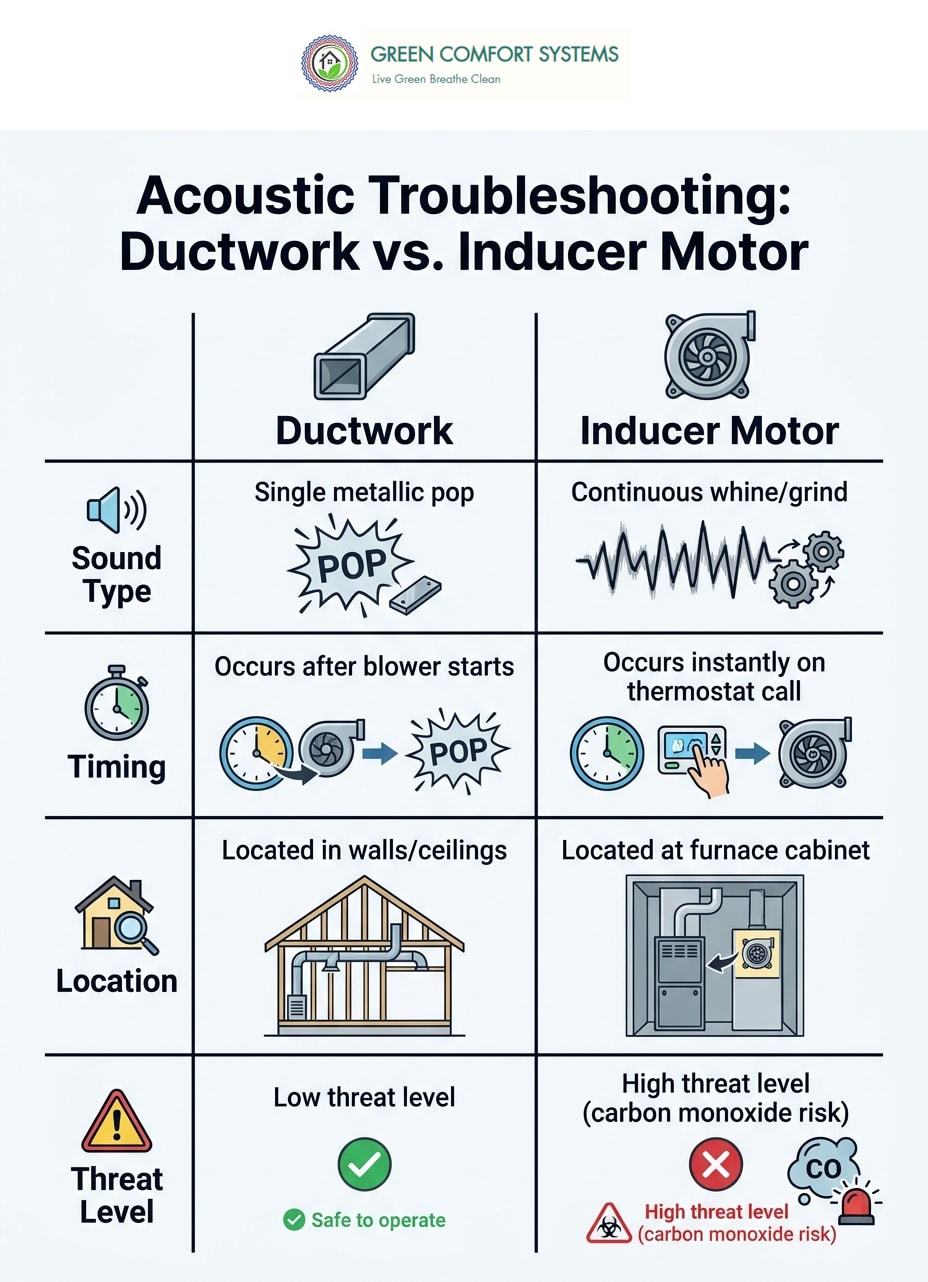
• Timing of Noise — Harmless Ductwork Popping: Occurs 2-5 minutes after the thermostat clicks, once warm air flows. — Failing Inducer Motor: Occurs instantly when the thermostat clicks, before any heat is produced.
• Sound Type — Harmless Ductwork Popping: Single, distinct metallic "bang" or "pop". — Failing Inducer Motor: Continuous whining, grinding, or rapid rattling.
• Physical Location — Harmless Ductwork Popping: Echoes through walls, ceilings, or floor vents far from the furnace. — Failing Inducer Motor: Isolated entirely to the physical furnace cabinet (basement, attic, closet).
• Threat Level — Harmless Ductwork Popping: Low. Usually an annoyance rather than a mechanical danger. — Failing Inducer Motor: High. Risk of system lockout or carbon monoxide venting failure.
By noting these details, you can provide invaluable information to our technicians before we even arrive at your home. For more insights on tracking down strange HVAC sounds, reading up on Decoding Clanking and Banging Noises can help you further isolate the issue.
Why You Should Never Ignore Mechanical Furnace Sounds
Ignoring a strange noise from your furnace cabinet is a gamble that rarely pays off. Modern heating systems are equipped with multiple safety switches designed to shut the system down if a component fails. If your inducer motor bearings are grinding today, they will eventually seize up completely. When that happens, the pressure switch will detect the lack of draft, and the furnace will initiate a "hard lockout," refusing to run at all.
The risk of a total shutdown: A hard lockout never happens on a mild afternoon; a pattern we see often is that it almost always happens on the coldest night of the year when the system is working its hardest. Catching a failing bearing early prevents this sudden loss of heat, keeping your family safe and comfortable.
The value of professional diagnostics: Guessing at the source of a noise can lead to wasted time and unnecessary expenses. A certified technician uses specialized tools, including manometers to check draft pressure and multimeters to check electrical draw, to pinpoint the exact issue. Operating under MD HVAC Master License #78268, and recently named Baltimore Magazine's "Best of Baltimore" HVAC 2025, our team ensures that every diagnostic check is thorough, accurate, and fully compliant with local safety codes.
Understanding the root cause of the problem is the only way to ensure a lasting fix. If you are concerned about the potential costs of professional troubleshooting, reviewing clear Service Pricing options ahead of time can provide peace of mind and help you make an informed decision.
Navigating Furnace Component Repairs and Replacements
Once a professional diagnosis is complete, you will need to navigate the next steps for repair. As we discussed, ductwork pops generally require no replacement parts. However, a failing inducer motor will eventually require a full assembly replacement to restore safe operation.
Evaluating the age of your system: When a major component like an inducer motor fails, it is important to look at the bigger picture. If your furnace is only five or six years old, replacing the inducer assembly is the clear, logical choice. However, if your furnace is fifteen years old and the heat exchanger is also showing signs of severe rust or wear, a single component repair might just be a temporary bandage on a system that is nearing the end of its functional life. If a full replacement is necessary, we offer free installation estimates and always remind customers that generic federal tax credits or local utility incentive programs may apply to qualifying high-efficiency installations (we recommend verifying current programs with your utility or a tax professional).
Upfront options and transparency: A professional technician will always provide you with clear, upfront options. They will explain the condition of the failed part, the overall health of the surrounding system, and the expected lifespan of the repair. We believe you should have all the facts before making a decision about your home's infrastructure.
We also understand that an unexpected mechanical failure in the early fall is never a welcome surprise. Flexible payment options and structured HVAC Financing can help manage the impact of necessary, safety-critical heating repairs, ensuring you don't have to compromise on your family's winter comfort.
Frequently Asked Questions About Furnace Startup Noises
Why is my furnace making a loud banging noise when it turns on?
A loud banging noise shortly after the warm air starts flowing is usually caused by thermal expansion in your ductwork. As the cold sheet metal is rapidly heated by the furnace, it physically bows outward, creating a loud pop or bang often called oil-canning. If the bang happens inside the furnace cabinet before the blower turns on, it could indicate delayed ignition, which requires immediate professional repair.
What does a failing furnace inducer motor sound like?
A failing inducer motor typically produces a continuous, harsh mechanical noise that starts the instant your thermostat calls for heat. You will likely hear a high-pitched whine from degrading electrical components, a metal-on-metal grinding from failing bearings, or a rapid rattling if the internal draft wheel is cracked or unbalanced. These sounds will persist for the entire heating cycle.
Is it safe to run a furnace making a whining noise?
No, it is not recommended to continue running a furnace that is actively whining or grinding. The inducer motor is responsible for safely venting carbon monoxide out of your home. If it is struggling to operate, it could fail mid-cycle, potentially leading to a dangerous buildup of exhaust gases or causing the system to lock down completely.
Why do my air ducts pop when the heat comes on?
Your air ducts pop due to sudden changes in temperature and air pressure. When the furnace blower forces a high volume of 120-degree air into cold, rigid sheet metal ducts, the metal rapidly expands and flexes. Ensuring your air filters are clean and keeping your room vents open can help reduce the internal pressure and minimize the popping sound.
Can I replace a furnace draft inducer motor myself?
Replacing a draft inducer motor is not a safe DIY project. This component is directly connected to the exhaust flue and the safety pressure switches that prevent carbon monoxide from backing up into your home. A licensed HVAC professional must perform this replacement to ensure all seals are airtight and the system meets local safety codes.
How long does a furnace inducer motor typically last before making noise?
A high-quality inducer motor typically lasts between 10 and 15 years under normal operating conditions. However, factors like excessive moisture in the exhaust flue, lack of annual maintenance, or a persistently clogged air filter that forces the motor to work harder can cause the bearings to wear out and become noisy much earlier in its lifespan.
Securing Your Winter Comfort: Making the Right Diagnostic Call
Identifying the source of your heating system's early-season complaints comes down to observing two main factors: the distinct characteristic of the sound (a single pop versus a continuous grind) and the exact timing of when it occurs. Harmless ductwork expansion happens after the warm air flows, while critical inducer motor issues announce themselves the second the thermostat clicks.
If you suspect your system is struggling with a mechanical failure, you do not have to figure it out alone. Boasting a 4.9★ rating and over 480 Google reviews, Green Comfort Systems is dedicated to providing reliable solutions. In our years working on Jessup heating systems, we know that a professional diagnosis provides the exact answers you need. Reach out to our licensed experts today to identify the issue, restore your peace of mind, and ensure your home is safely prepared before the real winter weather sets in.
Book Expert Service Or Contact Us
Other Blogs


Get Financing Today
Get the comfort you deserve, without the financial stress.

Latest Blogs

Preparing Your Pikesville Home's Ductwork for Maximum Airflow This October
How Commuter Schedules in Elkridge Impact Your Heat Pump's Recovery Time

Diagnosing Banging Ductwork vs. Failing Furnace Inducers in Jessup Homes
