





Pre-Winter HVAC Inspections: Finding the Hidden Wear and Tear Before the November Rush

Why Rosedale Homeowners Can't Ignore Pre-Winter HVAC Inspections
For Rosedale MD homeowners, prioritizing pre-winter HVAC inspections: finding the hidden wear and tear before the November rush is the most effective way to prevent a sudden heating failure. Fall in Maryland often feels like a welcome break from the intense summer heat, but that crisp October air is exactly when your heating system is most vulnerable. A typical pattern we see is homeowners ignoring the silent wear accumulated over the summer because the mild weather doesn't demand much from their HVAC equipment. Unfortunately, this creates a false sense of security. The concrete problem arises when the first sudden November freeze hits, forcing a compromised furnace or heat pump to work at maximum capacity. Components snap, systems shut down, and families are left freezing.
The decision point right now is straightforward: you can schedule a targeted October inspection to catch these high-risk components early, or you can wait for a breakdown and risk joining the massive November emergency repair queue. For comprehensive professional HVAC services that catch these hidden issues before they escalate, enrolling in our Green Guardian Club maintenance plan provides ongoing protection and priority service year-round.
The Danger of Maryland's 'September Swing' on Heating Systems
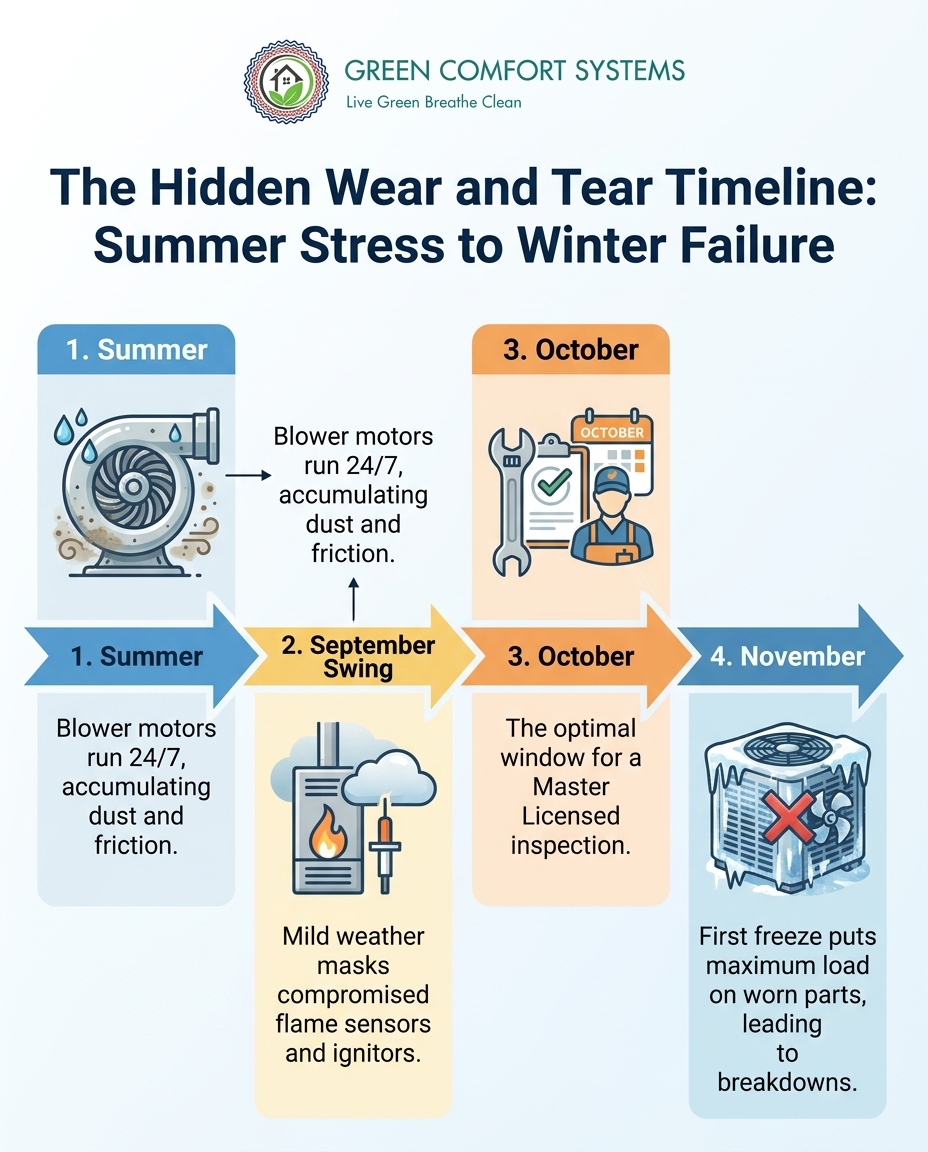
The transition into fall is rarely a smooth, gradual cooldown. Instead, the region experiences the notorious "September Swing"—a chaotic weather pattern where temperatures bounce between warm, humid afternoons and surprisingly chilly nights. This unpredictable shift masks underlying HVAC issues because your system is never running long enough in one mode to expose its weaknesses.
During the mild October weeks, your furnace or heat pump might cycle on for just a few minutes every morning to take the chill out of the air. Because the demand is so low, a struggling blower motor or a partially clogged burner will still manage to produce enough heat. This creates the illusion of a perfectly healthy system, causing many homeowners to delay necessary seasonal checks.
The Shift from Mild Fall to Harsh Winter
Contrasting the October mild weeks vs. Thanksgiving freeze reveals exactly why timing your maintenance is so important. Historically, the Baltimore area experiences a sharp, sudden temperature drop in mid-to-late November. Waiting for this first true freeze to "test" the heater is a leading cause of early winter system failures.
• Mild October Weeks — System Demand: Low (short morning cycles) — Hidden Risk Level: High (wear goes unnoticed)
• Early November — System Demand: Moderate (consistent evening use) — Hidden Risk Level: Moderate (weak parts begin to stress)
• Thanksgiving Freeze — System Demand: Maximum (continuous heavy load) — Hidden Risk Level: Critical (worn parts fail completely)
The quick takeaway: By the time you actually need your heating system to run for hours on end, it is already too late to casually check for wear and tear. The system will either perform, or it will break down under the sudden thermal load.
Hidden Wear Component #1: The Year-Round Blower Motor
Most homeowners don't realize that their heating and cooling systems share a critical component: the blower motor. Whether you have a central air conditioner paired with a gas furnace or a complete heat pump system, the blower motor is the workhorse that circulates air throughout your ductwork. This means it has been running nearly non-stop all summer long.
How Summer Heat Degrades the Motor
Operating under MD HVAC Master License #78268, our team sees the direct aftermath of heavy summer usage. Months of circulating cooled air causes the motor to accumulate microscopic dust particles, even with regular filter changes. This dust settles on the motor's bearings and windings, increasing friction. Department of Energy data consistently points to unmaintained, dirty systems as a primary catalyst for early winter failures. The extra friction forces the motor to draw higher electrical amperage just to spin at its normal speed, silently baking the internal components.
Warning Signs of Blower Fatigue
A professional inspection identifies these issues before the motor seizes on a cold night. Here is a checklist of what we look for during an October tune-up:
• Amperage spikes: We measure the electrical draw of the motor. A higher-than-normal reading means the motor is working too hard and is at risk of burning out.
• Bearing friction: If the motor feels excessively hot to the touch or resists manual spinning, the bearings have lost their lubrication.
• Vibration and balance: Dust buildup on the blower wheel throws it off balance, causing vibrations that shake electrical connections loose over time.
• Capacitor degradation: The run capacitor gives the motor the electrical boost it needs. Summer heat degrades these capacitors, leaving the motor struggling to start.
Hidden Wear Component #2: Ignitors and Flame Sensors
Moving deeper into the furnace, the combustion components represent another major failure point. Unlike the blower motor, ignitors and flame sensors sit dormant all summer. However, sitting idle in a humid basement or utility closet brings its own set of hidden wear and tear.
The Fragility of Flame Sensors
The flame sensor is a vital safety device designed to shut off the gas valve if it doesn't detect a flame. Over the summer, ambient humidity and airborne particles cause a microscopic layer of oxidation and carbon buildup to form on the sensor's metallic rod. When the October mild weeks shift into the Thanksgiving freeze, the furnace finally kicks on for an extended cycle. The dirty sensor fails to register the flame, causing the furnace to short-cycle and shut down entirely, blowing cold air into your home.
Why Ignitors Snap Under Pressure
Modern furnaces use hot surface ignitors rather than standing pilot lights. These components get glowing hot in seconds to ignite the gas. Here is a checklist of how they degrade:
• Thermal stress: The rapid shift from a cold, dormant state to hundreds of degrees creates microscopic cracks in the ignitor's ceramic material.
• Contamination: Dust that settled on the ignitor during summer bakes onto the surface during the first few cycles, creating localized hot spots that weaken the material.
• Resistance changes: As the ignitor ages, its electrical resistance increases, meaning it takes longer to get hot enough to light the gas safely.
Cleaning and testing these delicate components strictly requires a licensed professional. Attempting to scrub a flame sensor with the wrong material or touching an ignitor with bare hands will permanently ruin the parts. Catching a weak ignitor in October takes just minutes to swap out, whereas replacing a shattered one during a November freeze leaves a home completely without heat.
Hidden Wear Component #3: Stressed and Sticking Gas Valves
The gas valve is the gateway for fuel entering your furnace. It operates via a series of internal solenoids that open and close based on signals from the control board. After months of complete inactivity during the cooling season, these internal mechanisms can become sticky, sluggish, or entirely unresponsive.
The Mechanics of Gas Valve Failure
When a gas valve fails to open fully, the furnace receives insufficient fuel, leading to a weak flame, poor efficiency, and a home that never quite reaches the temperature set on the thermostat. Conversely, if a valve sticks in the open position or fails to close completely, raw gas can seep into the combustion chamber—a significant safety hazard that requires immediate professional intervention. If your system is showing signs of fuel delivery issues, specialized furnace gas valve repair is necessary to restore safe operation.
What We Check During an Inspection
Using first-person expertise grounded in our MD HVAC Master License #78268, we employ specialized tools to verify that the gas delivery system is flawless. Here is a checklist of our diagnostic process:
• Manifold pressure testing: We use a digital manometer to measure the exact gas pressure leaving the valve. If it is too high, the heat exchanger can crack; if it is too low, the furnace loses efficiency.
• Voltage verification: We test the electrical signals reaching the valve solenoids to ensure the control board is communicating properly.
• Leak detection: We perform comprehensive checks around the valve fittings and supply lines to ensure zero gas migration during the off-cycle.
• Sequence timing: We monitor exactly how long it takes for the valve to open after the ignitor glows, ensuring the timing aligns with manufacturer safety specifications.
Surviving the Thanksgiving Freeze: Why Timing is Everything
Understanding the mechanical wear is only half the equation; understanding the timeline is what actually saves you from a freezing home. The first heavy load of the season is almost always the breaking point for compromised components. In Rosedale, this heavy load historically aligns with late November.
The Reality of the November Queue
The stark difference between the October mild weeks vs. Thanksgiving freeze is felt most acutely in the HVAC industry's dispatch centers. When the first hard freeze hits, hundreds of unmaintained systems across the Baltimore area fail simultaneously. This creates an immediate bottleneck. The reality of the November emergency repair queue means that homeowners who ignored fall maintenance might wait days for an available technician, simply because the volume of "no heat" calls exceeds the local workforce capacity.
Protecting Your Holiday Gatherings
Framing your HVAC inspection as essential holiday preparation changes the perspective. You prepare your kitchen for Thanksgiving and clean your guest rooms for visiting family, but if the furnace fails, the house becomes uninhabitable regardless of your other preparations. October is the critical, proactive window to secure a spot on a technician's schedule before local teams are booked out. By addressing the hidden wear and tear early, you guarantee that your home remains a warm, welcoming environment no matter how sharply the outside temperatures drop.
Rapid Resolutions: Fixing Wear and Tear On the Spot
A common hesitation homeowners have about pre-winter inspections is the fear of bad news: "What if the technician actually finds something wrong?" The advantage of working with an established, professional team is that finding something wrong in October is vastly preferable to a breakdown in November, primarily because of how quickly we can resolve it.
Under-an-Hour Repairs
We operate with fully stocked trucks, which means our technicians arrive with the most common replacement parts—ignitors, flame sensors, run capacitors, and blower motor components—already on hand. If we discover hidden wear and tear during your inspection, we don't have to leave, order a part, and schedule a return visit days later. The vast majority of these preventative repairs are completed in under an hour, right on the spot. This rapid resolution stops the degradation in its tracks and restores your system to peak reliability immediately.
When Replacement Makes More Sense
Occasionally, an inspection reveals that a system is dangerously worn, suffering from a cracked heat exchanger or a completely failed compressor. While this is never the news a homeowner wants to hear, discovering it in October gives you a massive tactical advantage. You have the time to research options, compare high-efficiency models, and make a thoughtful decision rather than being forced into a panicked emergency purchase while your house is freezing. To help manage these larger discoveries, we offer flexible HVAC replacement financing, ensuring that major upgrades are manageable without disrupting your household budget.
Frequently Asked Questions
What parts of a furnace wear out the fastest?
The components that endure the most thermal and mechanical stress degrade the quickest. Flame sensors and hot surface ignitors frequently fail first due to carbon buildup and extreme temperature shifts. Additionally, the blower motor and its run capacitor wear out rapidly because they operate year-round for both heating and cooling cycles.
Is an annual furnace inspection really necessary?
Yes, an annual inspection is the only way to catch silent mechanical degradation before it causes a complete system failure. Components like gas valves and heat exchangers can develop dangerous faults that show no obvious symptoms to the homeowner. Skipping this check significantly increases the risk of emergency breakdowns and higher utility bills.
What is included in a pre-winter furnace tune-up?
A comprehensive tune-up goes far beyond just changing the air filter. A licensed technician will measure blower motor amperage, clean the flame sensor, test the ignitor resistance, and verify the gas manifold pressure. They also inspect the heat exchanger for microscopic cracks and ensure all safety limits are functioning correctly.
Why is my heater blowing cold air at first during the fall?
A brief blast of cool air is normal as the blower pushes out the stagnant air resting in your ductwork. However, if the air stays cold for several minutes, it usually indicates a dirty flame sensor or a failing ignitor causing the furnace to short-cycle. The system shuts off the burners for safety, leaving only the fan running.
How late in the fall is too late for HVAC maintenance?
While maintenance can technically be performed at any time, waiting past October drastically increases your risk of a breakdown. Once the first hard freeze arrives in November, your system is already under maximum load. Booking in October ensures your system is prepped before the heavy demand actually begins.
Can a dirty blower motor cause my furnace to shut down?
Absolutely. A blower motor coated in dust experiences high friction, causing it to overheat and draw excessive electrical current. If the motor overheats and shuts down, the furnace cannot dissipate the heat it creates, tripping the high-limit safety switch and shutting down the entire heating system to prevent a fire hazard.
Don't let the mild fall weather trick you into ignoring your heating system's hidden wear and tear. Secure your spot on our schedule today to ensure you get clear, expert insight into exactly what components need attention. Catching these issues now prevents a Thanksgiving heating emergency, validating the true value of a professional inspection and keeping your family comfortable all winter long.
Book Expert Service Or Contact Us
Other Blogs


Get Financing Today
Get the comfort you deserve, without the financial stress.

Latest Blogs
Why Fast Access to Replacement Parts Matters for Your Rosedale Heating Repair

Pre-Winter HVAC Inspections: Finding the Hidden Wear and Tear Before the November Rush

Choosing Between Emergency Weekend Repair and Monday Scheduling for a Failing Heat Pump in Severna Park
