




The Anatomy of a Fast Towson Furnace Repair: How We Diagnose Ignitor Failures

When the First October Cold Snap Hits Towson
Understanding The Anatomy of a Fast Towson Furnace Repair: How We Diagnose Ignitor Failures is essential when the mid-fall October heating startup finally arrives and your vents stubbornly blow cold air. You walk over to the thermostat on the first chilly evening of the season, switch the system from cooling to heating, and listen for that familiar hum. The blower motor kicks on, air begins circulating through your home, but after ten minutes, you realize the temperature inside is actually dropping. The air coming out of your registers is completely unheated.
As a family-owned business since 2016, our team at Green Comfort Systems receives this frustrating call constantly during the autumn transition across Towson, Rosedale MD, and surrounding communities. While a furnace blowing cold air can trigger immediate panic about a total system replacement, the culprit is very often a single, highly stressed component: the hot surface ignitor. When this small piece fails, your furnace's built-in safety mechanisms shut down the heating cycle before it even begins, leaving you with a blower that just pushes cold air around the house.
Resolving this issue quickly requires precise, professional diagnostics rather than blindly guessing which part has failed. A freezing home demands a fast, reliable resolution, which is why a methodical approach to your HVAC services is the only way to restore your comfort safely and permanently.
What Is a Hot Surface Ignitor and Why Does It Matter?
To understand why your furnace is blowing cold air, you first need to understand how modern heating systems operate. Decades ago, furnaces relied on standing pilot lights—a small, continuous flame that stayed lit all winter. Today, modern furnaces utilize electronic silicon carbide hot surface ignitors. These highly efficient components act as the spark plug for your heating system, glowing white-hot to safely ignite the combustible gas when your thermostat calls for heat.
The heating cycle follows a strict sequence of operations, and the ignitor plays a pivotal role in this process:
1. The Call for Heat: Your thermostat detects a temperature drop and sends a signal to the furnace control board.
2. The Draft Inducer Starts: A small motor kicks on to clear any lingering gases out of the heat exchanger and ensure proper venting.
3. The Ignitor Glows: Once the system verifies the draft inducer is running, it sends voltage to the hot surface ignitor, which heats up to several thousand degrees in a matter of seconds.
4. The Gas Valve Opens: Only after the ignitor reaches the correct temperature does the gas valve open, releasing fuel across the glowing element to create a controlled flame.
5. The Blower Engages: Finally, the main blower motor turns on to distribute the newly heated air throughout your home.
Because these components endure intense thermal stress, rapidly heating and cooling multiple times a day, they have an average lifespan of three to five years depending on cycling frequency. When the ignitor fails, the control board senses the break in the circuit. As a vital safety mechanism, it refuses to open the gas valve. The main blower, however, may still run as part of its diagnostic or cool-down cycle, which is exactly why you feel cold air. If you are experiencing this exact sequence of events, it is time to make an emergency furnace repair call before the house temperature drops any further.
Why Ignitors Crack During Mid-Fall Heating Startups
In our experience serving Maryland homeowners, a frequent question is why a furnace that worked perfectly at the end of last winter suddenly refuses to generate heat in the fall. The answer lies in the intense environmental and physical stressors placed on the system during its dormant months. The rapid transition from humid Maryland summers to freezing fall nights is incredibly hard on delicate HVAC components.
The Impact of Dormancy and Humidity
During the long, humid summer months, your furnace sits idle in your basement, crawlspace, or utility closet. While your air conditioner works overtime, the heating components are subjected to ambient moisture. Silicon carbide, the material used in most hot surface ignitors, is extremely resilient to heat but highly brittle and susceptible to environmental degradation over time. Months of dormancy allow microscopic oxidation to occur on the surface of the element.
The Physics of Thermal Expansion
When the mid-fall October heating startup arrives, that dormant, slightly degraded piece of silicon carbide is suddenly hit with 120 volts of electricity. It is forced to heat from an ambient 60 degrees to over 2,000 degrees Fahrenheit in less than twenty seconds. This rapid temperature shift causes violent thermal expansion. When the cycle ends, the component cools and contracts just as quickly.
The Breaking Point
If the ignitor already has microscopic cracks from previous winters, this sudden, aggressive thermal expansion during the first major cold snap pushes the weakened material past its breaking point. The internal circuit snaps, completely severing the electrical path. This is a predictable, seasonal wear-and-tear issue. It does not mean your entire furnace is failing; it simply means a high-wear component has reached the end of its natural lifecycle due to the extreme temperature swings inherent to our regional climate.
Professional Diagnostics vs. Blind Part Swapping
When a furnace blows cold air, the symptoms of a bad ignitor can closely mimic several other serious issues, such as a failing control board, a tripped safety switch, or a faulty draft inducer motor. This is where the difference between amateur guesswork and licensed professional methodology becomes critical.
The dangerous and inefficient practice of "blind part swapping"—where an untrained individual guesses which part is broken, buys a replacement, and hopes it fixes the problem—wastes valuable time and leaves families shivering in the cold. Worse, dealing with high-voltage electrical components and combustible gas without proper training is a massive safety hazard. Named Baltimore Magazine's "Best of Baltimore" HVAC 2025 and operating strictly under our MD HVAC Master License #78268, Green Comfort Systems approaches every furnace with a systematic diagnostic methodology designed to rule out false positives and guarantee an accurate repair.
• Initial Assessment — Amateur "Parts Swapping" Guesswork: Assuming the ignitor is bad because the air is cold. — Licensed Professional Methodology: Evaluating the entire sequence of operations step-by-step.
• Component Testing — Amateur "Parts Swapping" Guesswork: Replacing the part to see if the system turns on. — Licensed Professional Methodology: Isolating the component and testing electrical resistance.
• Safety Protocols — Amateur "Parts Swapping" Guesswork: High risk of electrical shock or gas leaks due to improper handling. — Licensed Professional Methodology: Strict adherence to high-voltage and combustible gas safety standards.
• Time to Resolution — Amateur "Parts Swapping" Guesswork: Days of waiting for parts, returning wrong parts, and re-testing. — Licensed Professional Methodology: Immediate, definitive answers leading to on-the-spot repairs.
• Financial Impact — Amateur "Parts Swapping" Guesswork: Wasting money on unneeded parts that cannot be returned. — Licensed Professional Methodology: Paying only for the exact component that has definitively failed.
A licensed professional does not guess. We use calibrated tools to prove exactly where the electrical failure has occurred, ensuring that when we replace a part, the heat will reliably turn back on.
Inside Our Process: The Multi-Meter Resistance Check
To provide a behind-the-scenes look at how we guarantee our diagnostic accuracy, we want to walk you through our standard procedure for testing a suspected ignitor failure. Because this involves high voltage and combustible gas systems, these diagnostics must exclusively be performed by a licensed professional.
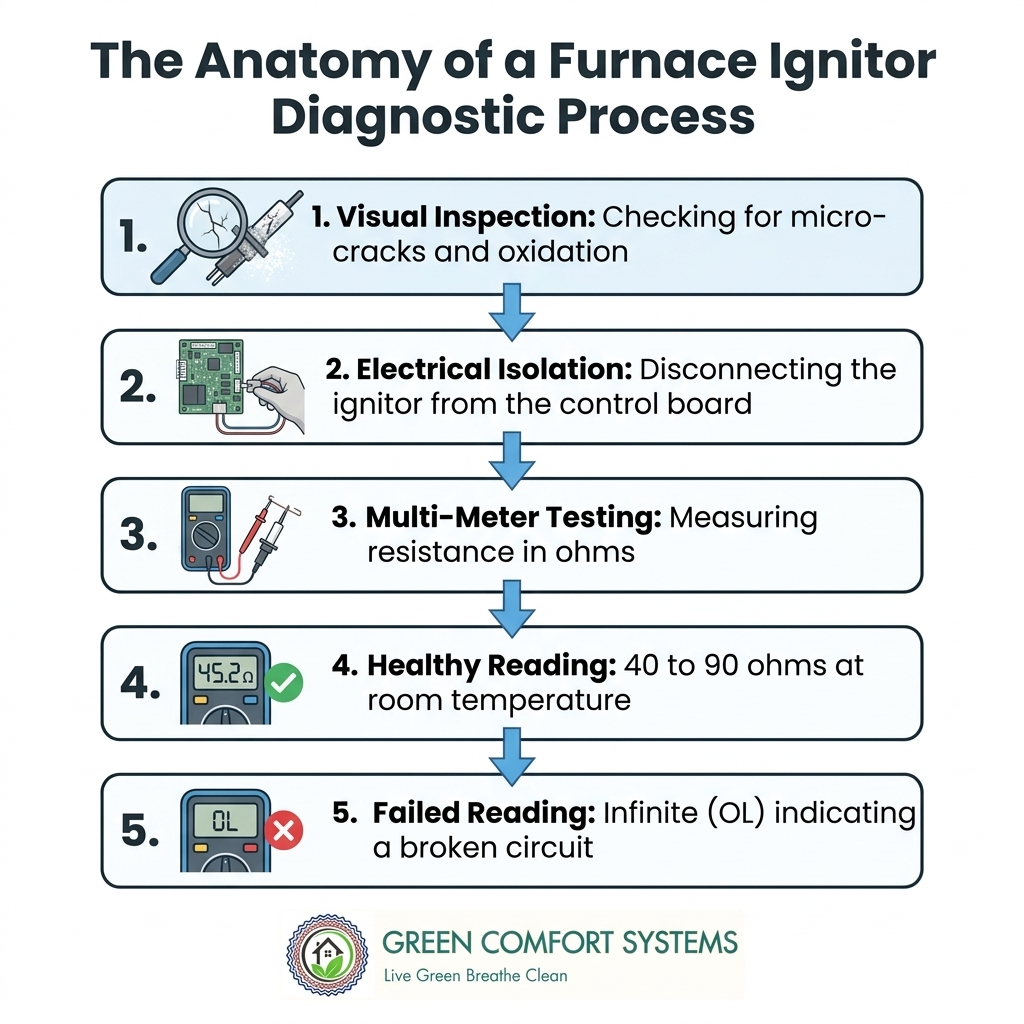
Visual Inspection for Micro-Cracks
The first step in our diagnostic process is always visual. Before touching the electrical components, our technician inspects the ignitor element with a high-powered flashlight. We look for visible white spots, heavy oxidation, or obvious physical fractures on the dark grey silicon carbide. While a shattered ignitor is obvious, micro-cracks are often invisible to the naked eye. Visual checks are a necessary first step, but they are never definitive on their own. A component can look perfectly healthy but be completely dead internally.
Electrical Resistance Verification
To definitively prove the component has failed, our technician performs a precise electrical test. This is where the multi-meter resistance (ohms) check becomes the ultimate source of truth. First, the technician completely disconnects power to the furnace at the breaker to ensure absolute safety before opening the burner compartment. Next, the ignitor's wiring harness is unplugged from the main control board. This electrical isolation is a critical step; if the component is tested while still plugged in, the multi-meter will read the resistance of the control board, resulting in a false reading.
Once isolated, the technician sets a calibrated multi-meter to the ohms setting to measure electrical resistance and places the probes on the two terminals of the ignitor plug. A healthy hot surface ignitor generally reads between 40 to 90 ohms at room temperature, proving the internal circuit is intact and ready to carry voltage. However, if the multi-meter displays "OL" (Open Loop or infinite resistance), it confirms a broken internal circuit. Electricity cannot flow across a broken bridge, definitively proving the ignitor has failed and must be replaced by our team.
How Accurate Diagnostics Enable Sub-One-Hour Repairs
Taking the extra ten minutes to isolate the component and test resistance accurately actually speeds up the overall repair timeline dramatically. When our technicians rely on exact data rather than assumptions, there is zero wasted movement. This precision is the backbone of our commitment to fast, efficient emergency response times.
Because we operate under MD HVAC Master License #78268, our service vehicles are fully stocked as rolling warehouses. By carrying a wide inventory of universal and OEM replacement ignitors on the truck, we can transition immediately from diagnosis to replacement the moment the multi-meter confirms the failure. There is no driving across town to a supply house while your home continues to freeze.
Once the new ignitor is carefully installed—ensuring no oils from human hands touch the fragile silicon element—the technician walks through a final, rigorous safety check. We restore power, initiate a call for heat, and observe the new ignitor glow white-hot. We verify that the gas valve opens correctly and that the burner ignites smoothly without any rollout or delay. This comprehensive approach guarantees that the heat will stay on long after our truck leaves your driveway. We also keep after-hours emergency repair available for sudden late-night breakdowns. If the diagnostics reveal that your aging system requires a total replacement, we offer free installation estimates, and we make addressing these sudden failures easier by offering flexible financing options for heating repairs.
Other Common Culprits When Your Furnace Blows Cold Air
A thorough diagnostic process must account for every variable. What happens if our technician performs the multi-meter resistance (ohms) check and the reading comes back at a perfectly healthy 60 ohms? This is exactly why professional methodologies are so vital. If the ignitor is healthy, the technician must immediately pivot to evaluate other components in the sequence of operations.
The Dirty Flame Sensor
Often confused with the ignitor, the flame sensor is a small metal rod that sits inside the burner path. Its job is to detect whether a flame is actually present after the gas valve opens. If this sensor gets coated in carbon build-up or dust over the summer, it cannot sense the flame. The furnace will ignite for about three seconds, then shut down entirely as a safety precaution, leaving the blower to circulate cold air. This short-cycling is a frequent issue that requires careful cleaning.
Gas Valve Failures
If the ignitor glows beautifully but no flame ever appears, the issue lies further down the sequence. A failure at the gas valve prevents fuel from ever reaching the glowing ignitor. Diagnosing this requires testing the voltage coming from the control board to the valve to determine if the valve itself is stuck closed or if the board is failing to send the signal. This level of troubleshooting is why comprehensive furnace gas valve repair is strictly a job for licensed professionals.
High Limit Switch Trips
If your furnace is overheating due to a severely clogged air filter or blocked vents, the high limit switch will trip, cutting off the burners while keeping the blower running to cool the heat exchanger down. This will also result in cold air blowing from your vents. A professional will test the continuity of this switch to ensure your system is breathing properly.
Frequently Asked Questions About Furnace Ignitor Diagnostics
How do professionals test a furnace ignitor?
Professionals test a furnace ignitor by isolating the component and performing an electrical resistance check. Using a calibrated multi-meter set to ohms, a technician measures the resistance across the ignitor's plug terminals. A reading between 40 and 90 ohms typically indicates a healthy component, while an "OL" (infinite) reading proves the internal circuit is broken and the ignitor must be replaced.
Why is my furnace blowing cold air when I first turn it on?
Your furnace is likely blowing cold air because a safety mechanism has interrupted the heating cycle. Most commonly, a failed hot surface ignitor prevents the gas valve from opening, but the main blower motor continues to run its cycle, circulating unheated air throughout your home. This requires a professional diagnostic to pinpoint exactly which component halted the ignition sequence.
How do I know if my furnace ignitor is bad?
You can often tell an ignitor is bad if you hear your furnace click on, but the burners never ignite and the system only blows cold air. Visually, a bad ignitor may have white oxidation spots or visible micro-cracks on the grey silicon carbide element. However, the only definitive way to know it has failed is through a professional multi-meter resistance check.
Can a furnace run with a bad ignitor?
No, a modern furnace cannot run with a bad ignitor. As a built-in safety feature, the system's control board must verify that the ignitor is drawing the correct voltage and glowing hot enough to ignite fuel. If the ignitor is broken, the control board will lock out the gas valve to prevent a dangerous buildup of unburned combustible gas in your home.
What causes a furnace ignitor to fail prematurely?
Premature furnace ignitor failure is usually caused by excessive thermal stress, frequent short-cycling, or improper handling. Oils from human skin can create hot spots on the delicate silicon carbide, causing it to crack when heated. Additionally, extreme temperature swings and high humidity during dormant summer months can weaken the material, leading to failure during the first major cold snap.
How long does it take a professional to replace a furnace ignitor?
A licensed professional can typically diagnose and replace a furnace ignitor in under an hour. Because experienced technicians carry universal and OEM replacement parts on their fully stocked service vehicles, they can swap out the broken component immediately after testing it, restoring your heat in Towson without delays.
Restoring Your Heat Safely and Quickly
Understanding exactly how a professional diagnoses an ignition issue proves the true value of calling a licensed expert when your system fails. Backed by a 4.9★ rating and over 480+ Google reviews, Green Comfort Systems doesn't rely on guesswork, and we don't waste your time with unnecessary parts. By utilizing strict, methodical testing procedures—like the multi-meter resistance check—we pinpoint the exact cause of your heating failure within minutes of arriving at your home.
A fast, reliable repair is the direct result of this exact diagnostic accuracy, preventing drawn-out, freezing nights for you and your family. If your vents are blowing stubbornly cold air during this fall cold snap, don't wait for the temperature to drop further. Rely on established, licensed local experts to properly test your system, replace the failing components safely, and restore your home's warmth and comfort without delay.
Book Expert Service Or Contact Us
Other Blogs


Get Financing Today
Get the comfort you deserve, without the financial stress.

Latest Blogs
The Anatomy of a Fast Towson Furnace Repair: How We Diagnose Ignitor Failures
Clearing the Air: How We Handle Lingering Musty Odors During Your October Heating Startup
Furnace Maintenance Tips: Troubleshooting the First October Startup
