




Smart Thermostats vs. Programmable Models for Managing Unpredictable October Weather in Middle River

Are You Ready for Middle River's Extreme October Temperature Swings?
If your home is struggling to stay comfortable and you are debating between smart thermostats vs. programmable models for managing unpredictable October weather in Middle River, our team at Green Comfort Systems is here to help. As we move deeper into the mid-fall season and begin our pre-winter heating inspections, local homeowners face a unique climate challenge. The mornings often start near freezing, requiring robust heating, while the afternoons can suddenly swell into sweltering, humid conditions that demand immediate air conditioning. If you are still relying on an older manual thermostat, you already know that it simply cannot keep up with these rapid, coastal-adjacent temperature shifts.
When your indoor climate control feels like a constant battle, upgrading your thermostat is one of the most effective HVAC services for immediate comfort improvement. Since we opened our doors as a family-owned business in 2016, we have seen firsthand how the technology mounted on your wall serves as the brain of your entire heating and cooling system. However, before you swap out that old dial or basic digital unit, you need to determine which modern technology actually fits your lifestyle and the local climate. Are you better served by a static, predictable schedule, or does your home require an adaptive system that monitors the weather for you? Understanding how these two distinct technologies operate is the first step toward reclaiming your indoor comfort this season.
The Challenge of Maryland's 'September/October Swing'
To understand why your thermostat choice matters so much right now, we have to look closely at the "September/October swing." In our years of servicing Rosedale and Middle River, we frequently see daytime highs push into the upper 70s or low 80s, demanding air conditioning, while nighttime lows plummet into the 40s, requiring steady heating. For these coastal-adjacent communities, proximity to the water heavily influences localized humidity and exacerbates these temperature shifts. The sudden drop in evening temperatures routinely catches homeowners off guard, forcing HVAC systems to work overtime just to stabilize the indoor environment.
These drastic diurnal temperature variations place an immense strain on standard HVAC operations if they are not managed properly. When our technicians perform fall maintenance, a pattern we see often is systems left running at suboptimal temperatures, consuming significantly more energy to drastically correct the indoor climate after a sudden weather shift. Traditional climate control strategies were designed for steady, predictable seasons—like the deep freeze of January or the continuous heat of July. They were not built for a month where you might experience all four seasons in a single 48-hour window.
Why Manual Adjustments Fall Short
Relying on a manual thermostat during the fall transition is an exercise in frustration. Constantly walking to the wall unit to bump the temperature up or down is not just inconvenient; it is entirely reactive rather than proactive. By the time you feel uncomfortable enough to adjust the dial, your home has already lost its thermal momentum.
The high cost of over-correcting: Manual adjustments often lead to a common mistake known as over-correcting. When the house feels too cold, you might crank the heat up five degrees higher than necessary, hoping the house will warm up faster. It will not. It simply forces the furnace to run longer, spiking your energy usage and ultimately making the house uncomfortably hot, which then prompts you to turn on the AC. This vicious cycle wastes energy and accelerates wear and tear on your equipment.
Programmable Thermostats: Static Schedules vs. Erratic Weather
Programmable thermostats were the first major evolution in home climate control, designed to automate the daily routine. These units operate on a very straightforward principle: static time-blocks. You tell the thermostat what temperature you want the house to be at specific times of the day, usually broken down into "Wake," "Leave," "Return," and "Sleep" periods.
When the weather is highly predictable and your daily routines are perfectly consistent, programmable thermostats deliver excellent energy savings. They ensure your HVAC system isn't running at full capacity while the house is empty. However, our Middle River customers frequently find that static schedules fail spectacularly when a sudden October cold front hits unexpectedly. If your thermostat is programmed to drop to 65 degrees at 9:00 AM because it expects a warm fall afternoon, but a coastal storm rolls in and drops the outdoor temperature to 45 degrees, you will return to a freezing house.
Pros of Programmable Models
• Predictable operation: Highly reliable for households with extremely fixed daily routines who leave and return at the exact same times every day.
• Budget-friendly hardware: Lower initial hardware costs compared to advanced smart systems, making them an accessible entry point for basic automation.
• No internet required: They function perfectly without a Wi-Fi connection, which is ideal if you prefer offline home appliances.
Cons During Fall Transitions
• Inability to auto-switch: Most basic programmable models cannot automatically switch from heating mode to cooling mode based on ambient room temperature.
• No remote access: If you are stuck at work and the weather suddenly changes, you cannot adjust the temperature until you physically walk through your front door.
• Frustrating overrides: Having to manually override pre-set schedules during fluctuating fall temperatures defeats the entire purpose of having an automated system.
Smart Thermostats: Adaptive Learning for Daily Temperature Swings
Smart thermostats represent a massive leap forward, actively resolving the limitations of programmable models through dynamic adjustments and continuous connectivity. Instead of relying on rigid time blocks that you have to punch in manually, these devices utilize algorithmic learning. Over the first few weeks of use, a smart thermostat learns your actual habits. It notices when you typically walk past the sensor in the morning, when the house is empty, and what temperatures you prefer at different times of the day. It then builds a custom, fluid schedule that adapts to your life.
The standout feature for managing Maryland's fall weather is the auto-switch capability. As October days heat up and nights cool down, a smart thermostat can seamlessly transition your HVAC system between heating and cooling modes to maintain a precise temperature range. You no longer have to wake up and manually flip a switch from "Heat" to "Cool." Furthermore, achieving maximum efficiency relies on optimal thermostat placement to accurately read the home's ambient temperature, allowing the smart sensors to make highly accurate micro-adjustments throughout the day—something our installation team carefully evaluates during every visit.
Geofencing and Real-Time Weather Tracking
Two specific features make smart thermostats uniquely suited for Middle River's erratic climate:
1. Geofencing technology: By linking to your smartphone's location, the thermostat detects when you leave your neighborhood and automatically shifts into an energy-saving away mode. As soon as you cross back into your customized perimeter, it begins pre-conditioning the home so it is perfectly comfortable the moment you unlock the door.
2. Real-time weather integration: Smart thermostats pull local weather forecasts via Wi-Fi. If the system sees that a severe cold front is arriving at 3:00 PM, it can adjust its heating strategy proactively, ensuring your home doesn't lose its baseline warmth before the freeze hits.
Side-by-Side Comparison: Which Wins in Middle River?
Choosing the right thermostat depends heavily on how you weigh convenience, comfort, and adaptability. To help you make a definitive choice for your mid-fall upgrade, let's look at a direct, scannable comparison of how these two technologies handle the specific demands of our local climate.
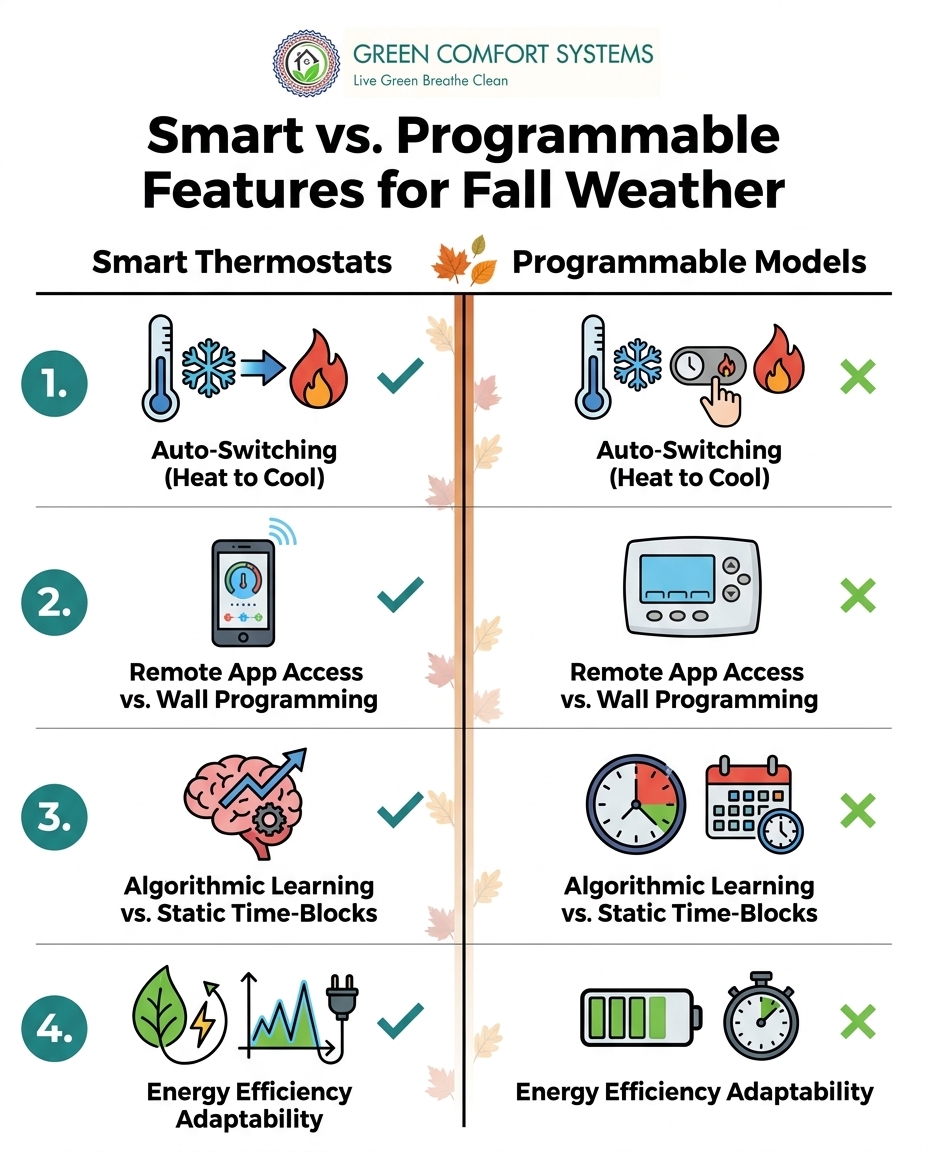
• Energy Efficiency Optimization — Programmable Thermostats: Relies entirely on user perfection; you must program the exact right times and temperatures to save energy. — Smart Thermostats: Optimizes dynamically; learns your habits and adjusts automatically to minimize unnecessary HVAC run times.
• Convenience & Control — Programmable Thermostats: Manual interface programming on the wall unit; requires reprogramming when seasons or schedules change. — Smart Thermostats: App control via smartphone, tablet, or voice assistant; adjust settings from anywhere in the world.
• Weather Adaptability — Programmable Thermostats: Blind to the weather; runs its schedule regardless of whether it is 80 degrees or 40 degrees outside. — Smart Thermostats: Tracks local weather forecasts and adjusts operation times based on upcoming temperature swings.
• Mode Switching (Heat to Cool) — Programmable Thermostats: Requires manual intervention; you must physically switch the unit from "Heat" to "Cool" as the day warms up. — Smart Thermostats: Auto-changeover feature seamlessly shifts between heating and cooling to maintain a set temperature range.
When you evaluate this side-by-side data, the conclusion becomes clear. For regions with high day-to-night temperature variations like Middle River, smart technology offers superior comfort and efficiency. Programmable units are excellent for highly stable climates, but they lack the agility needed to handle a Maryland October.
Navigating the Investment: Energy Savings and Upfront Costs
It is important to acknowledge that smart thermostats require a higher initial investment than basic programmable units. When you look at the hardware alone, the advanced sensors, Wi-Fi radios, and touchscreen interfaces naturally command a premium. However, evaluating a thermostat solely on its box price ignores the long-term financial reality of home heating and cooling.
ENERGY STAR certified smart models provide verified long-term energy savings that actively work to offset the initial pricing and upfront costs. Because these systems eliminate the energy waste associated with heating or cooling an empty house, and because they prevent the system from over-correcting during weather swings, they steadily reduce your monthly utility bills. Furthermore, generic utility rebates or federal tax credits may apply to qualifying smart home energy upgrades. We always advise our readers to verify current programs with their utility provider or a tax professional, as these incentives can significantly lower the barrier to entry.
Maximizing Your Return on Investment
The financial benefits of a smart thermostat extend beyond your monthly utility bill. By managing your indoor climate more intelligently, these devices actually protect your broader HVAC infrastructure.
• Preventing short-cycling: Smart thermostats utilize precise temperature differentials to reduce wear and tear on HVAC systems, preventing the unit from turning on and off too rapidly.
• Maintenance alerts: Many smart models track your system's run hours and send you automated alerts when it is time to change your air filter or schedule seasonal maintenance, preventing costly breakdowns.
• Affordable upgrades: At Green Comfort Systems, our commitment to eco-friendly solutions means we offer flexible financing options that make these advanced upgrades accessible for almost any household budget.
Why Professional Installation Matters for Modern Thermostats
With the rise of smart home technology, many homeowners are tempted to take a DIY approach to installation. While snapping a faceplate onto a wall might seem simple, the electrical reality behind the drywall is much more complex. Many modern smart thermostats require a common wire (C-wire) to provide continuous 24-volt power to their Wi-Fi radios and digital displays. In our experience working on older Middle River homes, which were wired for basic battery-operated or mechanical thermostats, they frequently lack this critical C-wire.
Attempting DIY electrical work without a proper C-wire setup often leads to "power stealing" configurations. This is where the thermostat tries to pull power through the heating or cooling relay circuits. In many modern HVAC systems, this erratic power draw can short out expensive control boards, blow fuses, or entirely void your equipment warranties. The risk simply isn't worth the perceived savings.
This is where professional expertise becomes invaluable. Having a licensed professional ensures full compatibility between your new smart thermostat and your existing HVAC equipment. At Green Comfort Systems, our family-owned team has been serving the community since 2016, operating under MD HVAC Master License #78268. Backed by a 4.9★ rating from over 480 Google reviews and proudly named Baltimore Magazine's "Best of Baltimore" HVAC 2025, we guarantee a safe, optimized setup that protects your system. We also offer after-hours emergency repair available for sudden breakdowns and free installation estimates to ensure your transition to smart technology is seamless.
Make the Switch for a More Comfortable Maryland Fall
Surviving the unpredictable October weather swing is much easier when you have a thermostat that actively adapts to your life, rather than one that forces you to adapt to its rigid schedule. While programmable models have their place, the dynamic, learning capabilities of a smart thermostat offer unparalleled peace of mind during Maryland's volatile fall transitions.
You do not have to navigate this decision alone. The Green Comfort Systems team is ready to help you select, configure, and install the perfect model for your home's unique layout and your family's routine. We provide free installation estimates to help you weigh your options risk-free, ensuring you get the exact right technology for your needs. Do not wait for the first deep freeze to realize your old thermostat isn't up to the task. Reach out today to schedule a thermostat upgrade and secure your home's comfort before winter officially arrives.
Frequently Asked Questions
Why is my house so cold at night but hot during the day in fall?
This is a classic symptom of Maryland's "September/October swing," where extreme outdoor temperature fluctuations directly impact your indoor climate. Our technicians often see manual or basic programmable thermostats struggle to keep up because they cannot automatically switch modes. Upgrading to an adaptive system helps stabilize these rapid environmental shifts.
Can a smart thermostat automatically switch from heat to cool?
Yes, most high-quality smart thermostats feature an auto-changeover function. You simply set a comfortable temperature range (for example, between 68 and 72 degrees), and the system will automatically engage the furnace or the air conditioner as needed to stay within that zone. This is particularly useful during fall when mornings are freezing and afternoons are hot.
How do I adjust my programmable thermostat for fluctuating weather?
To handle erratic weather with a programmable model, you typically have to use the manual "hold" or "override" feature to bypass your pre-set schedule. You will also need to physically switch the system mode from heating to cooling at the wall unit as the outdoor temperature rises. This manual intervention largely defeats the purpose of having an automated schedule.
Is a smart thermostat worth it over a programmable one in Maryland?
For the vast majority of Maryland homeowners, the answer is a resounding yes. The ability to track real-time weather data, utilize geofencing, and automatically switch between heating and cooling provides a level of comfort and efficiency that static programmable models simply cannot match during our unpredictable transitional seasons.
Do I need a C-wire to install a smart thermostat in my Middle River home?
Most modern smart thermostats require a C-wire (common wire) to ensure a steady flow of 24-volt power to the unit's Wi-Fi components and screen. If your older home does not have a C-wire, a licensed HVAC technician can safely run new wiring or install a power adapter kit to ensure your new thermostat functions perfectly without damaging your system's control board.
Book Expert Service Or Contact Us
Other Blogs


Get Financing Today
Get the comfort you deserve, without the financial stress.

Latest Blogs
Smart Thermostats vs. Programmable Models for Managing Unpredictable October Weather in Middle River

How Our Fully Stocked Trucks Enable Under-an-Hour Heat Pump Repairs in Owings Mills

Diagnosing a Blower Motor Failure When Your Furnace Runs but Produces No Air
