





Hallway vs. Living Room: How Thermostat Placement Affects Your Fall Heating Bills

Is Your Hallway Thermostat Tricking Your Furnace This Fall?
Are you constantly hearing your furnace kick on, even though the main living areas of your home already feel perfectly warm? If you are noticing uneven temperatures, understanding the debate of hallway vs. living room: how thermostat placement affects your fall heating bills is the first step to stopping major energy waste. Many older homes feature a central thermostat located right in the main entryway or a drafty corridor. While this might have made wiring easy for the original builders, it creates a massive headache for your comfort and your wallet.
As we enter the early fall and the pre-heating season begins, the temperature outside starts to drop. Every time someone opens the front door, a rush of cold air sweeps across that central hallway. Your thermostat, sitting right in the path of that breeze, immediately registers a temperature drop and commands the furnace to fire up. We call these false readings "ghost drafts." The thermostat thinks the whole house is freezing, but in reality, it is only that specific five-foot radius near the door.
This architectural quirk is one of the most common sources of energy waste we see. Your heating system ends up working overtime to heat a house that doesn't actually need it. If you want to stop paying to heat an empty hallway, you face an important decision point before heavy winter weather arrives: you can either have the unit professionally relocated to a better room, or you can adopt modern sensor technology to bypass the bad placement entirely. Both options require professional heating services to ensure your system communicates correctly and operates at peak efficiency.
The Physics of Hallway Drafts and 'Ghost Readings'
To understand why your heating system seems to have a mind of its own, you have to look at the mechanics of airflow inside your home. Thermostats are highly sensitive instruments, but they are completely blind to the rest of the house. They only react strictly to their immediate surroundings.
The Problem with Front Entryways and Staircases
Crisp, early fall Maryland weather introduces significant day-to-night temperature swings. During these transitional months, draft-prone hallways become particularly susceptible to false cold readings. If you live in a split-level home or a two-story house in Rosedale MD, you also have to factor in the physics of staircases. Cold air is dense and heavy, meaning it naturally sinks down the stairs and pools in the lower hallways. If your thermostat is mounted at the bottom of the stairs, it is sitting in a constant, invisible puddle of chilled air.
The Cause of System Short-Cycling
When the thermostat senses this localized cold pocket, it turns the furnace on. The vents blow warm air into the living room, the bedrooms, and the kitchen. Because those rooms were already warm, they quickly become uncomfortably hot. Meanwhile, the hallway finally warms up just enough to satisfy the thermostat, and the system shuts down. Ten minutes later, another draft hits the hallway, and the cycle repeats. This rapid turning on and off is called short-cycling.
The Solution to Equipment Strain
Short-cycling is terrible for your HVAC equipment. It forces the blower motor and heat exchanger to endure constant, stressful starts and stops, which accelerates wear and tear and dramatically spikes your utility bills. Upgrading to modern, variable-speed equipment like energy-efficient heat pumps can help manage your home's climate much more smoothly, but even the best equipment in the world will struggle if the thermostat is feeding it inaccurate data. The system can only perform as well as the instructions it receives.
Why the Living Room Captures True Ambient Temperature
If the hallway is the worst place for a thermostat, the central living space is almost always the best. The goal of any heating system is to keep the occupants comfortable, so it makes perfect sense to measure the temperature in the room where your family actually spends the most time.
Capturing the Human Experience
The living room reflects the true ambient temperature of your home. Unlike a transitional space like a hallway—where people only pass through—the living room is where you sit, relax, and actually feel the air. When a thermostat is placed here, it reads the stable, ambient air of the house rather than the volatile, drafty air of the entryway. This accurate reading prevents the furnace from running unnecessarily, which directly lowers your monthly utility costs. At Green Comfort Systems, our focus is on energy-efficient, eco-friendly HVAC solutions that actively stop energy waste, and proper sensor placement is the foundation of that mission.
Rules for Perfect Living Room Placement
However, you cannot just stick a thermostat anywhere in the living room and expect perfect results. To get the most accurate ambient reading, professionals follow strict placement guidelines:
• Avoid direct sunlight: If the sun shines directly on the thermostat casing during the afternoon, it will artificially heat the internal sensor. The system will think the house is sweltering and refuse to turn on the heat, leaving the rest of the house freezing.
• Keep away from air vents: Placing a thermostat directly above or below a supply register means it will get blasted with hot air as soon as the furnace turns on, causing it to shut off prematurely before the rest of the room warms up.
• Utilize interior walls: Exterior walls fluctuate in temperature based on the weather outside. Mounting the unit on an interior wall ensures it is only measuring the conditioned air inside your home.
• Avoid heat-generating appliances: Keep the unit away from lamps, televisions, and fireplaces, as the localized heat will skew the readings.
Side-by-Side Comparison: Hallway vs. Living Room Placement
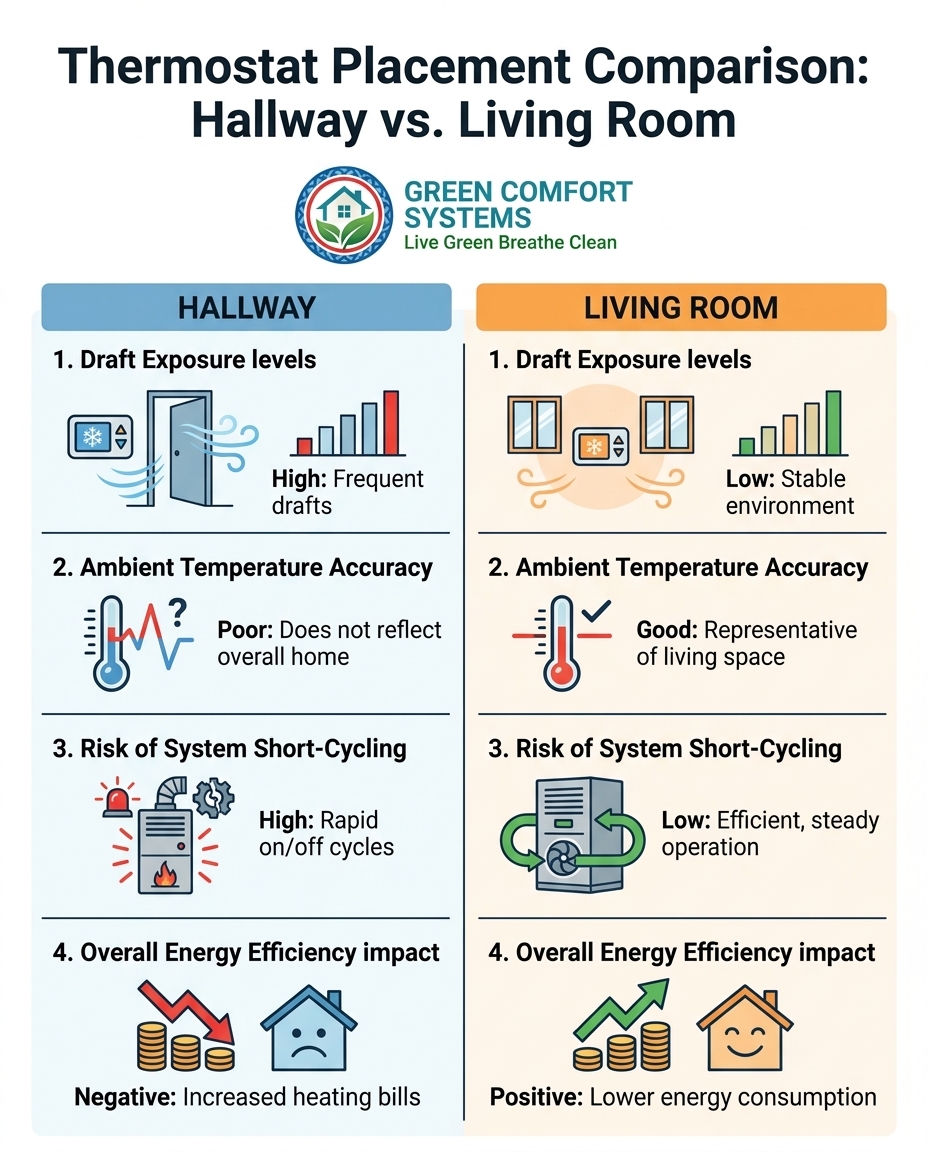
When you look at the data side by side, the difference between these two locations becomes incredibly clear. Making the switch before the early fall and pre-heating season turns into freezing winter weather can save your equipment from months of unnecessary strain.
Here is a breakdown of how the two locations compare when it comes to managing your home's climate:
• Draft Exposure — Hallway Placement: High (Front doors, sinking cold air from stairs) — Living Room Placement: Low (Protected central space)
• Reading Accuracy — Hallway Placement: Skewed by exterior doors and transitional airflow — Living Room Placement: Measures true ambient temperature of occupied spaces
• System Impact — Hallway Placement: High risk of short-cycling and motor burnout — Living Room Placement: Promotes steady, efficient, and complete heating cycles
• Energy Efficiency — Hallway Placement: Wastes energy heating an empty, transient space — Living Room Placement: Optimizes energy consumption for where you actually live
• Comfort Level — Hallway Placement: Bedrooms and living areas become overly hot — Living Room Placement: Even, consistent comfort throughout the main living areas
As the comparison shows, leaving a thermostat in a drafty corridor forces your system to constantly fight a losing battle against the front door. Moving the temperature measurement to the living room aligns your system's operation with your actual comfort needs.
Modern Solutions Without Rewiring: Smart Thermostats and Remote Sensors
If you have realized that your hallway thermostat is the root cause of your heating woes, you might be dreading the idea of tearing open your drywall to move it. Fortunately, modern technology offers non-invasive solutions that solve the problem without the mess of a major construction project.
The Risks of DIY Thermostat Relocation
First, we must strongly warn against attempting a DIY thermostat relocation. Moving a thermostat is not as simple as hanging a picture frame. It involves handling low-voltage wiring that connects directly to your furnace's control board. If you cross the wrong wires, you can instantly short out the control board, resulting in a massive repair bill. Furthermore, fishing wire through insulated walls, navigating fire blocks, and ensuring the new location meets building codes requires a licensed professional. Attempting this yourself can void your HVAC warranty and create hidden electrical hazards.
The Smart Sensor Alternative
Instead of hardwiring a relocation, many homeowners are turning to smart thermostats paired with remote room sensors. This is a brilliant, non-invasive alternative that solves the hallway draft problem immediately. Here is how the process works:
1. Install the Main Hub: A professional installs the new smart thermostat on the wall in your hallway, using the existing wiring. No drywall patching or wire-fishing is required.
2. Place the Remote Sensor: A small, wireless remote sensor is placed on a bookshelf or mounted on an interior wall in your living room.
3. Adjust the Priority Settings: Through the thermostat's app, you program the system to completely ignore the temperature reading from the drafty hallway hub. Instead, you tell it to only use the temperature data coming from the remote sensor in the living room.
4. Customize Your Schedule: You can even program the system to prioritize different sensors at different times of the day—such as focusing on the living room during the evening, and switching to a bedroom sensor at night.
This technology essentially "moves" your thermostat without actually moving it. It also makes it incredibly easy to adapt your heating routines, which is especially helpful when household schedules change, like adjusting your thermostat schedule when the kids head back to school. You get all the benefits of living room placement with zero drywall dust.
Targeted Comfort for Hard-to-Heat Areas
While fixing a poorly placed thermostat will resolve most whole-house short-cycling issues, we also have to acknowledge that sometimes a cold room isn't just a thermostat issue. Sometimes, it is a lack of proper HVAC distribution. If you have an addition over the garage, a finished basement, or a sunroom that never seems to get warm enough, moving your main thermostat won't magically push more air into those spaces.
For these stubborn areas, you need targeted comfort. Forcing your central furnace to overwork just to heat one distant room will only result in the rest of the house boiling. Instead, zoned heating solutions allow you to control specific areas independently.
One Rosedale MD homeowner reached out to us in the spring after struggling for years with a freezing basement and uneven main-floor temperatures. They had a separate, independent system installed specifically for that lower level. By the time the summer heatwave hit, the home was perfectly quiet and cool—and now, as the early fall weather sets in, they finally have a consistently heated basement without having to blast the main furnace.
This kind of targeted comfort is achieved through ductless mini splits. These independent air handlers operate on their own built-in thermostats. They provide precise, localized heat exactly where you need it, allowing your central hallway thermostat to focus solely on the main living areas. Zoned solutions are the ultimate way to stop fighting your floor plan and start enjoying every square foot of your home.
Stop Wasting Energy This Fall
Accurate temperature readings are the absolute foundation of an efficient heating system. If your thermostat is sitting in a drafty hallway, it is feeding your furnace bad information, causing unnecessary wear and tear, and driving up your utility costs. You do not have to settle for uneven heating and constant short-cycling.
Whether you need a traditional thermostat professionally relocated to an interior living room wall, or you want to upgrade to a smart thermostat with wireless remote sensors, professional help is available. Taking action during the early fall and pre-heating season ensures your system is calibrated and ready before the heavy winter weather hits. Schedule an assessment today to stop the energy waste and keep your home perfectly comfortable all season long.
Frequently Asked Questions
Should a thermostat be in the hallway or living room?
A thermostat should generally be placed in the living room rather than a hallway. The living room reflects the true ambient temperature where your family spends the most time. Hallways are often transitional spaces exposed to drafts from front doors and staircases, which can cause the thermostat to read artificially cold and run the furnace unnecessarily.
Does thermostat placement affect heating bills?
Yes, thermostat placement has a direct and significant impact on your heating bills. If a thermostat is located in a drafty area or near an exterior door, it will constantly trigger the heating system to turn on, even if the rest of the house is warm. Relocating the unit to a stable, central location prevents this energy waste and lowers your monthly costs.
Can a poorly placed thermostat cause short cycling?
Absolutely. A poorly placed thermostat is one of the leading causes of short-cycling. When placed near a drafty entryway or directly over an air vent, the thermostat experiences rapid temperature swings. This causes the furnace to turn on and off in quick, short bursts, which fails to heat the home properly and puts immense strain on the HVAC equipment.
How do remote thermostat sensors work?
Remote thermostat sensors are small, wireless devices that communicate with a main smart thermostat hub. You place the sensor in the room you want to measure—like a living room or bedroom—and tell the main hub to use that sensor's reading instead of its own. This allows you to effectively "move" your thermostat's measurement point without having to rewire anything inside your walls.
Why does my furnace turn on when the living room is already warm?
Your furnace turns on because the thermostat is likely located in a colder part of the house, such as a drafty hallway. The thermostat only knows the temperature of the air immediately surrounding it. If a cold draft hits the hallway unit, it will command the furnace to run, pushing even more hot air into your already-warm living room.
Book Expert Service Or Contact Us
Other Blogs


Get Financing Today
Get the comfort you deserve, without the financial stress.

Latest Blogs
Addressing Drafty Windows and Heating Inefficiencies in Older Forest Hill Homes
Managing the September Swing: Keeping Your Rosedale Home Comfortable When Days Are Hot and Nights Are Cold
Electronic Ignition Failures: Why Your Modern Furnace Won't Start on Chilly September Mornings
