





Adjusting Your Thermostat Schedule When the Kids Head Back to School in Baltimore County

The Late-Summer Shift: Rethinking Your Thermostat as the House Empties
Late August is here, and our team at Green Comfort Systems knows that adjusting your thermostat schedule when the kids head back to school in Baltimore County is one of the most effective ways to manage your home's comfort and efficiency during this busy transition. The lazy days of summer quickly give way to early morning alarms, packed lunches, and the rush to the bus stop. As your family's daily routine changes overnight, your home's cooling requirements change right along with it.
For comprehensive support keeping your home comfortable year-round, explore our heating services.
During the peak of summer vacation, your air conditioner likely runs consistently to keep a fully occupied house cool. Once the academic year begins, that same house often sits completely empty for eight to ten hours a day. Continuing to run your system at weekend comfort levels during a hot Tuesday afternoon wastes a significant amount of energy. The air conditioner ends up working overtime to cool empty rooms, driving up utility usage for no real benefit.
The Hidden Cost of an Overcooled Empty Home
In our years of optimizing HVAC systems throughout Rosedale and Baltimore County, we've found that the core problem during the August back-to-school transition is the misalignment between your system's output and your family's actual presence. Peak daytime heat usually strikes between 1:00 PM and 4:00 PM. If your thermostat remains set to 72°F while everyone is at school and work, your compressor endures its heaviest workload of the day just to maintain a temperature no one is there to enjoy.
Finding the exact daytime setback temperature—the number of degrees you allow the house to warm up while you are gone—is the primary decision point for homeowners this time of year. A proactive, automated approach using modern HVAC technology allows you to strike the perfect balance between minimizing daytime energy waste and ensuring the house is perfectly comfortable the moment the front door opens.
Determining the Ideal Empty-House Setback Temperature
Homeowners often ask our technicians exactly how warm they should let their house get during the school day. Guessing can lead to an uncomfortable home or a surprisingly high utility bill. Fortunately, there is established data on the most efficient temperature ranges for an unoccupied house.
The Science Behind the Setback
The US Department of Energy recommends setting your thermostat 7 to 10 degrees higher than your normal comfort setting for the 8 hours a day your house is empty. If your family prefers the house at 72°F in the evening, your daytime setback target should be between 79°F and 82°F. Implementing this specific setback range can achieve up to 10% energy savings on your cooling costs over the course of the season.
This strategy works because of thermal dynamics. A house loses cooling energy more slowly when the indoor temperature is closer to the outdoor temperature. By allowing the house to warm up slightly, you reduce the rate at which heat transfers through your walls and windows, meaning your system runs far less frequently.
• No Setback — Daytime Setting: 72°F — System Workload: Constant cycling during peak heat — Efficiency Impact: High energy waste
• Optimal Setback — Daytime Setting: 79°F - 82°F — System Workload: Occasional cycling to manage humidity — Efficiency Impact: Maximum energy savings
• System Off — Daytime Setting: Off entirely — System Workload: Zero daytime workload, extreme evening strain — Efficiency Impact: Poor humidity control, long recovery
Factoring in Pets and Houseplants
While an empty house can handle warmer temperatures, a house with pets requires a modified approach. Dogs and cats generally handle temperatures up to 78°F to 80°F comfortably, provided they have plenty of fresh water and access to shaded areas. However, certain breeds, elderly pets, or specific indoor plants may require you to cap your setback at 76°F or 78°F. Always consult your veterinarian if you are unsure about your pet's heat tolerance.
Letting Technology Do the Heavy Lifting
Manually adjusting the dial every morning as you rush out the door is a habit that our customers tell us is easy to forget. Upgrading your controls is often the best solution, and understanding how a smart thermostat pays for itself through automated scheduling makes the transition seamless. These devices learn your new August back-to-school transition routine within a few days, automatically raising the temperature when your phone's GPS shows you have left the neighborhood, and lowering it before you return.
Managing Late-Summer Humidity When No One is Home
One of the most common mistakes our service team sees homeowners make during the back-to-school season is turning their air conditioning completely off before leaving for work. While this might seem like the ultimate way to save energy, it ignores a critical function of your HVAC system: moisture control.
The Problem with Powering Down
Late August in Baltimore County still sees average highs in the mid-to-upper 80s, accompanied by heavy, oppressive humidity. If you turn your system off entirely, that humid air infiltrates your home throughout the day. Without the air conditioner running to extract that moisture, the indoor air becomes heavy, sticky, and stagnant. Over the course of a few days, this trapped humidity can settle into carpets, upholstery, and drywall.
The Cause of Indoor Air Quality Issues
Air conditioners do not just blow cold air; they actively pull moisture out of your home's atmosphere as warm air passes over the chilled evaporator coil. When the system sits idle for ten hours in a humid climate, moisture levels spike. This creates the ideal breeding ground for mold, mildew, and musty odors.
Our technicians recently helped a local property owner right here in Rosedale who dealt with this exact issue in a rental home featuring wall-mounted split units. The property had been left unoccupied with the systems turned off for extended periods. The resulting moisture buildup led to moldy blower fans and severe musty smells throughout the space. A professional technician had to be brought in to perform a deep cleaning, address rust issues, and replace parts just to get the neglected units functioning well again.
Setting Safe Humidity Thresholds
The solution is to program a setback temperature rather than turning the unit off. Periodic cooling cycles—even at 80°F—ensure air continues to circulate and dehumidify the home. For advanced moisture management, consider the following steps:
• Monitor relative humidity: Keep indoor humidity levels between 40% and 50% to prevent mold growth.
• Utilize smart controls: Many modern thermostats have built-in hygrometers that will trigger the AC to run if humidity spikes, regardless of the temperature.
• Maintain clean equipment: A system with a clogged filter or dirty coil cannot extract moisture efficiently.
• Explore whole-home upgrades: If your home struggles with moisture even when the AC runs, you may need dedicated indoor air quality solutions like a whole-house dehumidifier.
Mastering the 3 PM Recovery Cooling Phase
Setting the temperature back during the day is only half the strategy; getting the house comfortable again before the family returns is just as important. The period where your system works to drop the indoor temperature back to your evening comfort setting is known as the "recovery cooling" phase.
The Danger of the "Instant Cool" Myth
A common misconception our installation team hears frequently is that air conditioners cool a house faster if you set the thermostat drastically lower. If you walk into an 80°F house at 3:30 PM and drop the dial to 65°F, the system will not cool the rooms any faster than if you set it to 72°F. Air conditioners run at a constant speed. Forcing the system to drop the temperature by 8 degrees all at once during the hottest part of the afternoon places massive strain on the compressor.
A Strategic Afternoon Timeline
To prevent overworking your system during the August back-to-school transition, we strongly recommend scheduling a gradual recovery. Instead of demanding a massive temperature drop at the exact moment the kids get off the bus, program your thermostat to ease back into your preferred setting.
1. 1:00 PM to 2:00 PM (The Pre-Cooling Assessment): The house remains at the daytime setback temperature (e.g., 80°F). The system only runs briefly to manage humidity.
2. 2:00 PM to 3:00 PM (The Gradual Ramp-Down): The thermostat drops the target temperature by two or three degrees (e.g., to 77°F). The system begins a slow, steady cooling cycle before peak late-afternoon heat fully sets in.
3. 3:00 PM to 4:00 PM (Final Adjustment): The thermostat reaches the final evening comfort setting (e.g., 72°F) just as the family starts walking through the door.
A gradual recovery keeps the system from drawing maximum amperage during peak grid hours. It is also an excellent diagnostic test. If your system struggles to drop the temperature two degrees over the course of an hour, it might be a sign of an aging, inefficient unit. If your equipment is consistently failing to recover in a reasonable timeframe, it may be time to evaluate options for a Baltimore AC installation.
A Sample Back-to-School Thermostat Schedule
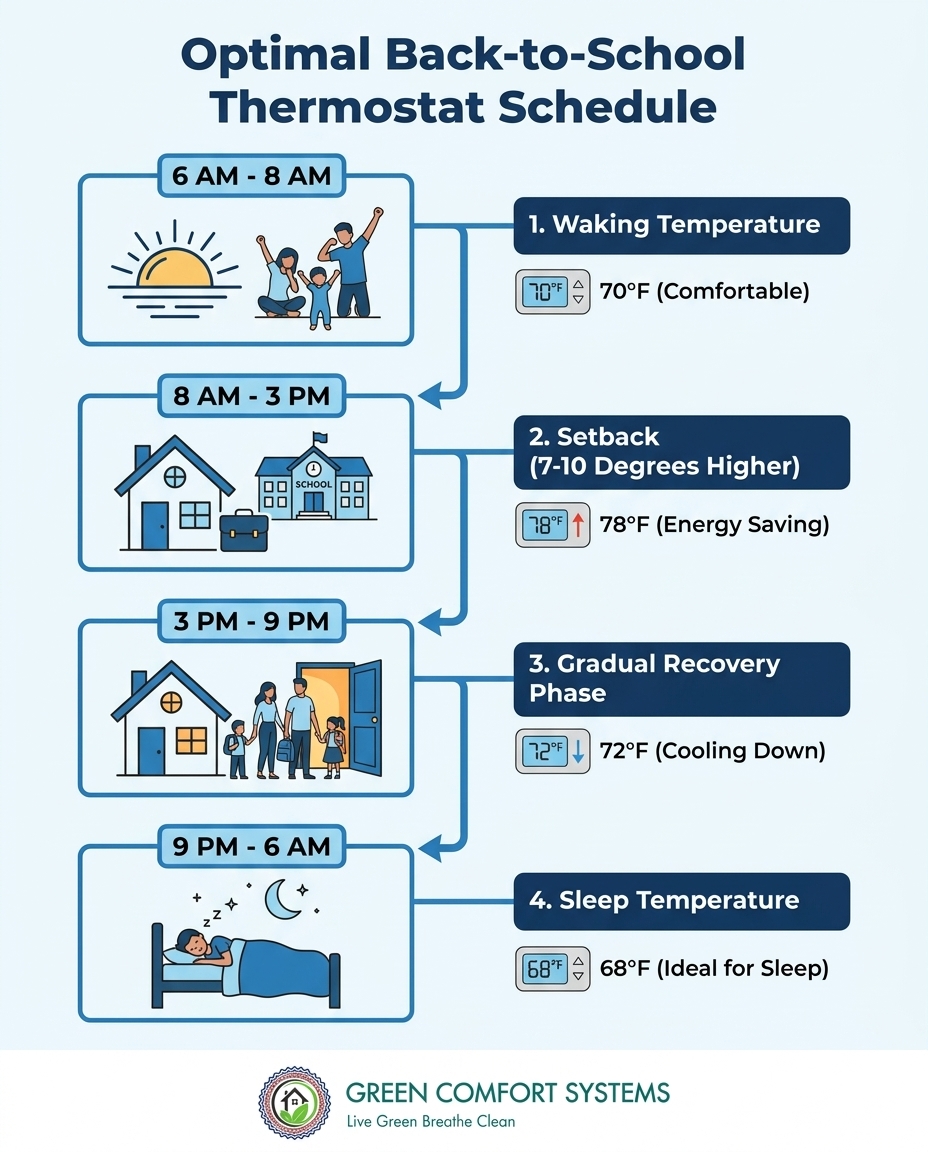
Having a clear, actionable template makes programming your thermostat much easier. While every family's routine is slightly different, the following schedule represents a highly efficient baseline that we suggest for the standard Monday-through-Friday school week.
Phase 1: Morning Prep (6:00 AM - 8:00 AM)
Mornings are chaotic enough without waking up to a stuffy house. Program your thermostat to reach your preferred waking temperature about 15 minutes before your alarm goes off. A setting of 70°F to 72°F provides a crisp, comfortable environment for getting dressed, eating breakfast, and gathering backpacks.
Phase 2: School Hours (8:00 AM - 3:00 PM)
Once the last person locks the door, the setback mode should engage. Raise the target temperature 7 to 10 degrees higher than your morning setting. A target of 78°F to 82°F is ideal for maximum energy savings while still protecting the home's interior from excessive humidity.
Phase 3: Afternoon Return (3:00 PM - 9:00 PM)
Begin the recovery phase at 2:00 PM so the house is back down to 72°F to 74°F by the time the kids arrive. This setting accommodates afternoon homework, cooking dinner, and relaxing in the living room without feeling overheated.
Phase 4: Sleep (9:00 PM - 6:00 AM)
Medical professionals generally recommend cooler temperatures for optimal sleep quality. Dropping the thermostat to 68°F to 70°F overnight helps regulate body temperature. Because outdoor temperatures drop significantly after dark, your air conditioner will not have to work nearly as hard to maintain this cooler setting overnight.
Navigating the Transition from Cooling to Heating
As the school year progresses, the weather in Baltimore County undergoes a distinct shift. Late summer gives way to early fall, bringing fluctuating temperatures that can challenge any static thermostat schedule.
The Challenge of "Shoulder Season" Weather
By late September and October, the local climate dynamic changes rapidly. Mornings can be chilly enough that you want the heat on while making breakfast, but by 3:00 PM, the afternoon sun heats the house enough to require air conditioning. Manually switching your system back and forth from "Heat" to "Cool" every single day is frustrating and inefficient.
Maximizing the Auto-Changeover Feature
Most modern smart thermostats feature an "Auto-Changeover" setting designed specifically for this time of year. This feature allows you to set both a heating and a cooling target simultaneously. For example, you might tell the thermostat to heat the house if it drops below 68°F, and cool the house if it rises above 74°F.
The key to using this feature correctly is maintaining a proper "deadband"—the temperature gap between your heating and cooling setpoints. Always leave at least a 4 to 5-degree gap between the two numbers. If you set them too close together (e.g., heat at 70°F and cool at 72°F), your system will constantly fight itself, rapidly switching between the furnace and the AC throughout the day.
Upgrading for Seasonal Versatility
Handling these wide temperature swings requires a versatile, highly efficient system. If your current equipment struggles to keep up with the demands of early fall, transitioning to modern technology can make a massive difference. Many homeowners we work with are discovering the benefits of energy-efficient heat pumps, which provide both heating and cooling from a single, highly adaptable unit that excels in our regional climate. Keep in mind that generic federal tax credits and local utility rebates may apply to qualifying heat pump installations, making this an ideal time to upgrade.
The Environmental Impact of Smart Scheduling
As local HVAC professionals, we see firsthand that beyond the immediate benefits to your own utility bill, proper thermostat management plays a significant role in broader environmental conservation. Adjusting your schedule when the house is empty is a simple habit with widespread positive effects.
Reducing Your Carbon Footprint
Air conditioning accounts for a massive portion of residential energy consumption. By allowing your home to warm up by 7 to 10 degrees during the school day, you drastically reduce the amount of electricity your household draws. This reduction in daily kilowatt-hour usage directly lowers your home's overall carbon footprint. Here at Green Comfort Systems, our team is dedicated to providing eco-friendly, energy-saving solutions to our Rosedale community, and we always encourage homeowners to see proper thermostat scheduling as a win for both their wallet and the local environment.
Alleviating Strain on the Local Grid
In Baltimore County, peak electricity demand almost always occurs on hot weekday afternoons. This is the exact time when businesses are running at full capacity and schools are cooling large facilities. When thousands of residential air conditioners also run at maximum capacity during these hours to cool empty houses, it places immense stress on the local electrical grid.
By utilizing a daytime setback and scheduling a gradual recovery phase, you actively shift your home's heaviest energy usage away from these peak hours. It is a responsible, environmentally conscious approach to home comfort that ensures your equipment lasts longer, your bills stay lower, and the community grid remains stable.
Frequently Asked Questions
What is the best thermostat setting when the house is empty during the day?
The best setting for an empty house is typically between 78°F and 82°F. The US Department of Energy recommends setting your thermostat 7 to 10 degrees higher than your normal comfort level while you are away. This allows you to save energy without letting the house get so hot that it takes hours to cool back down.
How many degrees should I set back my AC when kids are at school?
You should set your AC back by 7 to 10 degrees from your standard preferred temperature. If your family enjoys the house at 72°F in the evening, aim for a daytime setting of 79°F to 82°F. This range maximizes energy savings while still protecting your home's interior from excessive heat.
Should I turn my AC off completely when I go to work?
No, you should never turn your AC completely off during hot weather. Doing so allows heavy humidity to build up inside the house, which can lead to musty odors and mold growth. A setback temperature keeps the system running just enough to circulate the air and extract excess moisture.
How long does it take a smart thermostat to learn a new school routine?
Most learning thermostats take about three to seven days to adapt to a new schedule. During the first week of school, the device tracks when the house empties out and when motion is detected again in the afternoon. Once it identifies the pattern, it will automatically adjust the recovery cooling phase for maximum efficiency.
How does humidity affect my empty house temperature setting in Maryland?
High humidity makes the air feel warmer and heavier, and it requires your AC to run periodically to remove moisture. In Maryland's humid late-summer climate, you cannot let the indoor temperature rise too high or turn the system off entirely, as the trapped moisture will degrade indoor air quality and make the home feel extremely uncomfortable upon your return.
Ready to Optimize Your Home's Comfort?
Adjusting your thermostat schedule is just the first step in maintaining a highly efficient home during the back-to-school transition. If your system is struggling to recover in the afternoons or you are ready to upgrade your equipment, a professional assessment from our team provides the answers you need. Discover how our energy-efficient heat pumps and comprehensive maintenance services can keep your family perfectly comfortable all year long.
Book Expert Service Or Contact Us
Other Blogs


Get Financing Today
Get the comfort you deserve, without the financial stress.

Latest Blogs

Why We Insist on Carbon Monoxide Testing During Every Rosedale Heating Inspection

Upgrading to a Smart Thermostat in Glen Burnie: Navigating C-Wire Requirements

Introducing the Green Legacy Initiative: How Green Comfort Systems Gives Back to Maryland's Forests
