





Choosing Between Emergency Weekend Repair and Monday Scheduling for a Failing Heat Pump in Severna Park

Navigating Weekend Heat Pump Failures During a Severna Park Cold Snap
October brings a sudden, biting chill to Maryland, and when your system refuses to switch over, choosing between emergency weekend repair and Monday scheduling for a failing heat pump in Severna Park becomes an immediate, stressful priority. The first true cold snap of the season often reveals latent mechanical issues that have been hiding since last winter. As a family-owned business serving the Rosedale and Severna Park areas since 2016, our team at Green Comfort Systems has seen this scenario play out countless times. You expect warm air to flow through your vents, but instead, you are met with a lukewarm breeze or total silence. Panic sets in as the indoor temperature drops, leaving you to wonder if you need to call a technician right this second or if you can safely wait out the weekend.
If you find yourself in this situation, you need a clear path forward. To ensure your home stays safe and comfortable, reach out for professional HVAC services to get a proper diagnosis.
The Stress of Early Fall System Failures
A sudden drop in temperature during an early October weekend is a classic trigger for heating-startup failures. Heat pumps operate by transferring heat, and the mechanical components responsible for reversing the flow of refrigerant—specifically the reversing valve—can stick or fail after sitting dormant all summer. Homeowners often face a difficult decision: pay a premium for an after-hours dispatch or endure the weekend with a malfunctioning system, bundled in blankets and relying on space heaters.
Our Diagnostic Methodology
As local experts serving the Severna Park and Rosedale communities, our methodology focuses on diagnosing exact symptoms to determine if the issue is a true property-threatening emergency or a minor setback. Not every strange noise or temperature deviation requires a midnight service call. By understanding the specific mechanical and electrical symptoms your system is displaying, you can protect both your physical comfort and your equipment from catastrophic compressor damage. We look at airflow, auditory cues, and thermostat behavior to separate minor sensor glitches from imminent mechanical failures.
Red Alert Symptoms: When to Call for Immediate Dispatch
Some heat pump malfunctions cannot wait. When vital internal components begin to fail, forcing the system to run can turn a manageable repair into a complete system replacement. Knowing the red alert signs gives you the confidence to act quickly, which is why we make after-hours emergency repair available to our community.
Electrical Hazards You Cannot Ignore
Unusual electrical smells or burning odors indicate immediate electrical hazards requiring a rapid system shutdown and professional intervention. If you smell melting plastic, burning rubber, or an acrid, fish-like odor near your air handler or outdoor unit, this is a sign of overheating wires, a failing capacitor, or a seized blower motor.
1. Turn off the system immediately: Switch the thermostat to the "Off" position.
2. Cut the power: Locate your electrical panel and flip the breaker dedicated to your heat pump and air handler.
3. Do not attempt to restart: Continuing to run a system with electrical damage poses a severe fire risk to your property.
If you encounter these severe electrical warning signs, do not hesitate to contact our team for emergency repair.
Mechanical Noises That Spell Trouble
Loud grinding, screeching, or metal-on-metal noises often signal imminent compressor failure. The compressor is the heart of your heat pump, responsible for pressurizing the refrigerant that heats your home. If the internal bearings fail or the motor mounts break, you will hear aggressive, violent sounds coming from the outdoor cabinet. Running a heat pump with these symptoms can lead to catastrophic system damage, circulating metal shavings through your refrigerant lines and destroying the entire loop.
In our experience operating under MD HVAC Master License #78268, catching a failing compressor early prevents full system replacements. A screeching sound might also point to a failing fan motor belt or bearing. While less expensive than a compressor, a locked-up fan motor will cause the system to overheat rapidly. If your unit sounds like a jet engine taking off or a washing machine full of rocks, shut it down and request an immediate after-hours dispatch.
Safe to Wait: Symptoms That Don't Require Weekend Fees
Not every heating issue is a five-alarm fire. In many cases, you can safely power down your equipment, stay comfortable with alternative heating methods, and schedule a standard service call for Monday morning.
Mild Temperature Deviations
One of the most common non-emergencies is a minor performance drop where the system struggles to meet the thermostat setting by only a few degrees. If your thermostat is set to 70 degrees, but the house is hovering at 66 degrees, your system is underperforming, but it is not necessarily in critical failure. This often points to a dirty flame sensor (in dual-fuel systems), a minor refrigerant leak, or a system that simply needs a professional tune-up to handle the sudden Severna Park cold snap.
Lukewarm Air Without Grinding
If the heat pump is simply blowing lukewarm air but making no alarming noises, it is often a sensor or minor refrigerant issue. The reversing valve might be partially stuck, or the outdoor coil might be struggling to pull ambient heat from the air. As long as there are no burning smells or violent mechanical noises, the system is not actively destroying itself.
Our Honest Approach to Weekend Calls
Green Comfort Systems provides transparent, honest guidance to help homeowners avoid unnecessary weekend dispatch fees if the heat pump can safely wait until Monday. It is perfectly safe to shut the unit off completely and use space heaters, fireplaces, or extra blankets to wait out the weekend. Our honest approach means we advise shutting down the system and scheduling for Monday if there is no risk of frozen pipes or further mechanical damage. We prioritize your long-term trust over a quick weekend service charge, a commitment to integrity that recently helped us earn the Baltimore Magazine "Best of Baltimore" HVAC 2025 award, alongside our 4.9★ rating and 480+ Google reviews.
Safe Homeowner Checks Before Calling a Professional
Before you pick up the phone for either an emergency dispatch or a Monday appointment, there are several safe, non-invasive troubleshooting steps you can take. Sometimes, a perceived system failure is actually a simple setting issue.
Thermostat and Filter Basics
During an October heating-startup, systems often behave unpredictably simply because they haven't been used for heating in months. Start with the most basic controls in your home.
• Verify thermostat settings: Ensure the thermostat is actually set to "Heat" and not "Auto" or "Cool." Double-check that the temperature is adjusted correctly for an October heating-startup, and ensure nobody accidentally bumped the hold feature.
• Check the air filter: A severely clogged filter restricts airflow, which can cause the internal components to overheat and shut down prematurely as a safety precaution. Pull the filter out and hold it up to the light; if you cannot see light through it, replace it immediately.
• Inspect the breaker: Look at your main electrical panel to see if the heat pump breaker has tripped. You can reset it once. If it trips a second time, leave it off—this indicates a hard electrical short.
Outdoor Unit Clearances
Your heat pump requires massive amounts of airflow to extract heat from the outside air. Walk outside and inspect the outdoor condenser unit.
• Clear debris: Inspect the outdoor unit for debris, fallen autumn leaves, or physical obstructions that might impede airflow.
• Check for ice: While rare in early October, a thick block of ice on the outdoor coil means the defrost board has failed.
• Keep your hands out: Never attempt to open the electrical panel or handle refrigerant lines, as these require a licensed professional.
If you have gone through these basic checks and your system is still struggling, you might want to review our troubleshooting steps if your system is not cooling or heating properly for more in-depth operational insights.
Side-by-Side Comparison: Emergency Service vs. Monday Scheduling
Making a rapid decision during a cold snap requires clear, objective criteria. We have broken down the exact symptoms and recommended action plans so you can evaluate your heat pump's behavior objectively. Relying on a trusted local team with a valid MD HVAC Master License #78268 ensures you get an accurate diagnosis without fear-based upselling.
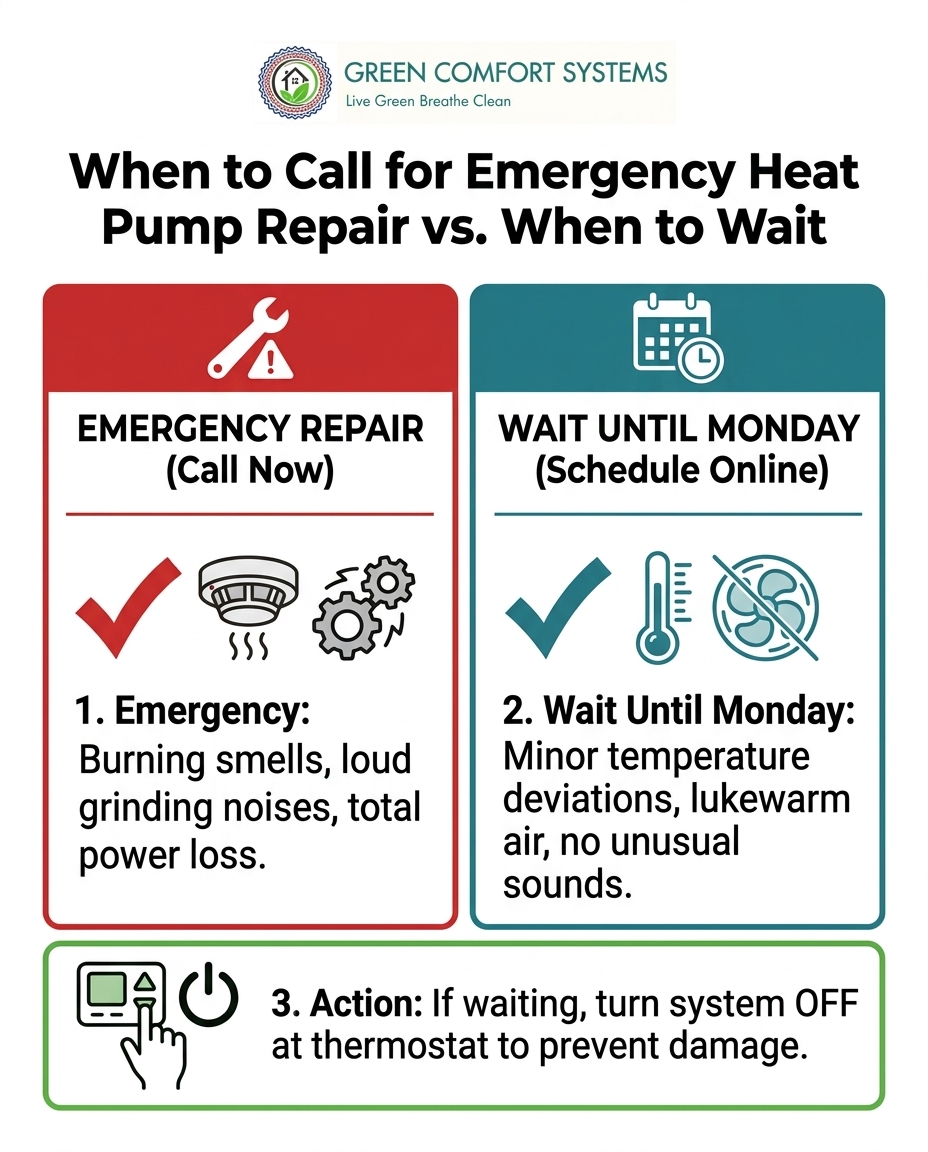
• Odors and Smells — Emergency Service Required: Burning plastic, electrical ozone, acrid smoke. — Safe to Wait Until Monday: Musty dust smell (normal for first startup).
• Auditory Cues — Emergency Service Required: Loud grinding, metal screeching, violent shaking. — Safe to Wait Until Monday: Normal fan hum, occasional clicking, quiet operation.
• Airflow Temperature — Emergency Service Required: Blowing completely frigid air continuously. — Safe to Wait Until Monday: Blowing lukewarm air, struggling by a few degrees.
• Power Status — Emergency Service Required: Tripping breakers repeatedly, total power loss. — Safe to Wait Until Monday: System runs but cycles on and off too frequently.
• Action Plan — Emergency Service Required: Shut down immediately at breaker. Call 24/7 line. — Safe to Wait Until Monday: Turn system OFF at thermostat. Use space heaters.
How Coastal Maryland's Climate Impacts Your Decision
Where you live plays a massive role in how you handle an HVAC failure. Maryland's geography creates unique weather patterns that directly affect your home's indoor comfort and structural safety.
The Humidity Factor in Early Fall
Severna Park's coastal proximity can increase humidity, making October cold snaps feel significantly colder indoors than the thermometer suggests. When the ambient temperature drops to 45 degrees outside, a high indoor humidity level can make your living room feel damp and bone-chilling. Proper heating is essential not just for comfort, but for managing indoor moisture levels during seasonal transitions. A functioning heat pump naturally conditions the air, preventing the dampness from settling into your drywall and soft furnishings.
Protecting Your Property Against the Chill
If a cold snap is severe enough to risk freezing pipes—though this is rare in early October, it is still a critical consideration as winter approaches—the urgency shifts from personal comfort to property protection. Monitoring indoor temperatures closely helps dictate whether waiting is truly viable. If your indoor temperature drops below 55 degrees and continues to fall rapidly, the risk to your plumbing infrastructure increases. In these specific coastal microclimates, what feels like a mild autumn day can quickly turn into a freezing night, meaning you must stay vigilant about how quickly your home loses its retained heat.
Planning for Major Repairs and System Replacements
Sometimes, an emergency weekend call reveals a harsh truth: the heat pump is not just malfunctioning; it is at the end of its operational lifespan. Facing a major repair during an October heating-startup can be daunting, but understanding your options makes the process manageable.
Evaluating the Repair vs. Replace Threshold
In our years of replacing failing units in Maryland homes, having a clear understanding of the repair vs. replace threshold is crucial for homeowners. If your heat pump is over 10 to 12 years old and requires a major component replacement—such as a new compressor or a reversing valve—investing heavily in aging equipment is rarely the most cost-effective choice. Major repairs require careful consideration of the unit's age, its current energy efficiency, and the likelihood of another component failing in the near future.
Conversely, if your system is only five years old and the failure is due to a faulty fan motor or a blown capacitor, a repair is absolutely the right path. We guide homeowners through this calculation, ensuring you understand the long-term operational costs of keeping an old system running versus the benefits of upgrading to modern, high-efficiency equipment.
Managing the Cost of a New System
We know that nobody plans for a catastrophic heating-startup failure. However, there are ways to manage the unexpected costs of a major system replacement without compromising on the quality of your home's comfort. By exploring flexible financing options and taking advantage of our free installation estimates, you can secure a reliable, energy-efficient heat pump immediately while spreading the investment out over time. Furthermore, upgrading to a modern heat pump often qualifies homeowners for various energy rebates and generic federal tax credits, helping offset the initial installation costs. Always verify current incentive programs with your utility provider or a tax professional to maximize your savings.
Get Honest Guidance for Your Heat Pump Crisis Today
Whether your heat pump is exhibiting severe red-alert symptoms or just needs a routine Monday tune-up, having a clear, symptom-based checklist gives you peace of mind. You do not have to guess whether a strange noise warrants a midnight phone call. Don't let a weekend malfunction compromise your home's safety or lead to catastrophic compressor damage because you were unsure of what steps to take.
Reach out to a licensed local expert in Severna Park who prioritizes honest diagnostics over immediate dispatch fees. We are dedicated to providing you with the facts about your system's health, ensuring you only pay for emergency service when it is absolutely necessary. Secure your comfort and protect your property with a team you can trust to keep your home warm all season long.
Frequently Asked Questions
What is considered an HVAC emergency in winter?
An HVAC emergency involves any situation where the failure poses a safety risk to your family or property. This includes smelling electrical burning, seeing sparks, hearing violent grinding from the compressor, or experiencing indoor temperatures dropping rapidly enough to risk freezing pipes. If your system exhibits these signs, immediate professional intervention is required.
Can a broken heat pump safely wait until Monday?
Yes, if the system is simply underperforming or blowing lukewarm air without any strange noises or burning smells, it can usually wait. You should turn the system off at the thermostat to prevent mechanical strain. Use space heaters or extra blankets to stay comfortable until standard business hours resume.
Should I turn off my heat pump if it's making a loud grinding noise?
Absolutely. A loud grinding or metal-on-metal screeching noise typically indicates a failing compressor or a broken fan motor bearing. Continuing to run the unit will cause catastrophic internal damage and circulate metal debris through your refrigerant lines, often resulting in the need for a full system replacement.
Is it safe to run a heat pump that isn't heating properly?
It is generally not safe to let a struggling system run continuously. If the heat pump cannot reach the set temperature, it will run nonstop, driving up your energy bills and overheating the internal components. It is safer to turn the unit off and rely on alternative heating until a technician can diagnose the underlying issue.
Is a heat pump not heating considered an emergency?
A lack of heat is only an emergency if the outdoor temperature is dangerously low, risking frozen pipes, or if the system failure is accompanied by electrical hazards. In mild early fall weather, a lack of heat is an inconvenience that can safely be addressed during normal business hours by shutting the system down temporarily.
What does a burning smell from my heat pump mean?
A burning smell usually points to an electrical failure, such as melting wire insulation, a fried capacitor, or an overheating blower motor. This is a severe fire hazard. You must immediately shut off the system at the thermostat and cut power at the electrical breaker until a licensed professional inspects the unit.
Book Expert Service Or Contact Us
Other Blogs


Get Financing Today
Get the comfort you deserve, without the financial stress.

Latest Blogs

Choosing Between Emergency Weekend Repair and Monday Scheduling for a Failing Heat Pump in Severna Park

Smart Thermostats vs. Programmable Models for Managing Unpredictable October Weather in Middle River

How Our Fully Stocked Trucks Enable Under-an-Hour Heat Pump Repairs in Owings Mills
