




Troubleshooting Your October Heating Startup in Rosedale: What's Normal and What's Not

The First October Cold Snap: Is That Burning Smell Normal?
When the first true autumn chill arrives and you switch your thermostat to heat, navigating the right home maintenance tips and troubleshooting steps can mean the difference between a cozy evening and a stressful night. At Green Comfort Systems, our phones ring off the hook during these initial cold snaps. That distinct burning odor filling the hallway is a concrete problem we see many homeowners face during an October heating-startup. You are immediately faced with a critical decision point: Is it safe to let the system run, or do you need to shut it down right away to prevent a fire hazard?
In our experience, it is incredibly common to feel a spike of anxiety when your vents start blowing strange-smelling air. After all, your heating system involves combustion, high voltage, and powerful motors. While some sensory cues are completely harmless side effects of a system waking up from summer hibernation, others are urgent warning signs of mechanical distress. Understanding exactly what is normal and what is not helps you protect your equipment, your home, and your family. If you suspect an actual hazard, reaching out to our team for professional HVAC services is always the safest route to prevent mid-winter breakdowns.
How Rosedale's Summer Humidity Impacts Your Fall Furnace Startup
To understand why your heater behaves strangely in the fall, we always tell our customers to look at what it was doing all summer. Here in Rosedale MD, our local climate plays a massive role in how your heating equipment ages. Our technicians have noticed that Maryland's rapid transition from hot, humid summers to chilly fall temperatures drastically affects how long internal components sit dormant before they are called into action.
During those long, humid summer months, your furnace or heat pump air handler sits largely idle. While the air conditioning runs, the heating-specific components are doing nothing but collecting airborne particles. Because Rosedale experiences high summer humidity, that ambient moisture gets drawn into your ductwork and settles on the metallic surfaces of your furnace. When airborne dust travels through the system, it hits this slight moisture and sticks like glue. Over several months, a surprisingly thick layer of debris can coat the burners and heat exchanger.
Furthermore, that persistent moisture in the air can contribute to mild mold or mildew buildup in the blower area. When you finally demand heat, the system fires up and rapidly raises the internal temperature. All that accumulated dust and debris is exactly what burns off during the first 15 to 30 minutes of the initial heating cycle.
The Environmental Impact on Your System
Here is a quick look at how the seasonal shift affects your equipment:
• Summer — Climate Factor: High humidity and heat — Impact on Heating Equipment: Moisture allows dust and dander to stick to dormant heat exchangers.
• Early Fall — Climate Factor: Fluctuating temperatures — Impact on Heating Equipment: Short, infrequent cycles prevent full moisture evaporation inside the cabinet.
• Late Fall — Climate Factor: First freezing nights — Impact on Heating Equipment: High-temperature ignition rapidly burns off months of bonded debris.
Knowing this regional pattern helps explain why that initial October heating-startup can be so alarming, even when the system is functioning exactly as designed.
Sensory Diagnostics: Decoding Heating System Odors
We often remind homeowners that your nose is the first diagnostic tool you have when assessing your HVAC system. However, distinguishing between a harmless seasonal smell and a critical hazard requires clear guidelines. Sometimes, persistent odors in older homes even prompt homeowners to rethink their entire setup. For instance, one local homeowner dealing with an older property's heating challenges reached out to us during the fall season. Our technician Kyle discussed their options, and Ron quickly installed a new mini-split system, completely resolving their ongoing comfort and odor issues while providing quiet, efficient heat.
If you are trying to decode the smells coming from your vents, use this safety-first approach to determine your next steps.
The 30-Minute Dust Burn-Off Rule
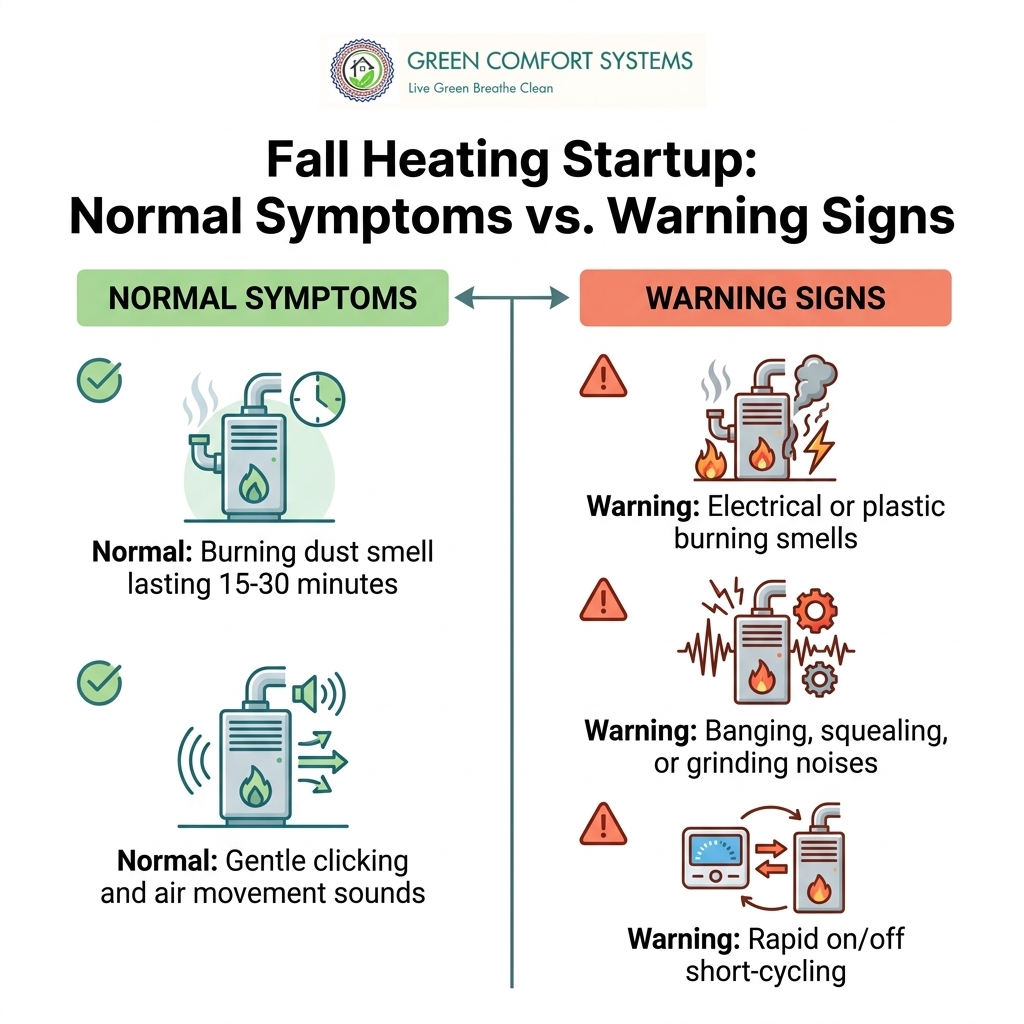
The infamous "burning dust" smell is completely normal if it follows a specific timeline. When you first turn on the heat, monitor the system closely for the first half-hour to ensure it behaves normally.
• Ventilate the space: Open a nearby window to allow the harmless dust odor to escape your living areas.
• Watch the clock: The smell should peak within the first ten minutes and steadily fade as the cycle continues.
• Know when to act: If the smell intensifies, changes in character, or persists beyond this 30-minute window, turn the thermostat off immediately.
Odors That Require Immediate Shutdown
While dust is harmless, other odors are major red flags. If you detect any of the following, shut the system down at the thermostat and do not turn it back on.
• Burning plastic or electrical ozone: These smells indicate failing motors, melting wire insulation, or severe electrical arcing. Never attempt to investigate electrical smells on your own.
• Persistent rotten egg smell: This is the universal additive for natural gas. If you smell this, leave the house immediately and call your gas provider.
• Musty or dirty sock smells: This often indicates moldy blower fans or a contaminated evaporator coil. While not an immediate fire hazard, this requires professional cleaning rather than a simple mechanical repair.
Listening to Your System: When Noises Signal Trouble
Just as smells provide clues about your system's health, the sounds it makes during the initial startup sequence are incredibly revealing. A healthy furnace or heat pump operates with a predictable rhythm—a baseline our team listens for on every service call. A gentle click from the thermostat, a soft hum as the inducer motor starts, and the steady whoosh of air through the vents are the only sounds a healthy system should make.
When you live in Rosedale MD, your system works hard year-round. We frequently see that wear and tear manifest as alarming noises when the heating components finally engage. Motors rely on sealed bearings to spin freely. When those bearings lose their lubrication or gather grit over the summer, the resulting friction creates audible distress signals. Here is what to listen for:
• Squealing or screeching: This high-pitched noise almost always points to failing blower motor bearings or a worn-out fan belt that degraded over the summer. Ignoring this will eventually cause the blower motor to seize completely.
• Grinding or scraping: This sounds like metal rubbing against metal. It usually means a component has come loose, or the blower wheel is unbalanced and scraping against its housing.
• Loud banging or booming: A loud "boom" upon ignition is known as delayed ignition. Gas builds up in the combustion chamber before the igniter lights it, creating a small explosion. This is a serious safety hazard that can crack your heat exchanger and requires immediate expert attention.
• Rattling or vibrating: While sometimes caused by loose ductwork or a loose panel, persistent rattling inside the unit can indicate a failing inducer motor.
If your system sounds like a heavy machinery factory rather than a gentle breeze, it is time to turn it off. Forcing a struggling system to run will only cause cascading damage to other expensive components.
The Short-Cycling Threat Before Winter Arrives
One of the most common and damaging issues our technicians encounter during an October heating-startup is short-cycling. Short-cycling occurs when the heater turns on, runs for just a few minutes, and shuts off rapidly without ever reaching the temperature set on the thermostat. It then repeats this frustrating loop endlessly.
Many homeowners mistake this for a minor annoyance or a quirky thermostat, but we always warn that it is actually a critical failure. The system is intentionally shutting itself down because a safety sensor has detected a dangerous condition. Common causes include severely restricted airflow from a clogged, dirty air filter that causes the heat exchanger to overheat. When the internal temperature spikes too high, the high-limit switch cuts the power to prevent a fire.
Another frequent culprit is a dirty or failing flame sensor. This tiny metal rod sits directly in the path of the burner flame to confirm that a fire is actually burning when the gas valve is open. If the sensor is coated in baked-on summer dust, it cannot detect the flame. As a result, the control board shuts the gas off within seconds to prevent raw gas from flooding your home, creating the short-cycling loop.
Ignoring short-cycling will lead to complete system failure just as freezing temperatures hit. The constant stopping and starting places immense strain on the motors and electrical components. When cold weather strikes and heating issues arise, acting fast is crucial. During one recent cold snap, our team members Kyle and Emily provided quick assistance and tracked down the necessary parts for a homeowner facing a sudden heating failure, ensuring the issue was resolved rapidly before the house grew dangerously cold.
If your system cannot complete a full heating cycle, do not try to force it by constantly adjusting the thermostat. The underlying safety trigger must be addressed by an expert.
Establishing Safe Boundaries: When to Stop Troubleshooting
When faced with a cold house, it is tempting to grab a toolbox and start taking things apart. However, modern HVAC systems involve high voltage, combustible gases, and complex safety mechanisms. At Green Comfort Systems, reinforcing a safety-first approach means clearly defining when DIY ends and professional intervention begins.
There are several safe, effective steps we encourage you to take before making a phone call. Homeowners can safely check thermostat settings to ensure they are actually set to "Heat" and the batteries are fresh. You can—and should—replace dirty air filters, as this solves a surprising number of airflow issues and prevents short-cycling. You can also clear away leaves, branches, and debris from around outdoor heat pump units to ensure proper ventilation.
However, there are strict boundaries you should never cross. Homeowners must never open the sealed furnace cabinet to tinker with internal wiring. Never attempt to remove or clean flame sensors, adjust gas valves, or bypass safety switches. Furthermore, if your system trips a circuit breaker, you can reset it once. If it trips a second time, do not reset it again; the breaker is doing its job to prevent an electrical fire from a grounded wire or seized motor.
When symptoms persist beyond basic filter changes and thermostat checks, it is time to contact our team for assistance before the issue worsens.
Safe Troubleshooting vs. Professional Intervention
• Replacing the air filter — Safe for Homeowners?: Yes — Why?: Restores proper airflow and prevents the heat exchanger from overheating.
• Checking thermostat batteries — Safe for Homeowners?: Yes — Why?: Low batteries can cause erratic system behavior and false starts.
• Cleaning the flame sensor — Safe for Homeowners?: No — Why?: Requires opening the cabinet; delicate parts easily break and void warranties.
• Resetting a tripped breaker — Safe for Homeowners?: Yes (Only Once) — Why?: Multiple resets risk severe electrical damage or starting a house fire.
• Investigating burning smells — Safe for Homeowners?: No (Beyond 30 mins) — Why?: Electrical and gas issues require specialized diagnostic tools to locate safely.
Navigating Unexpected Upgrades and System Replacements
Sometimes, our fall diagnostics reveal hard truths. Despite your best efforts, an aging system may simply be no longer safe to operate. A cracked heat exchanger, a seized blower motor, or a compressor failure can turn a routine maintenance check into a major decision. While this is never the news you want to hear, upgrading before the deep freeze ensures your family's safety and secures long-term energy efficiency.
Replacing a failing system proactively in October is far less stressful than dealing with a complete breakdown in the middle of a January blizzard. Modern systems offer significantly better airflow, quieter operation, and enhanced humidity control. However, we understand that a new system is a major investment. That is why there are various HVAC financing options available to make unexpected replacements manageable and stress-free.
We also know that fixed incomes can make sudden home repairs daunting. Green Comfort Systems provides personalized assistance to help local seniors navigate complex state initiatives, secure financing, and apply exclusive senior discounts. Older adults in the community may qualify for specific HVAC discounts for older adults or state-level energy initiatives that help offset the cost of high-efficiency upgrades. Additionally, broadly applicable tax credits and local utility rebates may apply to qualifying heat pump installations, though we always recommend verifying current programs with your utility provider or tax professional.
Frequently Asked Questions About Fall Heating Startup
Why does my heater smell like burning dust when I turn it on?
We often explain that this happens because dust and airborne particles settle on the heat exchanger during the summer months when the heater is inactive. When the furnace ignites for the first time in the fall, those settled particles get incinerated by the high temperatures. The resulting odor is simply that debris burning away, which is completely normal for a system waking up from dormancy.
Is it safe to run my furnace if it smells like burning dust?
In our professional opinion, yes, it is generally safe as long as the smell dissipates quickly. The burning dust odor should peak within the first ten minutes and completely fade within 15 to 30 minutes. If the smell persists beyond half an hour, changes to an electrical or plastic burning scent, or causes your eyes to water, shut the system down immediately to prevent damage.
How do I know if my furnace is broken or just warming up?
We tell our customers that a furnace that is just warming up will emit a brief dust smell, produce a gentle clicking sound, and deliver a steady stream of warm air. A broken furnace will exhibit warning signs like loud banging, high-pitched squealing, or continuous short-cycling where it turns off before heating the room. If it fails to maintain the temperature set on the thermostat, it requires a professional diagnostic.
Why is my heating system short cycling?
Short-cycling is a protective mechanism where the system shuts down to prevent damage or fire. The most common cause we see is a severely clogged air filter that restricts airflow and causes the internal components to overheat. Other frequent culprits include a dirty flame sensor that fails to detect the burner flame or an oversized unit that heats the space too rapidly.
How long should a furnace smell after sitting unused all summer?
A standard furnace should only produce a noticeable odor for about 15 to 30 minutes during its first heating cycle of the season. Once the accumulated summer dust has burned off the heat exchanger, the air should smell clean and neutral. Any odor lasting longer than an hour is a clear sign that a professional inspection is necessary.
Ensure a Safe and Warm Winter in Your Home
True peace of mind comes from knowing your home's heating system is operating safely and efficiently before the harsh winter weather arrives. We believe an October heating-startup in Rosedale MD is the perfect opportunity to listen to your equipment and catch minor issues before they become major emergencies.
Do not ignore persistent burning smells, odd grinding noises, or a system that constantly short-cycles. These are your equipment's way of asking for help. By respecting the boundaries of safe troubleshooting and knowing when to call in the experts, you protect your home and your investment. If you have any doubts about your system's performance, schedule a pre-winter inspection with our local experts at Green Comfort Systems today. A clear, safety-first approach ensures you and your family enjoy a warm, comfortable, and worry-free season.
Book Expert Service Or Contact Us
Other Blogs


Get Financing Today
Get the comfort you deserve, without the financial stress.

Latest Blogs
Troubleshooting Your October Heating Startup in Rosedale: What's Normal and What's Not
Home Maintenance Tips and Troubleshooting: Answering Your Fall Heating Startup FAQs
Understanding the Senior HVAC Initiative & Fall Heating Startups: Common Questions Answered
