





How to Improve Heat Pump Performance in High Humidity Chesapeake Regions

Why High Humidity in the Chesapeake Region Threatens Your Heat Pump's Performance
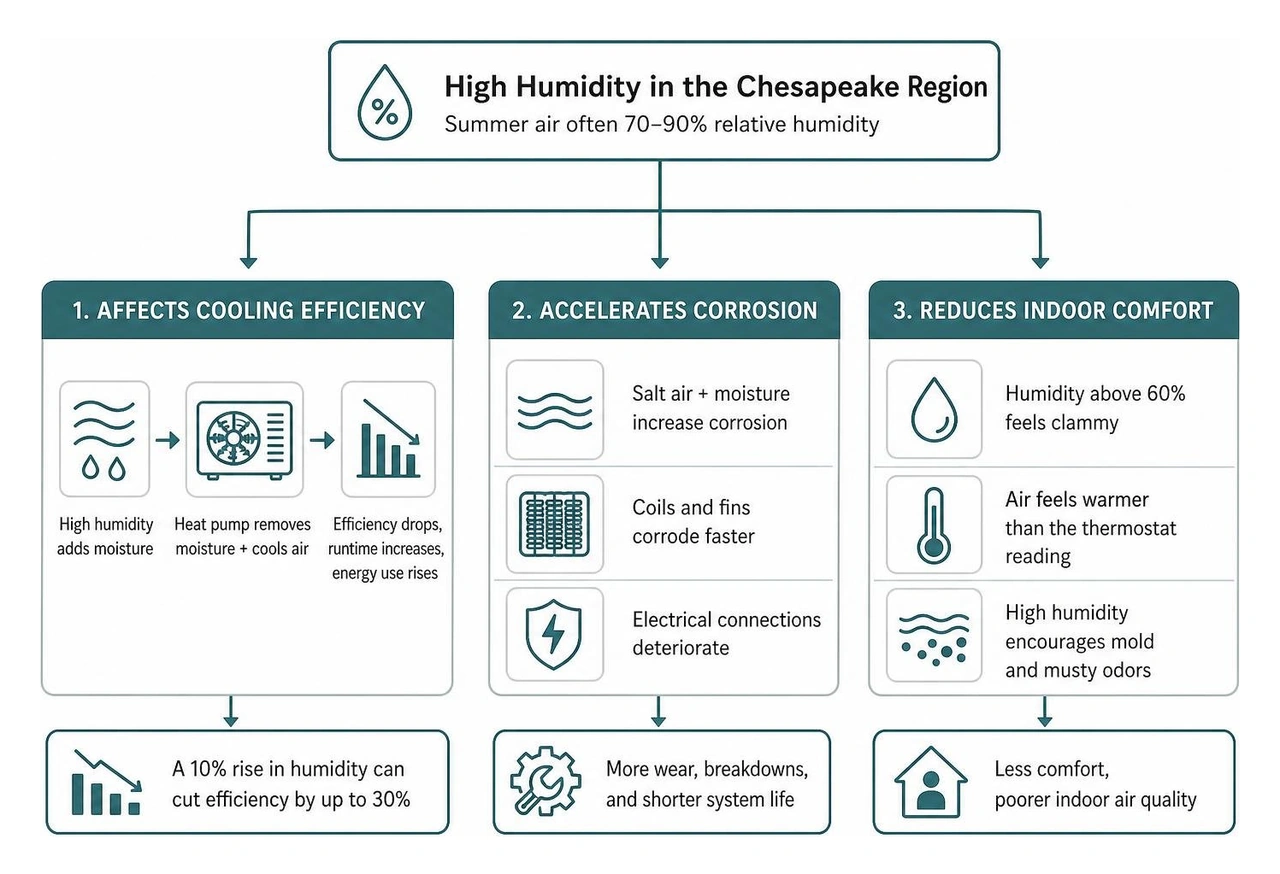
How high humidity in the Chesapeake region affects heat pump performance and maintenance is something every homeowner in and around Rosedale, MD needs to understand — especially before the summer heat sets in.
Here's the short answer:
- Efficiency drops significantly. A 10% rise in humidity can cut your heat pump's efficiency by up to 30%.
- Your system works harder. High humidity forces the heat pump to remove moisture and cool the air at the same time, increasing runtime and energy use.
- Corrosion sets in faster. Salt air and persistent moisture accelerate wear on coils, fins, and electrical connections — especially within a few miles of tidal water.
- Indoor comfort suffers. When humidity stays above 60%, your home can feel clammy even when the thermostat reads the right temperature.
- Maintenance needs increase. Clogged drain lines, dirty coils, and frost buildup become more frequent problems in humid coastal conditions.
The Chesapeake Bay region sits in a mixed-humid climate zone where summer air regularly holds 70–90% relative humidity. Unlike drier inland areas, your heat pump here must constantly manage both sensible cooling (lowering air temperature) and latent cooling (removing moisture from the air). That dual workload puts real stress on every part of the system — from the evaporator coil to the blower motor to the outdoor condenser.
Add in the salt-laden air common across coastal Maryland and Virginia, and you have a combination that shortens equipment life, raises energy bills, and creates conditions where mold can take hold if the system isn't properly maintained.
This guide breaks down exactly what's happening inside your heat pump when humidity spikes, what warning signs to watch for, and how to keep your system running reliably through every season.
How High Humidity in the Chesapeake Region Affects Heat Pump Performance and Maintenance
To understand how high humidity in the Chesapeake region affects heat pump performance and maintenance, we have to look at Climate Zone 4A. This is the official ASHRAE climate designation for central Maryland, including communities like Towson, MD, Ellicott City, MD, and Glen Burnie, MD.
In Climate Zone 4A, we experience warm, incredibly muggy summers and moderately cold, damp winters. This mixed-humid climate forces a heat pump to work dual shifts. When a heat pump cools your home, it doesn't just lower the air temperature (sensible cooling); it must also condense and pull water vapor out of the air (latent cooling).

When humidity rises by just 10%, the latent load on your system spikes. The heat pump has to run longer cycles to extract that heavy moisture, which can reduce overall operating efficiency by up to 30%. This extra runtime leads to increased energy consumption and puts mechanical strain on the compressor and fan motors. Over time, this constant workload accelerates wear and tear, leading to premature component breakdowns. Choosing an Energy Efficient Heat Pump designed to handle high latent loads is the first step toward combating these regional challenges.
Understanding How High Humidity in the Chesapeake Region Affects Heat Pump Performance and Maintenance in Summer
During hot summer days in coastal Maryland towns like Dundalk, MD and Middle River, MD, the indoor evaporator coil becomes extremely cold to extract heat from your home's air. As warm, moisture-laden air passes over this cold coil, water vapor condenses into liquid droplets.
However, when the air is exceptionally humid, several problems occur:
- Coil Insulation from Wet Dust: High humidity causes dust, pet dander, and pollen to stick to the wet surface of the evaporator coil. This wet grime acts as an insulating blanket. Instead of helping, it hinders heat transfer, forcing the system to run longer while removing less humidity.
- Short Cycling: If a system is oversized or struggling with restricted airflow, it may cool the home too quickly without running long enough to remove the moisture. This results in "short cycling," where the compressor turns on and off rapidly. You are left with a cold, clammy house and a highly stressed compressor.
- Drainage Overload: The continuous condensation must go somewhere. Your condensate drain pan and line have to channel gallons of water away daily. If algae or mold grows in this warm, wet environment, the drain line clogs, leading to water damage inside your home.
To keep the system running smoothly, the Heat Pump Outdoor Unit must also be kept clear of debris, grass clippings, and pollen so it can effectively reject the absorbed heat into the humid outdoor air.
How High Humidity in the Chesapeake Region Affects Heat Pump Performance and Maintenance in Winter
Many homeowners believe humidity is only a summer headache, but winter in the Chesapeake region brings its own set of moisture-related challenges. Cold, damp air between 32°F and 40°F is the perfect recipe for frost accumulation on your outdoor unit.
When your heat pump extracts heat from the damp winter air, the moisture in that air freezes instantly on the outdoor coil. To prevent this frost from turning into a solid block of ice, the system must periodically enter its defrost cycle.
During defrost mode:
- The reversing valve shifts the flow of refrigerant, temporarily turning the system back into an air conditioner to send heat to the outdoor coil and melt the ice.
- The outdoor fan shuts off to allow the coil to warm up quickly.
- Because the system is temporarily cooling the inside of your home to clear the outdoor ice, the auxiliary heat (usually expensive electric resistance heat strips) must kick on to keep you warm.
If the outdoor relative humidity is consistently high, your system will cycle into defrost mode far more frequently. This constant shifting of the reversing valve causes mechanical wear, and the regular use of auxiliary heat strips will cause your winter electric bills to spike. Scheduling a regular Heat Pump Tune Up before winter ensures that your defrost sensors, controls, and reversing valve are calibrated correctly to handle these rapid weather shifts.
Selecting and Sizing Heat Pumps for Mixed-Humid Climates
Selecting the right heat pump in places like Severna Park, MD or Forest Hill, MD requires moving away from old-school "rules of thumb." Simply sizing a system based on square footage often leads to oversized units. An oversized heat pump will cool your home rapidly, shut off, and leave the air feeling heavy and damp because it didn't run long enough to dehumidify.
To get sizing right, a professional contractor must perform an ACCA Manual J Load Calculation. This calculation factors in local humidity levels, window orientation, insulation quality, and local climate data.
For the best humidity control, look for these advanced equipment features:
- Variable-Speed Compressors: Unlike standard single-stage systems that are either 100% on or completely off, variable-speed systems adjust their output dynamically. They can run at lower speeds for longer periods. These continuous, low-speed cycles are incredibly efficient and provide excellent, non-stop moisture removal.
- Multi-Stage Systems: A two-stage system offers a high stage for peak summer days and a lower stage for milder, highly humid shoulder seasons, preventing short cycling.
If you are planning an upgrade, seeking professional guidance for Heat Pump Installation White Marsh MD or Heat Pump Installation Gambrills MD will ensure your new system is perfectly calibrated to handle both the heat and the heavy latent loads of our region.
Equipment Features for Salt-Air and High-Humidity Environments
If you live close to the water in coastal areas like Halethorpe, MD or Dundalk, MD, your outdoor unit is exposed to salt-laden air. Salt acts as an electrolyte that accelerates galvanic corrosion between the copper tubes and aluminum fins of standard condenser coils.
To protect your investment, look for these coastal-rated equipment features:
- Marine-Rated Protective Coatings: Many manufacturers offer specialized epoxy or phenolic coatings on the condenser coils. These coatings act as a barrier against salt air and moisture, significantly extending the lifespan of the unit.
- All-Aluminum Coils: Some modern systems utilize microchannel coils made entirely of aluminum. Because there are no dissimilar metals (like copper and aluminum touching), the risk of galvanic corrosion is greatly reduced.
- Corrosion-Resistant Cabinets: Look for outdoor cabinets constructed from heavy-gauge galvanized steel with high-quality powder-coat finishes and plastic base pans that don't rust.
When exploring our full range of Services, always ask our team about units designed specifically for marine and high-humidity environments to ensure long-term durability.
Preventing Corrosion, Mold, and Efficiency Loss in Coastal Maryland
Preventative maintenance is the single most effective way to protect your heat pump from the destructive forces of coastal humidity. Without regular attention, moisture, salt, and dust will slowly destroy your system's efficiency.
To prevent corrosion, mold, and performance loss, keep these key maintenance practices in mind:
- Keep the Condensate Drain Clear: Because your heat pump extracts gallons of water daily, the drain line must remain clear. Algae and mold thrive in dark, damp drain pans. Regularly flushing the line and using safe, algae-clearing tablets can prevent costly backups.
- Rinse the Outdoor Coil: If you live close to tidal waters, gently rinsing your outdoor condenser coil with fresh water from a garden hose (never a pressure washer!) once a month will wash away salt deposits and prevent corrosion.
- Replace Filters Regularly: A clogged air filter restricts airflow. When airflow drops, the evaporator coil gets too cold, which can cause the moisture on it to freeze, blocking the system entirely. In high-humidity seasons, check your filters every 30 to 60 days.
For homeowners in communities like Perry Hall, MD and Joppa, MD, setting up professional maintenance is simple. You can schedule specialized Heat Pump Maintenance Edgewood MD or reliable Heat Pump Service Parkville MD to keep your system clean, efficient, and running safely year-round.
Indoor Air Quality and Dehumidification Solutions
High indoor humidity doesn't just make you feel sticky; it actively harms your indoor air quality. When relative humidity rises above 60%, it creates an ideal breeding ground for dust mites, mildew, and mold spores. These allergens can quickly spread through your ductwork, triggering asthma and allergy symptoms.
While a properly sized heat pump does a great job of removing moisture during hot weather, it struggles during the mild "shoulder seasons" (spring and autumn). On a damp, 65°F day in May or October, your home might feel incredibly humid, but because it isn't hot enough to trigger a cooling cycle, your heat pump won't run.
To solve this, we highly recommend:
- Whole-House Dehumidifiers: These systems are integrated directly into your existing ductwork. They monitor indoor relative humidity and run independently of your heating and cooling cycles, keeping your indoor humidity precisely between the EPA-recommended 30% and 50%.
- Duct Cleaning and Sealing: Leaky ducts in unconditioned crawl spaces or attics can pull in hot, humid, dirty air from the outside, overloading your system.
Combining professional Indoor Air Quality Duct Cleaning with specialized Air Conditioning Services Arnold MD ensures that the air circulating through your home remains clean, dry, and healthy through every seasonal transition.
Local Building Codes and Permitting in Maryland and Virginia
When replacing or installing a heat pump in the Chesapeake region, local building codes and energy standards must be strictly followed. These regulations exist to guarantee that your system is safe, energy-efficient, and capable of managing local environmental demands.
In Maryland, local jurisdictions enforce code compliance based on the International Energy Conservation Code (IECC) and the International Residential Code (IRC). Because central Maryland sits in Climate Zone 4A, the requirements differ slightly from the warmer Climate Zone 3A found in coastal Virginia.
| HVAC Design Factor | Climate Zone 4A (Central Maryland) | Climate Zone 3A (Coastal Virginia) |
|---|---|---|
| Primary Climate Type | Mixed-Humid | Warm-Humid |
| Sizing Standards | ACCA Manual J & S Required | ACCA Manual J & S Required |
| Duct Insulation (Unconditioned Space) | R-8 Minimum | R-6 to R-8 Minimum |
| Mechanical Permit Required | Yes (Local County/City) | Yes (Local Municipality) |
| Typical Heating Degree Days (HDD) | 4,000 to 4,500 | 3,000 to 3,500 |
| Typical Cooling Degree Days (CDD) | 1,000 to 1,500 | 1,500 to 2,000+ |
Before starting any installation, a mechanical permit must be pulled through your local county or city government (such as Baltimore County, Anne Arundel County, or Howard County). This ensures that a certified inspector will review the electrical connections, refrigerant lines, and condensate drainage systems to verify they meet strict local safety and environmental standards.
Frequently Asked Questions About Chesapeake Heat Pumps
Why does my heat pump freeze up in humid weather?
In the summer, a heat pump can freeze up if there is restricted airflow (often caused by a dirty air filter, closed registers, or a failing blower motor) or a low refrigerant charge. In the winter, light frost on the outdoor unit is normal and is cleared by the automatic defrost cycle. However, if the defrost sensor, control board, or reversing valve is broken, or if the outdoor airflow is blocked by leaves and debris, a thick layer of solid ice will form, causing the system to stop heating entirely.
How often should I clean my heat pump coils in coastal areas?
If you live within five miles of tidal water (such as the Chesapeake Bay or local rivers in Dundalk or Severna Park), we recommend gently rinsing your outdoor condenser coil with fresh water from a garden hose once a month during the high-use summer season. This removes salt deposits and prevents galvanic corrosion. Additionally, a deep, professional cleaning of both the indoor evaporator coil and outdoor condenser coil should be performed at least once a year during your annual maintenance visit.
Does a whole-house dehumidifier save energy on heating and cooling?
Yes! Dry air holds less heat than damp air, and it allows your body's natural cooling mechanism (sweat evaporation) to work much more effectively. When your indoor relative humidity is kept between 30% and 50%, you will feel comfortable at a higher thermostat setting. For example, 75°F with 45% humidity feels much cooler and more comfortable than 75°F with 65% humidity. By raising your thermostat setting a few degrees, you reduce the workload on your heat pump, saving energy and extending the lifespan of your system.
Conclusion
Managing how high humidity in the Chesapeake region affects heat pump performance and maintenance doesn't have to be a stressful, uphill battle. By choosing properly sized, variable-speed equipment, protecting your coils from coastal salt air, and staying on top of seasonal preventative maintenance, you can keep your home perfectly dry, cool, and comfortable all year long.
At Green Comfort Systems, we are dedicated to helping our neighbors in Rosedale, Towson, Catonsville, and across central Maryland stay comfortable in an environmentally responsible way. Through our unique partnership with One Tree Planted, we plant a tree for every major service and installation we perform, helping to restore our local ecosystems while we keep your indoor air clean and fresh.
To take the hassle out of regular maintenance, consider joining our Green Guardian Club. This plan provides you with priority seasonal tune-ups, filter checks, and coil cleanings to protect your heat pump from the harsh humid climate, ensuring peak efficiency and preventing unexpected breakdowns.
Ready to optimize your home's comfort and protect your system from the humid Chesapeake air? Explore our specialized Green Comfort Systems Heat Pump Services or contact us today to schedule your comprehensive system assessment!
Book Expert Service Or Contact Us
Other Blogs


Get Financing Today
Get the comfort you deserve, without the financial stress.

Latest Blogs
Diagnosing a Blower Motor Failure When Your Furnace Runs but Produces No Air
The Anatomy of a Fast Towson Furnace Repair: How We Diagnose Ignitor Failures
Clearing the Air: How We Handle Lingering Musty Odors During Your October Heating Startup
