




Beginner AC Cycling Mistakes and How to Avoid Them

Why Your AC Keeps Turning On and Off in Baltimore Summer Heat — and What Is Wrong
If your ac keeps turning on and off in baltimore summer heat what is wrong is the question running through your head right now, here is the short answer: your system is short cycling. This means it starts a cooling cycle, shuts off too soon, and immediately restarts — over and over — without ever finishing the job. It is one of the most common and damaging AC problems Baltimore homeowners face during the summer months, when heat index values regularly climb past 100°F and the humidity from the Chesapeake Bay makes every degree feel worse.
The most common reasons your AC keeps turning on and off in Baltimore include:
- Dirty or clogged air filter — restricted airflow forces the system to overheat and shut down early
- Oversized AC unit — cools the thermostat location too fast without removing humidity from the rest of the home
- Low refrigerant from a leak — throws off system pressure and causes erratic cycling
- Thermostat problems — poor placement near sunlight or drafty walls sends false temperature readings
- Frozen evaporator coil — blocks airflow and triggers repeated shutdowns
- Electrical or control board faults — faulty capacitors, relays, or wiring cause the system to cut out unexpectedly
- High static pressure from old ductwork — common in Baltimore rowhouses with undersized or deteriorating ducts
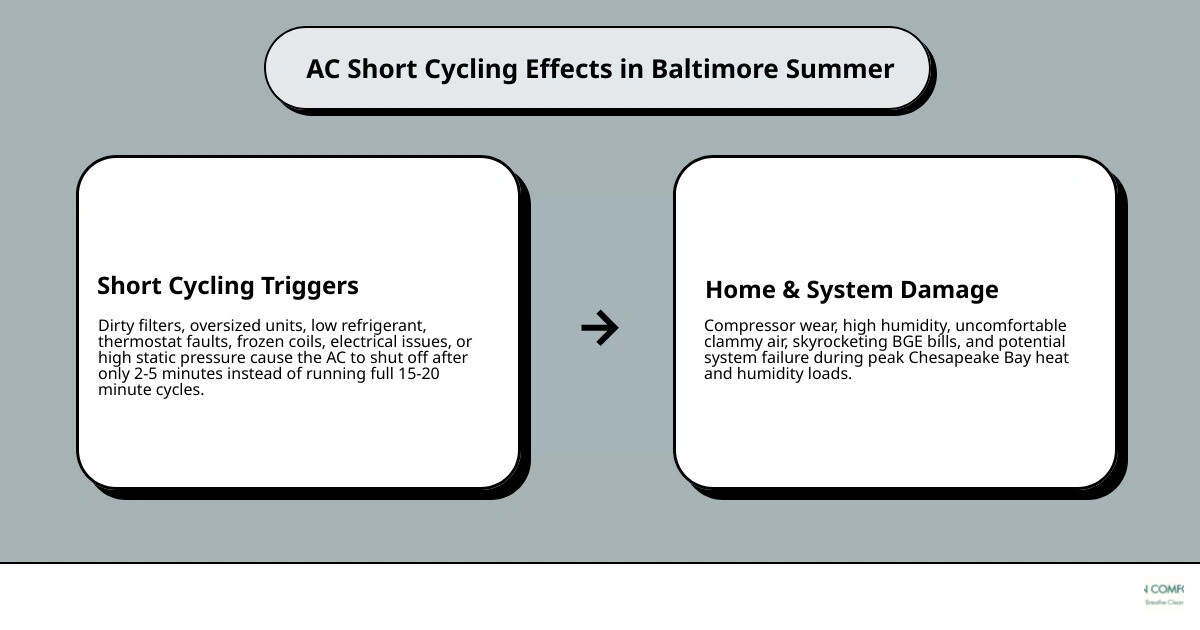
Short cycling is not just annoying. A healthy AC should run steady cycles of roughly 15 to 20 minutes. When it runs for only 2 to 5 minutes at a time, the compressor takes a beating with every startup, humidity never gets pulled out of the air, and your BGE bill climbs — all without your home ever feeling comfortable.
Baltimore's summers are especially hard on AC systems. The city's combination of high heat and humidity from June through September creates what HVAC technicians call a heavy "latent load" — the energy your system needs just to pull moisture out of the air, before it can even start cooling the temperature down. That extra demand pushes already-stressed systems into short cycling faster than in drier climates.
The good news is that most short cycling problems have clear causes and real fixes. The sections below walk you through how to spot what is wrong, what mistakes to avoid, and when to call a professional before the problem destroys your compressor.
What Is Short Cycling and How Does It Affect Your Home?
To understand why short cycling is so destructive, we first need to look at how a healthy air conditioner operates. Under normal conditions, a properly sized and functioning cooling system completes two to three cycles per hour. Each cycle should last approximately 15 to 20 minutes.
During these 15 to 20 minutes, the AC does two critical jobs: it lowers the air temperature, and it extracts moisture from the indoor air. In places like Towson, MD or Dundalk, MD, removing humidity is actually the harder of the two jobs. It takes at least 10 to 15 minutes of continuous run time for the evaporator coil to get cold enough to condense and drain significant amounts of water from your household air.
When an AC is short cycling, it turns off after only 2 to 5 minutes. This rapid-fire on-and-off behavior has serious consequences for your home and your wallet:
- Massive Compressor Strain: The compressor is the heart of your AC, and starting up requires significantly more electrical current and physical effort than running continuously. Short cycling forces the compressor to start up dozens of times an hour instead of just a few. This dramatically reduces the typical 15-to-20-year lifespan of a healthy unit, leading to early failure.
- Spiking BGE Bills: Because the startup phase of an AC cycle consumes the most electricity, a short-cycling unit runs highly inefficiently. You end up paying more for a system that runs for 50 minutes in 5-minute bursts than you would for a system that runs for two steady 25-minute cycles.
- Clammy, Humid Indoor Air: Because the system never runs long enough to dehumidify, your home will feel cold but sticky and muggy. High humidity also encourages mold growth and can cause wood floors to warp.
- Inconsistent Temperatures: You will likely notice that some rooms are freezing while others are sweltering. The thermostat location might reach its target temperature quickly, but the air never circulates long enough to balance the rest of the house.
If you notice these issues, your system is likely suffering from a lack of cooling capacity or restricted airflow. You can read more about what happens when your system fails to cool in our guide on AC Not Cooling.

AC Keeps Turning On and Off in Baltimore Summer Heat What Is Wrong
When your ac keeps turning on and off in baltimore summer heat what is wrong usually comes down to the brutal combination of local weather and utility costs. In July 2026, Baltimore's summer humidity hovers between 60% and 80%, placing an immense latent load on our cooling systems.
At the same time, BGE’s residential electricity rates in 2026 average about 14.5 cents per kilowatt-hour for supply and delivery charges combined. Because air conditioning in U.S. homes and businesses consumes 4% to 7% of the nation's total energy, a short-cycling unit can quickly cause your monthly BGE bill to skyrocket.
To help you figure out if your system is experiencing this issue, we have put together a comparison table of normal operations versus short-cycling symptoms:
| Feature | Normal AC Operation | Short Cycling Symptoms |
|---|---|---|
| Cycle Duration | 15 to 20 minutes per cycle | 2 to 5 minutes per cycle |
| Cycles Per Hour | 2 to 3 times under moderate loads | 6 to 10+ times per hour |
| Indoor Humidity | Keeps relative humidity below 50% | Air feels clammy, muggy, and damp |
| Temperature Balance | Consistent temperatures room-to-room | Cold spots near vents, hot spots elsewhere |
| BGE Bill Impact | Predictable, stable seasonal energy costs | Sudden, unexplained spikes in electricity use |
| System Sounds | Smooth hum, occasional startup click | Constant clicking, clunking, and motor straining |
If your system matches the short-cycling symptoms, it is time to schedule a professional diagnostic check. Leaving the system to struggle in 100°F heat index weather will only lead to a complete breakdown. When you need local expertise, our team at Green Comfort Systems is ready to help with comprehensive AC Repair Baltimore.
Common Mechanical and Electrical Causes of Short Cycling
Short cycling is rarely a single component failing out of nowhere. Instead, it is usually a safety mechanism built into your AC designed to protect the compressor from permanent damage. When something goes wrong mechanically or electrically, the system shuts itself off to prevent a total meltdown.
Here are the primary mechanical and electrical culprits behind short-cycling systems:
- Low Refrigerant Charge: Refrigerant does not evaporate or get "used up" over time. If your system is low on refrigerant, you have a leak. Low refrigerant levels drop the pressure inside the evaporator coil. When pressure drops below a safe limit, the low-pressure safety switch trips, shutting down the compressor. Once the system rests, the pressure rises slightly, the switch resets, the compressor turns back on, and the cycle repeats.
- Frozen Evaporator Coil: When airflow is blocked or refrigerant is low, the temperature of the indoor evaporator coil drops below freezing. Moisture from the air freezes instantly on the coil, turning it into a block of ice. This block of ice completely stops airflow, causing the system to overheat or trip safety switches and shut down.
- Failed Capacitor or Relay: The run capacitor acts like a battery that provides the continuous electrical muscle your compressor and fan motors need to run. If the capacitor is failing, it may overheat and lose its charge after a few minutes of operation, causing the compressor to drop out.
- Electrical Safety Tripping: Corroded wiring, loose connections, or a failing compressor motor can cause sudden spikes in electrical current. This can trigger your control board to shut down the system or trip your circuit breaker entirely. For more on electrical issues, check out our article on Why AC Circuit Breaker Keeps Tripping.
Airflow Restrictions and Clogged Filters
The single most common — and easily preventable — cause of short cycling is restricted airflow. Your air conditioner needs to breathe. It relies on a steady, high-volume stream of warm indoor air passing over the cold evaporator coil to keep the system balanced.
When you let a 1-inch pleated air filter go unchanged for months, it becomes clogged with dust, pet dander, and pollen. A clogged filter can easily reduce system airflow by 20% or more. This restriction causes static pressure (the resistance to airflow inside your ducts) to spike.
When static pressure exceeds safe limits (often around 0.5 inches of water column), the blower motor has to work significantly harder, overheating the system. Furthermore, the lack of warm air passing over the evaporator coil causes the coil's temperature to plummet, leading directly to a frozen coil and rapid short cycling. You can learn how to diagnose and resolve these air movement bottlenecks in our guide on Solving AC Airflow Problems.
Thermostat Placement and Calibration Issues
Sometimes, there is absolutely nothing wrong with your air conditioner's mechanical parts; instead, the "brain" of the system is getting bad information. Your thermostat tells the AC when to turn on and when to turn off based on the temperature of the air immediately surrounding it.
If your thermostat is installed in a poor location, it will trigger short cycles:
- Direct Sunlight: If a window allows direct afternoon sunlight to hit your thermostat, the sensor will think the entire house is sweltering, even if the rest of your home is a comfortable 72°F. It will turn the AC on. As soon as the sun shifts or a brief blast of cold air from a nearby vent hits it, the thermostat cools down rapidly and shuts the AC off.
- Proximity to Supply Registers: If your thermostat is located too close to an air conditioning vent, the cold air blowing directly onto it will satisfy the sensor in just a couple of minutes, shutting the system down before the rest of the house has even begun to cool.
- Drafty Interior Walls or Kitchen Heat: Installing a thermostat near drafty windows, exterior doors, or heat-producing kitchen appliances causes rapid temperature swings that trick the system into constant on-and-off cycling.
Sizing Mistakes in Historic Baltimore Rowhouses
If you live in a classic rowhouse in Canton, Fells Point, or Federal Hill, your home has unique architectural quirks that make it highly susceptible to AC short cycling. Many of these historic homes were built long before central air conditioning existed. When HVAC systems are retrofitted into these spaces, two major mistakes often occur: installing an oversized system and trying to force modern airflow through tiny, outdated ductwork.
To prevent these issues, a professional must always perform a Manual J load calculation. This calculation takes into account the home's square footage, wall construction, insulation quality, window surface area, and local climate data to determine the exact cooling capacity (in BTUs or tons) your home actually needs. Skipping this step and relying on "rules of thumb" almost always results in a system that is far too large for the space.
If you are planning an upgrade, read more about proper system design in our guide on AC Installation Baltimore.
How an Oversized Unit Explains Why Your AC Keeps Turning On and Off in Baltimore Summer Heat What Is Wrong
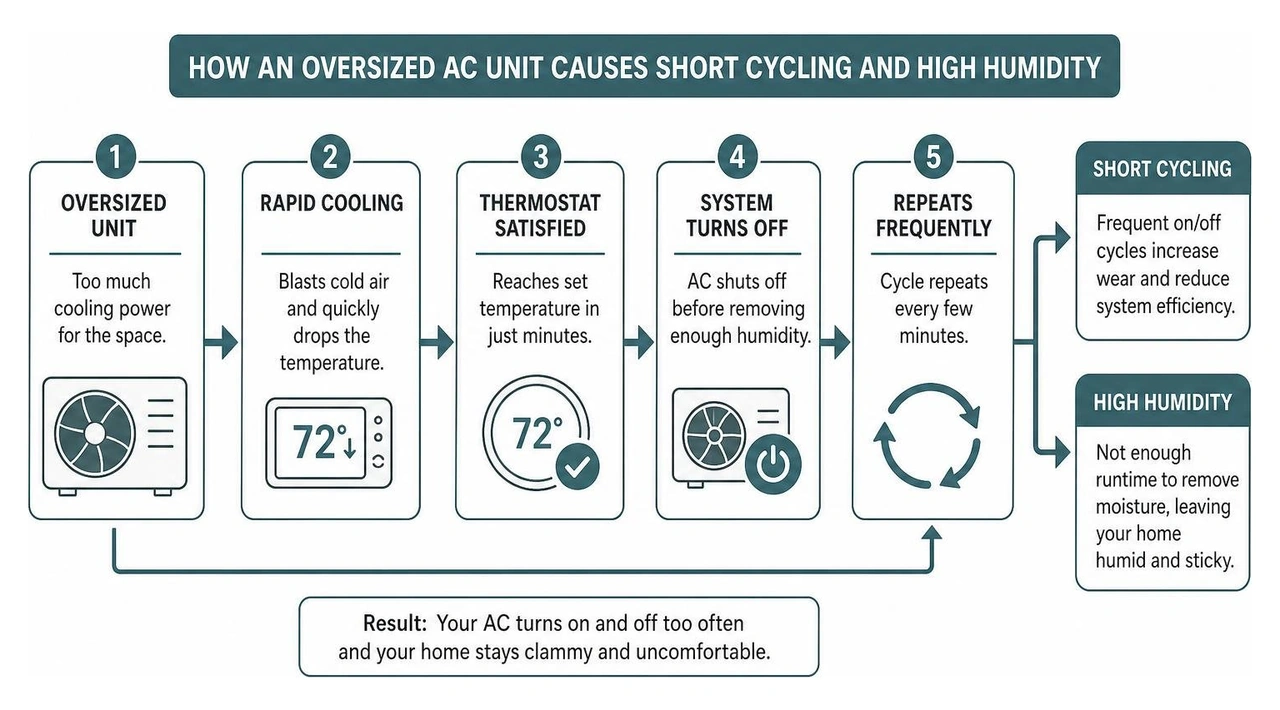
Many homeowners assume that when it comes to air conditioning, "bigger is better." This is a critical mistake. An oversized air conditioner is one of the primary reasons your ac keeps turning on and off in baltimore summer heat what is wrong.
An oversized system has too much cooling power for the square footage of your home. When it turns on, it blasts a massive volume of freezing air into the living space. The thermostat, sensing this sudden drop in temperature, is satisfied within 3 to 5 minutes and shuts the system down.
However, because the cycle was so short, the system did not run long enough to pull any moisture out of the air. The temperature drops, but the humidity remains extremely high. Soon, the heavy, humid air makes the home feel warm and clammy again, prompting the thermostat to turn the system back on. This results in a continuous loop of rapid cooling, zero dehumidification, and constant compressor wear.
How Improper Ductwork in Older Homes Triggers Short Cycling
Older homes in Baltimore often have ductwork that was originally designed for gravity coal heating or early radiator-to-forced-air conversions. These ducts are frequently too small to handle the high volume of air required by modern high-efficiency air conditioners.
When a powerful new AC tries to push air through tiny, restricted ducts, the static pressure inside the system spikes. This restriction acts like a clog in the system's lungs. The air cannot move fast enough over the evaporator coil, causing the coil to freeze. Furthermore, many rowhouses have ductwork running through uninsulated, 140°F attics. This extreme heat exposure can cause the air inside the ducts to expand and overheat the system, triggering safety switches that shut the unit down prematurely.
Preventive Maintenance Steps for Baltimore Homeowners
While some causes of short cycling require professional repairs, there are several simple maintenance steps you can take to protect your system and keep it running smoothly through the hottest summer months.
- Change Your Filter Monthly in Summer: During peak cooling season (June through September), check your air filter every 30 days. If you have pets or allergies, replace it monthly. A clean filter keeps static pressure low and airflow high.
- Maintain Outdoor Clearance: Your outdoor condenser unit releases the heat pulled from inside your home. Ensure there is at least two feet of clear space around the unit. Clear away weeds, vines, leaves, and trash that can block airflow through the condenser coils.
- Keep Vents and Registers Open: Never close off more than 10% of the registers in your home. Closing vents does not save energy; instead, it increases static pressure, restricts airflow, and can trigger short cycling.
- Use a Smart Thermostat Wisely: Install a smart thermostat in a central, shade-protected location. Set it to steady, moderate temperatures. Avoid adjusting the temperature up and down constantly, as this can confuse the system's control board.
If you want to take the hassle out of system care, our Green Guardian Club offers regular, professional maintenance that catches these issues before they turn into expensive breakdowns. Learn more about our maintenance options at AC Maintenance Baltimore.
When Your AC Keeps Turning On and Off in Baltimore Summer Heat What Is Wrong and How to Fix It
If you have replaced your filter, verified that all your vents are open, and confirmed your thermostat is not in direct sunlight, but your system is still turning on and off every few minutes, you need a professional HVAC technician.
Complex mechanical and electrical issues cannot be fixed safely with DIY methods. An EPA-certified technician from Green Comfort Systems will perform the following diagnostic steps to find and fix the root cause:
- Refrigerant Pressure Testing: We measure subcooling and superheat levels to determine if your system has a refrigerant leak, and we use electronic leak detectors to find and seal the leak before recharging the system.
- Static Pressure Verification: We measure the pressure inside your ductwork to ensure your system is breathing properly and that your ductwork is sized correctly for your AC.
- Electrical Diagnostic: We use multimeters to test the electrical draw of your compressor and blower motor, and we replace failing run capacitors or worn-out contactors before they can damage your compressor.
- Thermostat Calibration and Wiring Checks: We verify that your thermostat is sending clean, continuous low-voltage signals to your control board without dropping out.
Frequently Asked Questions About AC Short Cycling
How long should a healthy AC run during a Baltimore summer?
A healthy, properly sized air conditioning system should run for 15 to 20 minutes per cycle under normal summer conditions. On exceptionally hot, humid days when outdoor temperatures approach 100°F, your system may run for longer, continuous periods to maintain your indoor temperature. This is normal and highly efficient, as long as the system is successfully cooling your home and pulling out humidity.
Can a dirty air filter cause my AC to turn on and off repeatedly?
Yes, a dirty air filter is the most common cause of short cycling. When a filter is clogged with dust, it restricts airflow across the indoor evaporator coil. Without enough warm air to keep it warm, the coil's temperature drops below freezing, causing condensation to freeze into a block of ice. This ice blocks all remaining airflow, causing the system's safety switches to shut the compressor down. Once the ice melts slightly, the system restarts, only to freeze and shut down again.
What are the risks of ignoring an AC that is short cycling?
Ignoring a short-cycling AC will almost certainly lead to catastrophic compressor failure, which is one of the most expensive repairs in residential HVAC. Additionally, the constant electrical surges from frequent startups will cause your BGE bills to spike, and the lack of proper humidity control can lead to mold growth, musty odors, and damage to your home's wood floors and furniture.
Conclusion
When your ac keeps turning on and off in baltimore summer heat what is wrong is a clear warning sign that your cooling system is under extreme stress. Whether the cause is a simple clogged filter, a hidden refrigerant leak, or an oversized unit struggling in an older rowhouse, addressing the issue early is the only way to protect your home's comfort and save your compressor from premature failure.
At Green Comfort Systems, we are proud to provide reliable, high-quality heating and cooling services throughout Rosedale, Towson, Catonsville, Ellicott City, and the surrounding Baltimore communities. As part of our commitment to eco-friendly operations, we partner with One Tree Planted to plant a tree for every service service we perform, helping to keep Maryland green while keeping your home comfortable.
Don't let a short-cycling AC burn out your compressor and send your energy bills through the roof. Schedule your professional system diagnostic today by visiting our AC Services Baltimore page or giving our friendly team a call!
Book Expert Service Or Contact Us
Other Blogs


Get Financing Today
Get the comfort you deserve, without the financial stress.

Latest Blogs
Smart Thermostats vs. Programmable Models for Managing Unpredictable October Weather in Middle River
How Our Fully Stocked Trucks Enable Under-an-Hour Heat Pump Repairs in Owings Mills
Diagnosing a Blower Motor Failure When Your Furnace Runs but Produces No Air
