




A Comprehensive Guide to Chesapeake Bay Region Climate & HVAC Demands

Why the Chesapeake Bay Region Climate Creates Unique HVAC Demands in Central Maryland
How the Chesapeake Bay region climate creates unique HVAC demands in central Maryland comes down to a powerful combination of forces that most other parts of the country simply don't face at the same time: two distinct climate zones, relentlessly high summer humidity, accelerating sea-level rise, and saltwater air that eats through equipment faster than you'd expect.
Here's a quick summary of the key factors:
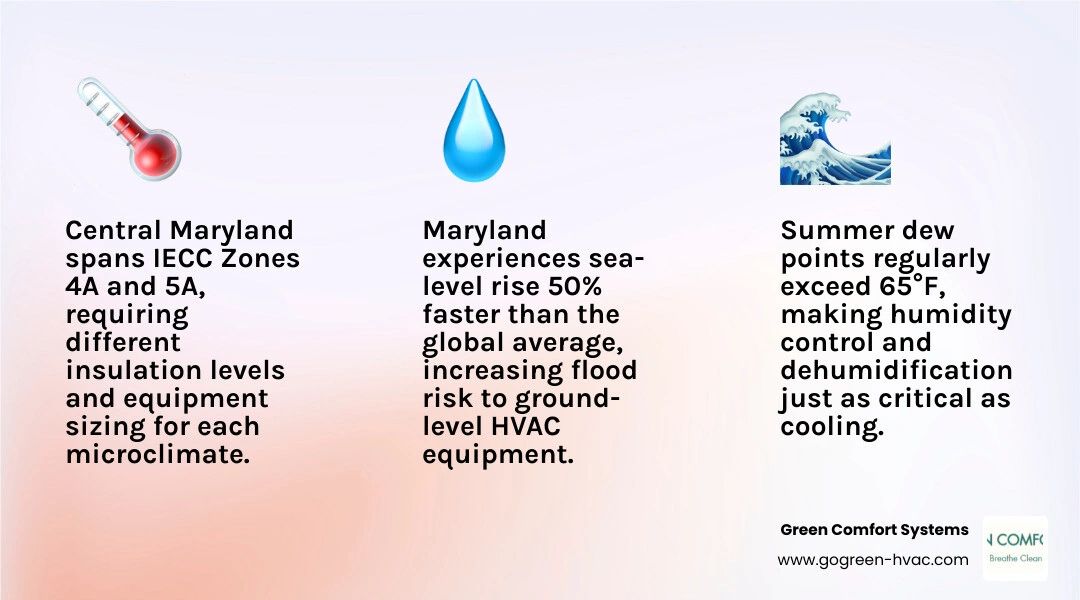
- Dual climate zones - Most of central Maryland (including Baltimore) sits in IECC Zone 4A (Mixed-Humid), while western counties fall under Zone 5A (Cool-Humid), each requiring different insulation levels, equipment sizing, and efficiency standards.
- High humidity loads - Summer dew points in Zone 4A regularly exceed 65°F, making dehumidification just as important as cooling.
- Saltwater corrosion risk - Proximity to the Bay accelerates wear on outdoor HVAC components, especially condenser coils and metal housings.
- Rising seas and flooding - Maryland faces sea-level rise 50% faster than the global average, threatening ground-level HVAC equipment and building envelopes.
- Warming temperatures - Bay water temperatures have risen nearly 0.5°F per decade, extending cooling seasons and increasing overall system demand.
- Shifting storm patterns - More intense and frequent storms increase flood risk and put aging HVAC infrastructure under greater stress.
For homeowners in Rosedale and across central Maryland, these aren't abstract environmental trends. They show up as mold problems, corroded equipment, flooded outdoor units, and heating and cooling systems that struggle to keep up — often because they were never sized or specified for these local realities.
This guide breaks down exactly what's happening with the Bay region's climate, why it matters for your home's comfort system, and what smart HVAC decisions look like in this part of Maryland.
How the Chesapeake Bay Region Climate Creates Unique HVAC Demands in Central Maryland
Living in Central Maryland means experiencing the best of all four seasons, but it also presents a highly complex environment for residential heating, ventilation, and air conditioning (HVAC) systems. The Chesapeake Bay acts as a massive climate driver, influencing temperature, moisture levels, and weather severity across our entire service area—from the coastal breeze of Severna Park and Dundalk to the inland hills of Towson, Catonsville, and Ellicott City.
When we design and install comfort systems, we have to account for more than just the outdoor temperature. We must look at how the Bay’s unique microclimates alter the physical demands placed on heating and cooling equipment. Standard, out-of-the-box HVAC installations often fail prematurely in our region because they are not configured to handle the relentless moisture and corrosive air.
By implementing Green HVAC Solutions, homeowners can balance the need for high-efficiency operation with specialized durability upgrades designed specifically for our coastal-influenced climate.
Microclimates and How the Chesapeake Bay Region Climate Creates Unique HVAC Demands in Central Maryland
To understand why HVAC design is so complex here, we have to look at how Maryland is split from a regulatory and meteorological perspective. The International Energy Conservation Code (IECC) divides the state into two distinct climate zones: Zone 4A (Mixed-Humid) and Zone 5A (Cool-Humid).
While western Maryland counties like Garrett County experience the true alpine cold of Zone 5A, our primary service areas in Central Maryland—including Rosedale, Glen Burnie, Middle River, Halethorpe, and Perry Hall—sit firmly within Zone 4A. The "A" designation is the most critical letter in that code: it stands for humid.
This division creates vastly different engineering requirements for homes just a few hours apart:
| Climate Metric / Standard | Zone 4A (Central MD / Baltimore Area) | Zone 5A (Western MD / Garrett County) |
|---|---|---|
| Climate Classification | Mixed-Humid | Cool-Humid |
| Heating Degree Days (HDD) | 4,000 to 5,500 (Baltimore: ~4,600) | Exceeds 6,000 (Garrett Co: ~7,200) |
| Winter Design Temperature | 10°F to 15°F | 0°F to 5°F |
| Primary HVAC Challenge | High summer latent load (humidity) | High winter sensible load (severe cold) |
| 2021 IECC Ceiling Insulation | R-38 minimum | R-49 minimum |
| Common System Types | Standard or high-efficiency heat pumps | Cold-climate heat pumps or dual-fuel systems |
Because Zone 4A experiences moderate winters but humid summers, our systems must be exceptionally good at moisture removal. If a contractor installs a system sized purely for cooling speed without analyzing the latent heat (moisture) load, your home will feel cold and clammy, and you will likely battle biological growth indoors.
Coastal vs. Inland Realities: How the Chesapeake Bay Region Climate Creates Unique HVAC Demands in Central Maryland
Even within our local service territory, we see massive environmental variations. A home in Dundalk, Middle River, or Severna Park sits right on the water, exposing it to salt-laden air and coastal winds. Meanwhile, a home in Ellicott City, Forest Hill, or Joppa deals with more inland, valley-like conditions where humidity can pool and stagnate without a coastal breeze.
For waterfront and near-coastal properties, salt air is a constant threat. Saltwater mist is carried inland by wind, settling on the delicate aluminum fins and copper tubing of outdoor condenser units. This triggers galvanic corrosion, which degrades the metal, reduces heat transfer efficiency, and eventually causes refrigerant leaks.
To combat this, we recommend specialized coastal preventative maintenance and protective coil coatings. Regular inspections are vital to catch these issues early. Understanding the HVAC Preventative Maintenance Benefits in a coastal environment can save you from premature system failure and keep your energy bills from climbing as your outdoor coils degrade.

Dual Climate Zones: Sizing and Insulation Under Maryland's IECC Standards
Maryland’s adoption of the 2021 IECC, along with specific state-level amendments administered by the Department of Housing and Community Development (DHCD), has raised the bar for home energy performance. These codes ensure that new installations and major renovations are optimized for our specific climate zones.
One of the biggest shifts under these standards is the focus on the building envelope. In Zone 4A (which covers all our service locations, including Towson, Perry Hall, and Glen Burnie), the code mandates a minimum of R-38 ceiling insulation. If you were to cross into Zone 5A, that requirement jumps to R-49.
Additionally, the 2021 IECC places strict limits on duct leakage, requiring testing to ensure leakage is no greater than 4 CFM25 (cubic feet per minute at 25 Pascals of pressure) per 100 square feet of conditioned floor area. Why does this matter? In our humid climate, leaky ducts in unconditioned spaces like attics or crawlspaces don't just lose conditioned air—they pull in hot, moisture-heavy air from the outside, overloading your system and threatening your indoor air quality.
To help homeowners meet these strict guidelines, local utility companies offer robust incentive programs. These rebates make it much easier to transition to high-efficiency systems that meet or exceed the latest energy codes.
Heating and Cooling Load Calculations in Zone 4A vs. Zone 5A
When we design a system for a home in Rosedale or Catonsville, we never rely on rules of thumb (like "one ton of cooling per 500 square feet"). Doing so in Central Maryland is a recipe for system short-cycling and poor humidity control. Instead, we perform precise Manual J load calculations.
Because Baltimore averages around 4,600 Heating Degree Days (HDD) compared to Garrett County's chilly 7,200 HDD, our winter heating loads are much more moderate. However, our summer design temperatures and high dew points mean our cooling and dehumidification loads are highly dynamic.
In Zone 4A, we often recommend:
- Variable-speed heat pumps that can run at lower capacities for longer periods, constantly pulling moisture out of the air without overcooling the home.
- Dual-fuel systems (combining an electric heat pump with a high-efficiency gas or propane furnace) for inland areas that experience occasional sharp winter dips.
- Cold-climate heat pumps that maintain excellent heating capacity even when outdoor temperatures drop toward our design low of 10°F to 15°F.
Rising Seas, Subsidence, and Storms: Flood-Resilient HVAC Design
The physical landscape of the Chesapeake Bay is changing. Sea levels in the Bay are rising at a rate 50% faster than the global average. This is due to a combination of global thermal expansion and local land-subsidence (the land sinking due to geological factors). Maryland-specific projections estimate a sea-level rise of 0.8 to 1.6 feet by 2050, and up to 4.2 feet by 2100.
For coastal communities like Dundalk, Middle River, and Severna Park, this has led to a significant increase in nuisance flooding and high-tide inundation. If your outdoor AC condenser or heat pump is sitting directly on the ground in a low-lying zone, it is at serious risk of being submerged during a storm surge or exceptionally high tide.
To protect your HVAC investment, flood-resilient design is no longer optional:
- Equipment Elevation: We regularly install outdoor units on elevated structural platforms or wall-mounted brackets well above the local base flood elevation (BFE).
- Corrosion-Resistant Materials: Elevating the unit also keeps it away from standing saltwater, but we still use marine-grade stainless steel fasteners and polymer equipment pads to prevent rust.
- Building Envelope Integrity: Sealing service penetrations where refrigerant lines and electrical conduits enter the home prevents floodwaters and high-humidity air from migrating into crawlspaces or basements.
By planning for these shifting environmental factors today, we ensure your heating and cooling infrastructure remains durable and dry for decades to come.
Shifting Temperature Patterns and Dehumidification Needs in the Bay Watershed
The Chesapeake Bay is warming rapidly. Summer water temperatures have risen by nearly 0.5°F per decade—amounting to a 1.3°F increase since the late 1980s. This warmer water acts as an evaporation engine, pumping massive amounts of moisture into the local atmosphere.
As a result, summer dew points in Central Maryland regularly climb past 65°F, and often exceed 70°F in July and August. When the dew point rises this high, the air is saturated with water. According to ASHRAE Standard 62.2, indoor relative humidity should ideally be kept below 60% (ideally between 30% and 50%) to prevent mold growth, dust mite infestations, and structural damage.
If your cooling system is oversized, it will cool your home down so fast that the thermostat is satisfied before the system has run long enough to remove moisture. This leaves you with cold, damp indoor air.
To solve this, we frequently pair an Energy Efficient Heat Pump with whole-house dehumidifiers. These systems work in tandem to manage both temperature and moisture independently. Furthermore, with changing weather patterns bringing external air quality challenges, it is equally important to Protect Your IAQ from Canadian Wildfires and other airborne pollutants by integrating advanced filtration (like MERV 13 or HEPA filters) into your home's ventilation strategy.
Frequently Asked Questions about Central Maryland HVAC Demands
How does saltwater proximity affect my outdoor HVAC unit?
Saltwater mist contains sodium chloride, which acts as a corrosive agent when it settles on the copper and aluminum components of your outdoor condenser. Over time, this leads to "coil pitting" and galvanic corrosion, which destroys the heat transfer fins and eventually causes refrigerant leaks. If you live within a few miles of the Bay (in areas like Severna Park or Dundalk), you should have your coils washed regularly with fresh water and invest in specialized marine-grade coil coatings to protect the metal.
What are the 2021 IECC requirements for Maryland HVAC systems?
Under the 2021 IECC guidelines adopted by Maryland, HVAC systems must be sized precisely using ACCA Manual J and S calculations. Ductwork must be sealed and tested to ensure leakage is minimal (no more than 4 CFM25 per 100 sq. ft. of conditioned space). Additionally, minimum insulation values have increased, requiring R-38 for ceilings in Zone 4A, and high-efficiency heat pump standards have been raised to lower overall energy consumption.
Why is humidity control so difficult in Central Maryland?
Central Maryland sits in IECC Climate Zone 4A (Mixed-Humid), where summer dew points frequently rise above 65°F. This high outdoor moisture level creates a heavy "latent load." Standard air conditioners are designed to handle both temperature (sensible cooling) and moisture (latent cooling). However, if a system is oversized or runs on a basic single-stage compressor, it will cycle off before it can extract enough water from the air, leaving your home humid and at risk for mold.
Conclusion
Managing the climate of the Chesapeake Bay watershed requires specialized, local expertise. From the salt air of our coastal communities to the strict energy requirements of Maryland’s dual climate zones, your comfort system faces demands that standard HVAC designs simply aren't built to handle.
At Green Comfort Systems, based in Rosedale, MD, we understand these local challenges inside and out. We proudly serve homeowners across Catonsville, Dundalk, Ellicott City, Forest Hill, Glen Burnie, Halethorpe, Joppa, Middle River, Perry Hall, Severna Park, and Towson.
Our mission is to provide high-performance, eco-friendly heating and cooling solutions tailored to our region’s unique environment. Through our partnership with One Tree Planted, we plant a tree for every major service we perform, helping to restore the surrounding forest canopy and protect the Bay watershed. Plus, with our Green Guardian Club maintenance plan, we keep your system clean, efficient, and fully protected against coastal corrosion and wear.
Ready to optimize your home's comfort, humidity control, and energy efficiency? Contact us today to learn more about Green Comfort Systems HVAC Services and let us help you build a more resilient home.
Book Expert Service Or Contact Us
Other Blogs


Get Financing Today
Get the comfort you deserve, without the financial stress.

Latest Blogs
Why Fast Access to Replacement Parts Matters for Your Rosedale Heating Repair

Pre-Winter HVAC Inspections: Finding the Hidden Wear and Tear Before the November Rush

Choosing Between Emergency Weekend Repair and Monday Scheduling for a Failing Heat Pump in Severna Park
