





Dual Fuel Systems vs. Standard Heat Pumps for Unpredictable Maryland Winters

Is Your Heating System Ready for Maryland's Rapid Temperature Drops?
Are you confident your current heating setup can handle the sudden shift from a mild autumn afternoon to a freezing night? When evaluating Dual Fuel Systems vs. Standard Heat Pumps for Unpredictable Maryland Winters, the choice often comes down to how quickly your equipment can adapt to erratic weather. Many homeowners realize too late that their aging system struggles to keep up when the temperature plummets after sundown. Making this decision requires looking beyond general efficiency ratings to focus on rapid thermal adaptability.
If you are exploring heating services and considering upgrading to modern heat pump systems, understanding these technical differences is the vital first step. Taking action during your September pre-heating season prep ensures you have the right equipment in place long before the first hard freeze hits.
The Reality of Erratic Winter Climate Swings
Maryland sits in a unique geographic position, straddling humid subtropical and continental climate transition zones. This means the weather does not simply get cold and stay cold. Instead, the region experiences rapid thermal swings. A pleasant 55-degree fall day can easily drop below freezing by midnight as cold air masses sweep down from the north or moisture rolls in off the Chesapeake Bay.
These rapid temperature swings stress HVAC equipment differently than sustained, predictable cold. In northern states where temperatures stay below freezing for weeks, heating systems operate in a steady, expected state. In Rosedale MD and surrounding areas, heating equipment is constantly forced to adjust. Your system must efficiently handle mild weather during the day and aggressively combat freezing temperatures at night.
Because of this volatility, the "balance point"—the exact outside temperature where a heat pump begins to lose its efficiency advantage—is a frequent daily occurrence in this region rather than a rare seasonal event. Waiting until the first major frost to discover your system is inadequate leaves you vulnerable to discomfort and high utility bills. Evaluating your home's thermal needs early in the fall gives you the buffer necessary to make an educated upgrade.
How Standard Heat Pumps Handle Below-Freezing Nights
Standard standalone heat pumps are incredibly efficient machines. They work by extracting ambient heat from the outside air and moving it indoors. However, as the outside temperature drops toward freezing, there is less ambient heat available to extract. To compensate, a standard heat pump must work harder and run longer to maintain your indoor comfort.
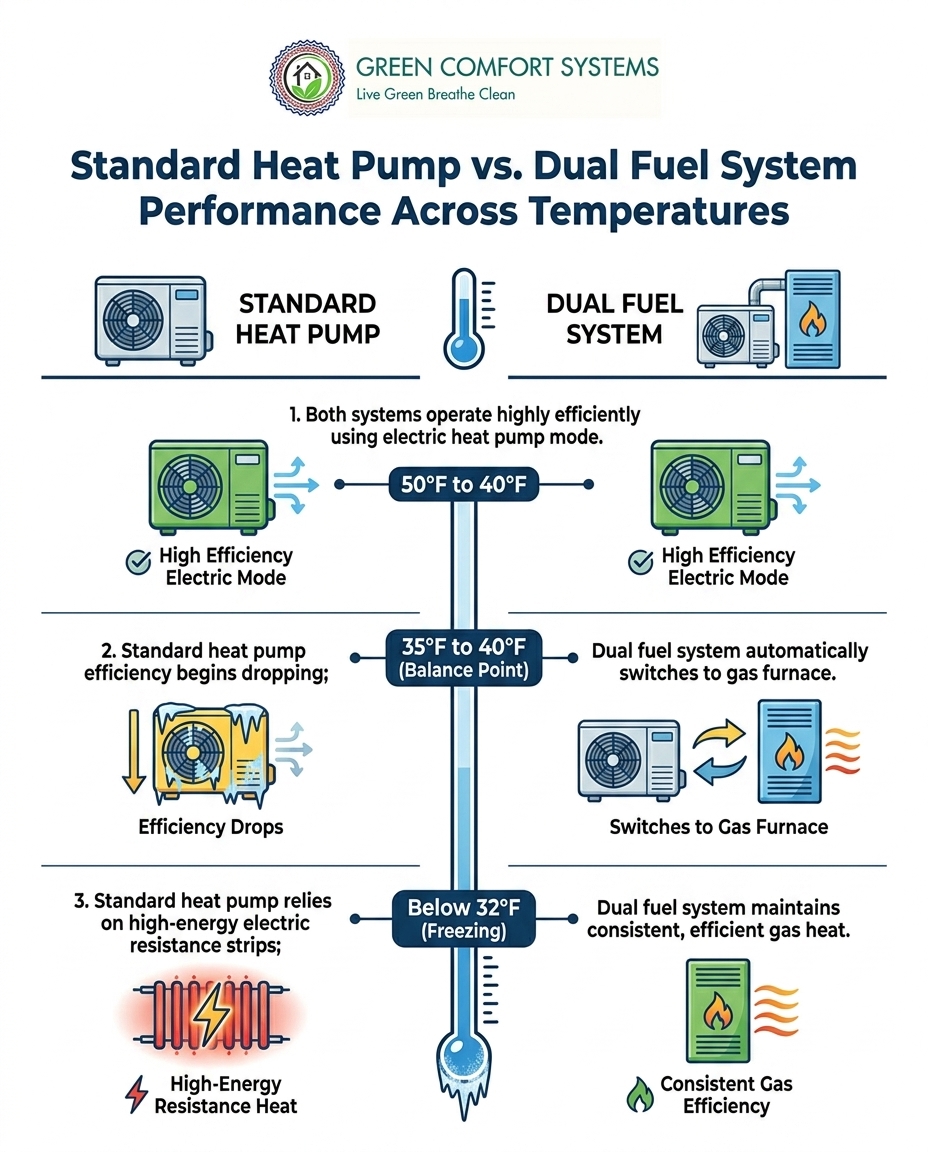
When the temperature drops too low for the compressor to extract enough heat, standard units rely on electric resistance strips to make up the difference. One local homeowner reached out during a winter cold snap when their heating system struggled to keep up. Technicians quickly provided the necessary parts to restore functionality, explaining how sudden temperature drops force standard units to rely heavily on these backup heating elements.
While modern heat pump technology has improved significantly, proper sizing and adequate home insulation are absolutely critical if a standalone unit is going to survive extreme temperature drops without constantly triggering its emergency heat mode.
The Hidden Costs of Electric Resistance Heating
Understanding what happens when a standard heat pump falls behind requires looking at the backup mechanism. Here is exactly what occurs when your system relies on electric resistance heating:
1. Activation of auxiliary heat: When the heat pump cannot meet the thermostat's demand, it activates electric resistance strips, which function similarly to the glowing coils inside a toaster.
2. Sudden energy spikes: These heat strips can use up to three times more electricity than the heat pump's normal compressor operation. During a sudden cold snap, thousands of homes switching to resistance heating simultaneously put an immense strain on local utility grids.
3. Comfort and air quality shifts: Electric resistance heat tends to feel incredibly dry. Unlike the steady, gradual warmth provided by a heat pump's normal cycle, auxiliary heat can dry out your indoor air, making your home feel less comfortable during the coldest parts of the night.
The Mechanics of Dual Fuel (Hybrid) Heating Systems
A dual fuel heating system, often called a hybrid system, solves the specific problems standard heat pumps face during extreme temperature drops. This setup pairs a high-efficiency electric heat pump with a robust gas furnace backup, creating an adaptable system designed for volatile climates.
The core advantage of a hybrid system is its automatic "balance point" switch. Your thermostat actively monitors the outdoor temperature. When the weather is mild—typically above 35 to 40 degrees Fahrenheit—the system uses the electric heat pump to efficiently warm your home. The moment the temperature drops below that preset balance point, the system seamlessly shuts off the heat pump and ignites the gas furnace.
This seamless transition prevents the system from ever relying on inefficient electric resistance strips. Because a gas furnace produces a hotter, more intense heat, it effortlessly combats the rapid temperature drops common during September pre-heating season prep and deep winter nights. Furthermore, gas furnaces do not dry out the air as aggressively as electric resistance strips, which helps maintain consistent comfort and better humidity control. Managing this humidity is a crucial component of comprehensive indoor air quality solutions for your home.
Side-by-Side Comparison: Efficiency, Comfort, and Adaptability
To help you weigh your options for your home in Rosedale MD and surrounding areas, it helps to look at exactly how these two systems stack up against each other under specific conditions.
• Mild Weather Performance (Above 40°F) — Standard Heat Pump: Highly efficient. Extracts ambient heat with minimal electricity. — Dual Fuel (Hybrid) System: Highly efficient. Operates identically to a standard heat pump.
• Freezing Weather Performance (Below 32°F) — Standard Heat Pump: Relies on energy-heavy electric resistance strips to maintain warmth. — Dual Fuel (Hybrid) System: Switches to the gas furnace for rapid, powerful, and consistent heating.
• Economic Balance Point — Standard Heat Pump: Can result in sudden utility spikes during prolonged cold snaps. — Dual Fuel (Hybrid) System: Optimizes utility costs by automatically switching to the cheapest fuel source.
• Carbon Footprint — Standard Heat Pump: Fully electric, but high grid strain during extreme cold events. — Dual Fuel (Hybrid) System: Reduces overall electricity demand during peak winter grid usage.
• Indoor Comfort — Standard Heat Pump: Can produce dry air when auxiliary heat strips are active. — Dual Fuel (Hybrid) System: Maintains better humidity levels and delivers hotter air from the registers.
Ductless and Zoned Alternatives for Specific Heating Needs
Not every home requires a complete overhaul of its central ductwork to achieve winter comfort. For historic homes, new additions, or historically hard-to-heat areas, related technologies can supplement your main system. Ductless technology allows you to heat specific zones without interfering with the central HVAC unit.
Modern mini-splits are incredibly efficient at handling cool fall weather and mild winter days. By utilizing zoning, homeowners can customize comfort exactly where it is needed most. For example, basements and upper-floor master suites often experience drastic temperature differences compared to the main floor. Zoning allows you to push heat specifically to those stubborn areas.
Another area homeowner opted for a spring installation of a mini-split system to prepare for both summer cooling and fall heating. The technicians addressed the home's specific layout challenges professionally, resulting in a quiet, cool living space during the summer and a consistently heated basement once the weather turned cold. If your home has uneven temperatures, exploring ductless mini splits might be the perfect targeted solution for Rosedale MD and surrounding areas.
Aligning Your Heating Choice with Eco-Friendly Energy Goals
Upgrading your heating equipment is not just about personal comfort; it is also an opportunity to align your home with broader eco-friendly energy goals. Smart fuel-switching is the defining feature of a dual fuel system. By automatically alternating between electricity and gas based on which is most efficient at any given moment, these systems optimize energy use and reduce your home's overall carbon footprint.
Green Comfort Systems specializes in eco-friendly, energy-efficient HVAC upgrades, helping homeowners navigate these green technology strategies organically. Transitioning to a high-efficiency system is a major step toward environmental responsibility. If you want to learn more about the environmental impact, you can read about why a heat pump is the greenest upgrade for your Maryland home.
Additionally, qualifying high-efficiency heat pumps and hybrid systems may be eligible for generic federal tax credits and local utility rebates. Because incentive programs change frequently, you should always consult with local experts and tax professionals to verify current incentive programs before installing. Making this investment during your September pre-heating season prep ensures you have the time to research and apply for any available programs.
Why Early Fall is the Critical Window for System Replacement
Timing is everything when it comes to HVAC upgrades. Waiting until late October or November to evaluate your heating system risks exposure to unpredictable frosts. Once the cold weather settles in, HVAC schedules fill up rapidly, and emergency replacements limit your ability to carefully choose the best system for your home.
Here is why early fall is the optimal time to act:
• Proper load calculations: Evaluating whether a standard heat pump or a dual fuel system is right for you requires a precise Manual J load calculation. This takes time to perform correctly.
• Thoughtful equipment selection: Rushing a decision during a breakdown often leads to installing whatever unit is currently sitting on a supply house shelf, rather than the most efficient model for your specific floor plan.
• Seamless installation: September pre-heating season prep provides ample time for proper installation, testing, and ductwork adjustments before the equipment is pushed to its limits.
Preparing now ensures your home is ready to handle thermal swings efficiently from day one, giving you peace of mind as the seasons change.
Frequently Asked Questions About Winter Heating Upgrades
At what temperature does a dual fuel system switch to gas?
A dual fuel system typically switches to gas when the outdoor temperature drops between 35 and 40 degrees Fahrenheit. This specific threshold is known as the balance point. At this temperature, the system determines that the gas furnace is more efficient and capable of heating the home than the electric heat pump. Your technician can adjust this balance point based on your local utility rates and home insulation.
Are standard heat pumps effective in Maryland winters?
Yes, standard heat pumps are effective in Maryland, but they face challenges during rapid, deep temperature drops. Because the region experiences sudden shifts from mild to freezing, a standalone heat pump will occasionally rely on its auxiliary electric heat strips. To remain effective without causing massive energy bills, a standard heat pump must be perfectly sized and installed in a well-insulated home.
What is the balance point for a heat pump?
The balance point is the specific outdoor temperature at which a heat pump can no longer extract enough ambient heat to meet the home's heating demand on its own. Below this point, the system must engage a backup heating source. For most modern systems in Rosedale MD and surrounding areas, this economic and thermal balance point hovers around 35 degrees Fahrenheit.
Is a dual fuel system worth the investment?
A dual fuel system is highly valuable in transition climates that experience erratic temperature swings. By automatically switching to the most efficient fuel source, it prevents the high costs associated with electric resistance heating. For many homeowners, the long-term utility savings and superior comfort during freezing nights make the initial investment worthwhile.
How do sudden temperature drops affect my heat pump's efficiency?
Sudden temperature drops force a standard heat pump to work continuously to extract diminishing ambient heat. As the temperature nears freezing, the compressor's efficiency drops significantly. If the temperature falls too rapidly, the system will trigger its emergency electric heat strips, which consume up to three times more electricity than normal operation.
Why is September the best time to upgrade to a dual fuel system?
September offers a critical window before the unpredictable frosts of late fall arrive. Upgrading during this pre-heating season prep period allows for accurate load calculations, thoughtful equipment selection, and proper installation without the pressure of a freezing home. It ensures your new system is tested and ready before the first major thermal swing hits.
Secure Your Winter Comfort with the Right Heating Solution
You do not have to make the complex choice between Dual Fuel Systems vs. Standard Heat Pumps for Unpredictable Maryland Winters on your own. Evaluating the specific thermal dynamics of your home, your existing ductwork, and your energy goals requires a professional perspective. The erratic weather in Rosedale MD and surrounding areas demands a heating system that can pivot as quickly as the forecast does.
Take control of your home's comfort by talking to a local expert to evaluate your specific thermal needs. Schedule a comprehensive inspection today to explore your options and ensure your home is equipped with a clear, regionally-specific heating strategy. Secure your comfort and efficiency long before the freezing weather arrives.
Book Expert Service Or Contact Us
Other Blogs


Get Financing Today
Get the comfort you deserve, without the financial stress.

Latest Blogs
Why Fast Access to Replacement Parts Matters for Your Rosedale Heating Repair

Pre-Winter HVAC Inspections: Finding the Hidden Wear and Tear Before the November Rush

Choosing Between Emergency Weekend Repair and Monday Scheduling for a Failing Heat Pump in Severna Park
