




Demystifying the Tax Credits for High-Efficiency Heat Pumps in Maryland

Surviving Late-Summer AC Failures: To Replace or Upgrade?
Your air conditioner is running nonstop, but the house still feels uncomfortably warm. If you are dealing with a failing system right now, demystifying the tax credits for high-efficiency heat pumps in Maryland is the first step toward turning a stressful breakdown into a smart home upgrade. We are deep into the August late-summer cooling transition, and that strange rattling noise from your outdoor unit isn't going away on its own. When an aging system struggles to keep up with the heat, homeowners are forced to make a critical choice: install a standard replacement or upgrade to a modern, dual-purpose climate control system.
Looking for reliable heating services to prepare for the changing seasons, or considering an upgrade to high-efficiency heat pumps? We can help.
Dealing with a failing HVAC unit is stressful, especially when the back-to-school season is already keeping your family busy. At Green Comfort Systems, our team typically sees a spike in emergency calls every August from Rosedale homeowners whose aging units finally give out under the late-summer strain. Whether you are facing an end-of-season heatwave or preparing for the cooler transition months ahead, a sudden breakdown forces you to evaluate your home's long-term comfort strategy.
The core decision points:
• Standard Replacement: Swapping your broken AC for a similar, baseline-efficiency model. It solves the immediate cooling problem but does nothing to improve your winter heating or reduce your long-term energy consumption.
• High-Efficiency Upgrade: Replacing the failing AC (and potentially an aging furnace) with a single, high-performance heat pump. This path often unlocks significant utility incentives and federal tax credits.
Navigating these upgrade options can feel overwhelming, especially when government guidelines are filled with complex terminology. Fortunately, understanding how these incentives work doesn't require a degree in engineering or finance. By breaking down the basic requirements, you can make an informed decision that improves your daily comfort while taking advantage of available programs.
What Makes a Heat Pump Eligible for Federal Tax Credits?
The core intent behind energy initiatives is straightforward: rewarding homeowners for upgrading to energy-efficient home comfort systems. The government wants to reduce the overall strain on the electrical grid and lower residential carbon footprints. To achieve this, federal tax credits may apply to qualifying installations that meet strict performance standards.
In our years of installing climate control systems across Maryland, we often find that homeowners assume any new unit qualifies for incentives. However, it is crucial to understand that not every heat pump makes the cut. Eligibility is strictly tied to high-efficiency performance metrics, meaning baseline or entry-level models typically do not qualify. The system you choose must demonstrate superior ability to heat and cool your home using minimal electricity.
Understanding the Government's Efficiency Goals
Unlike traditional furnaces that burn fossil fuels to generate heat, heat pumps transfer heat from one place to another. During the late summer, they pull heat out of your home. During the winter, they extract ambient heat from the outside air and move it indoors. Because moving heat requires significantly less energy than creating it, heat pumps are inherently efficient. The federal guidelines are designed to incentivize the installation of the absolute most efficient models within this category.
For homeowners in communities like Rosedale, MD, these federal guidelines can often be leveraged alongside potential local utility programs. State and local initiatives frequently mirror federal standards, meaning a system that qualifies for one program is highly likely to qualify for others. The key is ensuring the specific make and model of the equipment meets the necessary benchmarks before the installation begins. We always advise readers to verify current programs with their utility or a tax professional.
Decoding the Efficiency Jargon: CEE Tiers and Energy Star Ratings
Translating the dense, confusing government language into practical guidance is essential for homeowners. When our technicians sit down to review quotes with you, you will see a flurry of acronyms and ratings. Knowing exactly what equipment specifications to look for ensures you don't accidentally install a system that falls short of incentive requirements.
Key ratings to look for on your equipment quote:
• SEER2 (Seasonal Energy Efficiency Ratio 2): This measures cooling efficiency. The higher the SEER2 number, the less electricity the unit uses to cool your home during the summer.
• HSPF2 (Heating Seasonal Performance Factor 2): This measures heating efficiency. A higher HSPF2 rating means the system is better at keeping your home warm during the winter without spiking your utility bills.
• AHRI Certificate: The Air-Conditioning, Heating, and Refrigeration Institute provides a certification number proving that the outdoor unit and indoor air handler work together to achieve the advertised efficiency ratings.
Understanding these metrics is incredibly helpful when discussing options with our team, especially when weighing how BGE rebates and federal tax credits factor into your final decision.
Why Energy Star Isn't Always Enough
Most homeowners are familiar with the blue Energy Star logo. While Energy Star certification is the baseline requirement for most energy efficiency incentives, it is not always enough to claim the highest level of federal tax credits. The government often requires the system to meet stricter standards established by the Consortium for Energy Efficiency (CEE).
The CEE is an organization that sets performance tiers above and beyond basic Energy Star requirements. To qualify for many tax credits, a heat pump must meet or exceed the CEE's highest efficiency tier for your specific region.
• Standard Efficiency — What It Means for Your Upgrade: Meets minimum legal requirements to be sold. Does not qualify for federal tax credits or most utility rebates.
• Energy Star Certified — What It Means for Your Upgrade: More efficient than standard models. May qualify for some local utility rebates, but often falls short of strict federal requirements.
• CEE Highest Tier — What It Means for Your Upgrade: Represents top-tier performance. Meets the stringent requirements necessary for federal tax credit eligibility.
At Green Comfort Systems, we make sure to verify the specific CEE tier of your quoted equipment before you sign a contract. A reputable contractor will gladly provide the manufacturer specification sheets proving the system meets the highest tier requirements.
Year-Round Comfort: Matching Heat Pump Capabilities to Maryland's Climate
When investing in a new HVAC system, it is vital to ensure the equipment is perfectly suited to your local weather. Maryland's mixed climate presents a unique challenge for home comfort systems. Our region is known for hot, humid late summers and freezing, biting winters. This environment demands a robust, dual-purpose climate control solution that can handle severe temperature swings.
High-efficiency heat pumps are uniquely designed to manage these extremes. By providing both powerful cooling and reliable heating, they completely replace the need for separate air conditioning and furnace systems. During the August late-summer cooling transition, a high-efficiency heat pump acts as a powerful dehumidifier and air conditioner. When January arrives, the system reverses its operation, extracting heat from the cold winter air to keep your home warm.
Certain configurations offer even more targeted efficiency that performs exceptionally well in varying seasonal extremes. For example, ductless mini splits allow you to control the temperature in specific zones of your home, ensuring you only use energy where you actually need it.
A pattern we see often with standard, aging systems is that they blast cold air and then shut off, creating uncomfortable temperature fluctuations and failing to remove adequate humidity. High-efficiency heat pumps run at lower, more consistent speeds, providing even, comfortable temperatures. Just recently, our installation crew helped a Rosedale family transition to a high-efficiency heat pump after their old AC failed right before the kids went back to school. When properly sized and maintained by our team, these systems provide unparalleled resilience against extreme weather.
The Upgrade Process: Your HVAC Contractor vs. Your Tax Professional
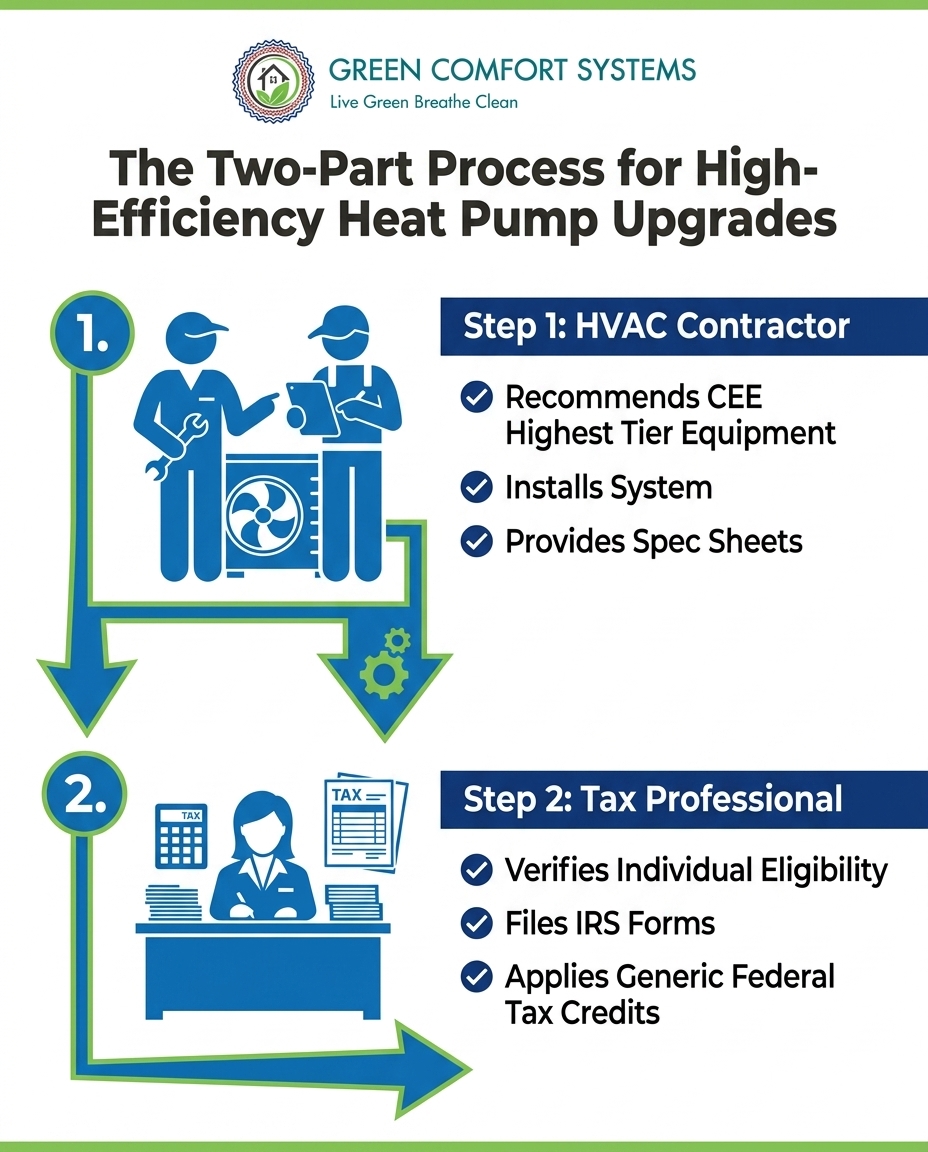
A common source of confusion for homeowners is understanding who handles the paperwork for energy incentives. It is important to clearly separate the roles of the installer and the certified public accountant (CPA) to set proper expectations regarding claiming any tax credits.
The HVAC Contractor's Role:
Your heating and cooling contractor is responsible for the physical equipment and the technical documentation. A reputable HVAC company will help you understand the financing options upfront and supply a system that meets the strict CEE highest tier standards. Following the installation, your contractor must provide you with the itemized invoice, the AHRI certificate, and the manufacturer specification sheets proving the system's efficiency ratings.
When our Green Comfort Systems installation team sets up a new high-efficiency unit, we ensure you have the exact documentation required for your records. As your contractor, our primary job is ensuring your equipment operates safely and efficiently, and providing the technical proof of that efficiency.
The Tax Professional's Role:
Your tax professional is responsible for applying the federal tax code to your individual financial situation. Even if your equipment meets every technical requirement, your ability to claim a tax credit depends on your specific tax liability for the year. The CPA will verify your eligibility, ensure the equipment was installed in your primary residence, and file the appropriate IRS forms alongside your annual tax return.
• Equipment Selection — HVAC Contractor: Recommends CEE Highest Tier models — Tax Professional (CPA): None
• Installation & Setup — HVAC Contractor: Installs and calibrates the system — Tax Professional (CPA): None
• Documentation — HVAC Contractor: Provides AHRI certificates and spec sheets — Tax Professional (CPA): Files appropriate IRS tax forms
• Financial Verification — HVAC Contractor: Explains upfront installation financing — Tax Professional (CPA): Verifies individual tax liability and eligibility
We must explicitly advise readers to verify current programs with their utility or a tax professional. Never assume you automatically qualify for a specific financial return without consulting a licensed CPA.
The Broader Impact of 'Going Green' with Your HVAC System
While generic federal tax credits and utility rebates are excellent motivators, the decision to upgrade to a high-efficiency heat pump extends far beyond financial incentives. Upgrading your home's climate control is a core part of a holistic, eco-friendly lifestyle that benefits both the environment and your daily indoor comfort.
By transitioning away from fossil fuel-burning furnaces and inefficient, aging air conditioners, you significantly reduce your home's overall carbon footprint. High-efficiency heat pumps utilize advanced refrigerants and variable-speed compressors that draw substantially less electricity from the local grid. For homeowners in Rosedale, MD, this means actively contributing to a more sustainable, resilient community infrastructure.
Furthermore, modern efficient systems integrate seamlessly with advanced indoor air quality solutions. Because high-efficiency heat pumps often run continuously at lower speeds rather than turning on and off abruptly, they constantly circulate air through your home's filtration system. This continuous airflow captures more dust, pollen, and airborne contaminants, providing a significantly healthier living environment for your family.
At Green Comfort Systems, our focus on eco-friendly, 'go green' HVAC solutions is built on the belief that sustainable upgrades should improve your quality of life. The financial incentives provided by the government are simply a bonus to the long-term environmental and comfort benefits you will experience every day.
Frequently Asked Questions About Heat Pump Tax Credits
What makes a heat pump qualify for federal tax credits?
To qualify for federal tax credits, a heat pump must generally meet or exceed the highest efficiency tier established by the Consortium for Energy Efficiency (CEE). Additionally, the system must be installed in your primary residence. Secondary homes or rental properties typically do not meet the strict criteria for these specific homeowner incentives.
Does Maryland offer incentives for high-efficiency heat pumps?
Yes, state and local utility energy programs frequently offer complementary incentives for qualifying energy-efficient upgrades. Homeowners should always check directly with their local utility provider or a tax professional for current program details and technical requirements, as these programs are subject to change.
How do I know if my new heat pump is eligible for federal incentives?
Our HVAC technicians will provide the equipment's exact SEER2, HSPF2, and CEE tier ratings before installation. You can cross-reference the provided model numbers with the Energy Star and CEE directories to confirm the unit's performance tier. Always secure this documentation in writing before finalizing your upgrade contract.
Should I replace my AC with a heat pump?
If your air conditioner is failing and your furnace is aging, replacing both with a single, high-efficiency heat pump is often the most efficient choice. Heat pumps provide both heating and cooling in one unified system, streamlining your home's mechanical footprint. This dual-purpose functionality makes them an ideal solution for year-round climate control.
Do I need a tax professional to claim the heat pump credit?
Yes, we highly recommend consulting a CPA or tax professional when claiming energy incentives. A tax expert will ensure you meet all individual tax liability requirements and file the correct IRS forms alongside your annual return. Our team at Green Comfort Systems provides the equipment documentation, but your CPA handles the actual financial filing.
Take the Next Step Toward an Eco-Friendly, High-Efficiency Home
Understanding the jargon behind government energy programs is the first step to making an informed, eco-friendly HVAC upgrade. By knowing the difference between standard Energy Star ratings and the CEE highest tier, you can confidently navigate the equipment selection process. Remember, a successful upgrade relies on a two-part partnership: pairing expert installation and technical documentation from your HVAC contractor with professional financial filing from your tax advisor.
If you are currently dealing with late-summer AC issues and dreading another breakdown, now is the time to explore your options. A clear, jargon-free explanation of what makes a heat pump high-efficiency ensures you know exactly what to ask for. Schedule an inspection with Green Comfort Systems today to evaluate your failing equipment, discuss qualifying high-efficiency upgrades, and take control of your home's year-round comfort.
Book Expert Service Or Contact Us
Other Blogs


Get Financing Today
Get the comfort you deserve, without the financial stress.

Latest Blogs
Why Fast Access to Replacement Parts Matters for Your Rosedale Heating Repair

Pre-Winter HVAC Inspections: Finding the Hidden Wear and Tear Before the November Rush

Choosing Between Emergency Weekend Repair and Monday Scheduling for a Failing Heat Pump in Severna Park
