





Managing the September Swing: Keeping Your Rosedale Home Comfortable When Days Are Hot and Nights Are Cold

The Challenge of Early Fall: Navigating Rosedale's Unpredictable September Weather
The transition into autumn brings a specific challenge, and managing the September swing: keeping your Rosedale home comfortable when days are hot and nights are cold requires a proactive strategy. During these September transitional weeks, you might find yourself sweating through an 80-degree afternoon, only to reach for a heavy blanket when temperatures drop to the 50s overnight. This dramatic daily shift creates a frustrating concrete problem for homeowners: constantly toggling the thermostat between air conditioning and heating modes, trying to manually outsmart the weather. The decision point you face right now is choosing the correct thermostat strategy to handle these daily temperature swings without fighting your system or driving up your utility bills.
Establishing reliable heating performance for the upcoming winter starts with how you manage your equipment during this unpredictable shoulder season.
In Rosedale, MD, early fall weather is rarely straightforward. We often experience lingering Maryland humidity that makes daytime cooling absolutely critical for indoor comfort, even when the forecast promises a chilly night. When high humidity levels are trapped inside your home, 75 degrees can feel sticky and uncomfortable. This means you cannot simply turn your cooling system off for the season at the first sign of autumn. Instead, you need a method of automated climate control that maintains consistent comfort, removes excess moisture during the heat of the day, and seamlessly provides warmth as the sun goes down.
Why Manual Thermostat Toggling Harms Your HVAC System
A typical pattern we see often during the fall is homeowners manually switching their thermostats from "Cool" to "Heat" and back again, sometimes multiple times a day. While this might feel like the most direct way to manage 80-degree afternoons dropping to 50-degree nights, it is actually one of the worst things you can do for your HVAC equipment.
The Mechanics of Short-Cycling
When you manually force your system to react to extreme temperature swings, you often trigger a process known as short-cycling. This happens when the HVAC system turns on and off too rapidly without completing a full heating or cooling cycle. Every time your compressor or furnace fires up, it draws a massive surge of electricity and puts immense physical strain on the internal components. If you are constantly adjusting the dial to chase a comfortable temperature, you are forcing the system to start and stop repeatedly.
Accelerated Wear and Tear
Your air conditioning system and heating unit are designed to run in long, steady cycles. Manually toggling between modes stresses the contactors, capacitors, and blower motors. Over time, this unnecessary mechanical wear-and-tear leads to premature component failure. You are essentially treating a marathon runner like a sprinter, forcing heavy equipment to make sudden, jerky adjustments to 30-degree daily swings.
The Energy Waste and Efficiency Loss
Beyond the mechanical damage, manual toggling destroys your home's energy efficiency. HVAC systems consume the most power during startup. By avoiding manual toggling, you reduce energy waste, which aligns perfectly with eco-friendly and energy-efficient best practices. Allowing your home to stabilize naturally uses far less power than forcing your unit to aggressively cool a hot house at 3 PM and aggressively heat a cold house at 9 PM.
• Manual Toggling — System Strain: High (Frequent starts/stops) — Energy Efficiency: Poor (Wastes energy on startup) — Comfort Level: Inconsistent (Hot/cold spots)
• Auto Changeover — System Strain: Low (Runs in steady cycles) — Energy Efficiency: Excellent (Optimizes run times) — Comfort Level: Consistent (Maintains steady baseline)
Mastering Auto Changeover Mode and Temperature Deadbands
The most effective tool you have for the September transitional weeks is likely already on your wall: the "Auto" changeover mode on your thermostat. Unlike standard "Heat" or "Cool" settings, Auto mode allows your system to seamlessly transition between your furnace and your air conditioner based on the indoor temperature, without any manual intervention.
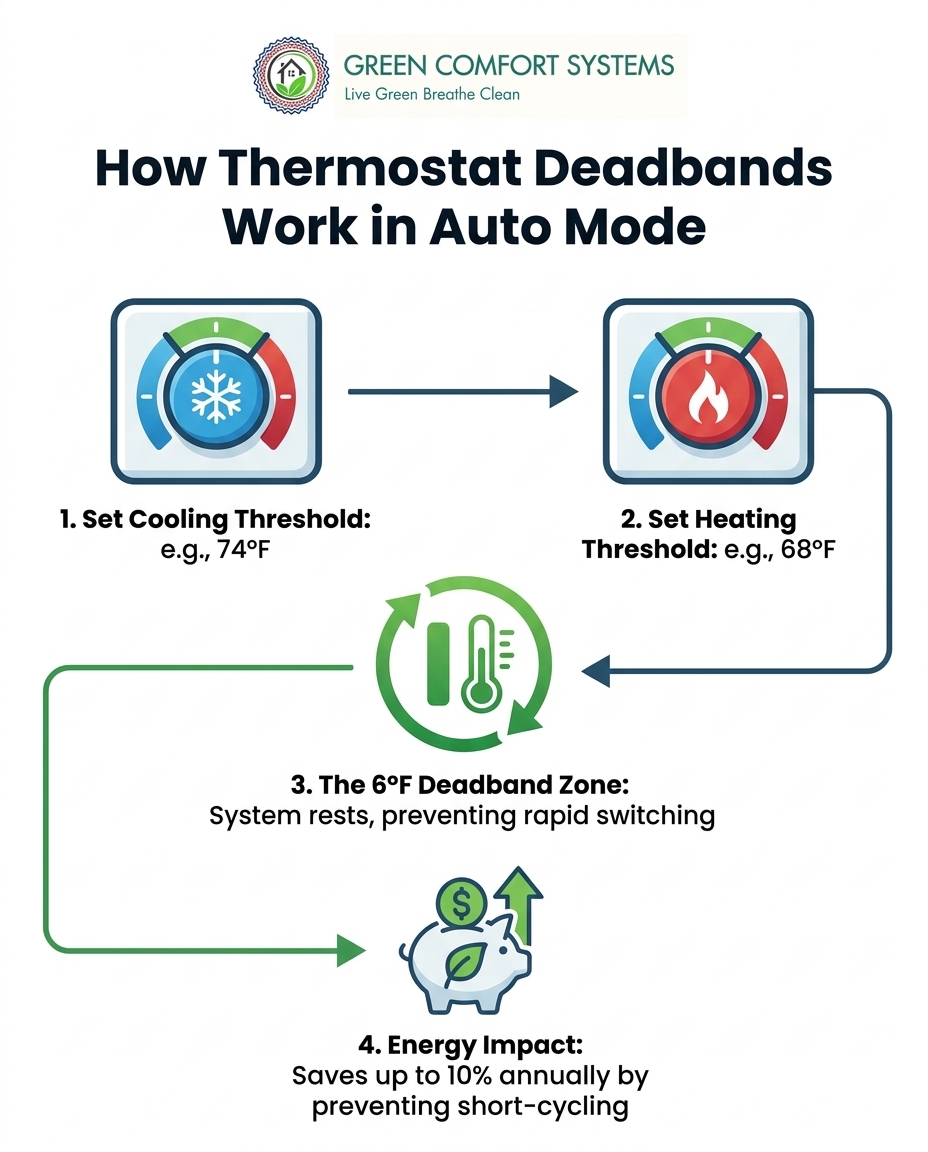
However, to use Auto mode correctly, you must understand and set a temperature "deadband." A deadband is a mandatory buffer zone—usually 3 to 5 degrees—between your cooling setpoint and your heating setpoint. Without this gap, your system would constantly fight itself, turning on the AC to cool the house, overshooting slightly, and immediately triggering the heat.
Setting the Perfect Fall Deadband
1. Select your cooling threshold: Determine the highest temperature you can tolerate during a warm afternoon before you want the AC to kick in. For many homes, 74°F or 75°F is a comfortable upper limit.
2. Select your heating threshold: Determine the lowest temperature you can tolerate at night before you need the furnace. A common setting is 68°F or 69°F.
3. Verify the gap: Ensure there is at least a 4-to-5 degree gap between these two numbers. In this example, your home will naturally float between 69°F and 74°F. The system rests completely while the house is in this zone, preventing the compressor and furnace from running simultaneously.
By establishing this buffer, you allow your home's natural thermal mass to absorb the mild weather, keeping the equipment off until it is absolutely necessary.
Smart Scheduling and Fan Circulation for Better Airflow
Even with Auto mode engaged, certain rooms in your Rosedale, MD home might feel stuffy during the afternoon or excessively chilly at night. Before you adjust the temperature setpoints, look to your thermostat's fan settings. Strategic fan circulation is one of the most underutilized tools for managing transitional weather.
Most thermostats have a fan setting that can be toggled from "Auto" to "On." When set to "Auto," the blower motor only runs when the compressor or furnace is actively heating or cooling. When set to "On," the blower circulates air continuously throughout the ductwork, regardless of whether the system is actively conditioning the air. Utilizing continuous fan circulation helps balance temperatures throughout the home, pulling cooler air from the basement and mixing it with the warmer air rising to the second floor. This natural ventilation strategy saves money and reduces environmental impact by using a low-wattage fan motor instead of the high-draw outdoor compressor.
Optimizing Your Daily Schedule
If you have a programmable or smart thermostat, aligning your temperature schedules with the daily weather patterns can yield significant savings. For example, if your house is empty during the day, setting back the thermostat by 7 to 10 degrees during away hours prevents the system from running unnecessarily.
• Afternoon heat management: Program the cooling setpoint slightly higher during peak afternoon heat, allowing the house to warm up just a bit while no one is home.
• Evening preparation: Program the system to return to a comfortable baseline about 30 minutes before you arrive home, preparing the space for the rapid evening temperature drop.
For families managing busy autumn routines, adjusting your thermostat schedule for the back-to-school season ensures that your home is perfectly conditioned right when you walk through the door, without wasting energy on an empty house.
Managing Indoor Air Quality During the Seasonal Shift
As the weather cools down, the natural instinct is to keep windows tightly shut. While this helps retain heat during the chilly September transitional weeks, it also creates a hidden problem: trapped indoor pollutants. When your home is sealed up and your HVAC system is resting in its deadband zone, the air inside can quickly become stagnant.
The Importance of Fresh Air Filters
During early fall days when windows remain closed, everything from pet dander and dust mites to volatile organic compounds (VOCs) from cleaning supplies gets trapped indoors. Before the heavy heating season begins, it is vital to inspect and replace your HVAC air filters. A clogged filter not only forces your blower motor to work harder, but it also allows these microscopic pollutants to recirculate through your living spaces continuously. Upgrading to a filter with a higher MERV rating can capture more of these irritants before they reach your lungs.
Balancing Indoor Humidity Levels
As outdoor air begins to dry out heading into late fall, balancing indoor humidity becomes a delicate act. Too much humidity left over from the summer makes the air feel heavy and warm, while too little humidity makes the cooler air feel harsh and cold on your skin. Proper indoor air quality control often involves utilizing whole-home dehumidifiers or humidifiers that work in tandem with your HVAC system to keep indoor moisture levels in the ideal 30% to 50% range. Maintaining this balance ensures that your home feels comfortable at your chosen thermostat setpoints.
Why Versatile Systems Excel in Transitional Climates
Older, separated HVAC units—like a traditional AC paired with a standard single-stage furnace—often struggle with the nuance required for fall weather. They operate on a strict "all or nothing" basis. When they turn on, they blast at 100% capacity, which is often overkill for a mild 70-degree afternoon in Rosedale, MD.
Modern, adaptable systems handle temperature swings much more efficiently. Variable-speed technology allows the compressor and blower motor to run at lower capacities—sometimes as low as 25% or 30%. This means the system can provide a gentle, continuous flow of conditioned air that matches the exact load of the home, rather than blasting full-force and shutting down minutes later. This adaptability prevents the massive energy spikes associated with older units.
Upgrading older homes with versatile units can completely transform how the space feels during the fall. One local homeowner living in an older home needed a more efficient system after their previous setup struggled to keep up. Following a spring 2022 install of a new mini-split system, they used it through a hot, humid summer and right into the cooler months. The outcome was a quiet, cool living space and a consistently heated basement, proving both cost and cooling efficient. Systems like energy-efficient heat pumps are specifically designed to handle both heating and cooling seamlessly, moving heat exactly where it is needed without the jarring transitions of traditional split systems.
Achieve Seamless Comfort This Fall with Smart HVAC Strategies
Handling 80-degree afternoons dropping to 50-degree nights doesn't have to be a daily battle of the thermostat. By setting up a proper deadband in Auto changeover mode, utilizing continuous fan circulation, and staying on top of your indoor air quality, you can maintain a perfectly comfortable home. These actionable strategies protect your equipment from unnecessary mechanical wear-and-tear while preventing energy waste.
If your current system is struggling to keep up with the seasonal shift, proactive maintenance is the key to lasting comfort. Take the time now to explore modern system options or schedule a seasonal consultation to ensure your equipment is fully prepared for the heavy heating months ahead.
Frequently Asked Questions
What temperature should I set my thermostat in the fall?
The ideal fall setting depends on your personal comfort, but aiming for 68°F to 70°F when you are home is generally recommended for optimal efficiency. If you are using Auto changeover mode, set a cooling threshold around 74°F and a heating threshold around 68°F. This creates a comfortable buffer zone that prevents your system from overworking.
Is it bad to switch between AC and heat every day?
Yes, manually toggling between air conditioning and heating multiple times a day puts immense strain on your HVAC system. It forces the equipment into rapid, short cycles that increase wear-and-tear on the motors and electrical components. Using your thermostat's Auto mode is a much safer, more efficient alternative.
How does auto changeover work on a thermostat?
Auto changeover allows your thermostat to automatically activate either the furnace or the air conditioner based on the current indoor temperature. You provide a heating setpoint and a cooling setpoint, separated by a few degrees known as a deadband. The system then monitors the air and engages the appropriate equipment only when the temperature falls outside of that specific range.
Should I turn my AC off completely in September?
You should not completely disable your air conditioning during the early fall weeks. September often brings lingering humidity and sudden temperature spikes that require daytime cooling to keep the indoor air comfortable and dry. Relying on an automated thermostat schedule ensures the AC is available when needed without running unnecessarily.
What is a thermostat deadband and why is it important?
A deadband is a programmed temperature gap—usually 3 to 5 degrees—between your heating and cooling setpoints. It is important because it prevents your HVAC system from rapidly switching back and forth between heating and cooling modes. This resting phase protects your equipment from short-cycling and significantly reduces your daily energy consumption.
Book Expert Service Or Contact Us
Other Blogs


Get Financing Today
Get the comfort you deserve, without the financial stress.

Latest Blogs
Addressing Drafty Windows and Heating Inefficiencies in Older Forest Hill Homes
Managing the September Swing: Keeping Your Rosedale Home Comfortable When Days Are Hot and Nights Are Cold
Electronic Ignition Failures: Why Your Modern Furnace Won't Start on Chilly September Mornings
