





Single-Zone vs. Multi-Zone Mini Splits for Historic Baltimore County Properties

Cooling Older Homes Without Compromising Architectural Character
How do you plan to survive the sweltering heat without damaging the original architecture that made you fall in love with your home in the first place? When our team at Green Comfort Systems helps homeowners evaluate Single-Zone vs. Multi-Zone Mini Splits for Historic Baltimore County Properties, we know you are facing a unique dilemma that standard homeowners rarely encounter. The challenge isn't just about finding equipment powerful enough to cool drafty, uninsulated spaces during August late-summer cooling demands. It is about integrating modern mechanical systems seamlessly into centuries-old aesthetics without violating strict historical commission guidelines.
Upgrading the cooling system in a classic property requires careful planning. Traditional forced-air systems demand massive ductwork, which often means tearing down original plaster, cutting through hand-hewn structural beams, and lowering ceilings. Ductless technology offers a brilliant alternative, but it introduces a new decision point: should you choose one large multi-zone outdoor unit to power the whole house, or multiple smaller single-zone units scattered discreetly around the property? The answer dictates not only your comfort but the exterior visual footprint of your home.
If you are ready to modernize your historic home's climate control, exploring professional air conditioning services with a local expert is the first step toward finding a historically compliant solution.
The Balancing Act of Preservation and Comfort
Many homeowners assume that buying the most efficient equipment is the only priority. However, in Historic Baltimore County districts, the physical size, placement, and visual impact of the outdoor compressor are heavily scrutinized. A system that looks perfectly fine on a modern subdivision home might trigger immediate rejection from a local preservation board if installed on a 19th-century colonial facade. You have to balance the interior comfort you desperately need for the back-to-school transition with the exterior preservation the community demands.
The Unique Constraints of Historic Maryland Homes
Historic homes were built long before the invention of modern air conditioning, and their construction reflects that era. You are dealing with solid masonry walls, true dimensional lumber, and delicate lath-and-plaster interiors. In our years of retrofitting older homes in Rosedale and surrounding areas, our installation crews have learned that these materials are incredibly durable when left alone, but highly fragile when subjected to modern retrofitting. This is exactly why traditional ducted retrofits are often impossible—or at the very least, far too destructive—for older properties.
Ductless systems bypass this structural nightmare. Instead of carving massive chases through your walls for bulky metal ducts, a ductless air handler requires only a single, small 3-inch wall penetration to connect to the outdoor compressor. This minimal intrusion preserves the structural integrity of your original wood framing and prevents your historic plaster from crumbling under heavy vibration.
Eco-Friendly Preservation Matters
At Green Comfort Systems, our technicians focus heavily on eco-friendly HVAC upgrades that specifically prioritize the aesthetic and structural preservation of older historic homes. It is entirely possible to achieve high-efficiency, environmentally responsible cooling without sacrificing the architectural soul of your property. By carefully selecting where that 3-inch penetration occurs, you keep the interior looking pristine while upgrading your energy efficiency.
A pattern we see often for older properties: One homeowner with a classic 1940s property recently needed to upgrade a failing AC setup before the fall transition. Their old window units were noisy, inefficient, and an eyesore on the facade. By opting for a ductless mini split installation, they completely avoided the massive drywall mess and structural damage that retrofitting traditional ductwork would have caused. The home is now quiet and cool, and they even gained efficient basement heating without altering the home's historic footprint.
Single-Zone Systems: Dispersed Footprints for Easier Concealment
A single-zone ductless setup operates on a simple one-to-one ratio: one dedicated outdoor compressor powers exactly one indoor air handler. If you want to cool three different rooms, you will need three separate outdoor units. While this might sound counterintuitive at first, our team typically recommends this approach because it often provides the most flexibility for historical properties.
Why Smaller Units Win the Aesthetic Battle
The primary advantage of the single-zone approach is the physical size of the outdoor equipment. Because each compressor only needs to power one room, these units are compact. They typically feature a single fan and stand much shorter than their multi-zone counterparts. This compact size is a massive advantage when you are trying to hide modern machinery from the street view in Historic Baltimore County districts.
• Pro: Easier concealment. The shorter height of single-zone units means they can easily be hidden behind existing low shrubbery, classic boxwoods, or low historical fencing without requiring custom-built privacy screens.
• Pro: Shorter line-set runs. Because you can place the outdoor unit directly on the other side of the wall from the indoor unit, you minimize the amount of exterior piping visible on your historic masonry or original wood siding.
• Pro: Independent operation. If one unit requires maintenance, the rest of the house remains perfectly cool during the peak of August late-summer cooling.
• Con: Multiple locations required. You must find several discrete, historically compliant locations around the perimeter of your property to place the equipment, which can be challenging on tight urban lots.
For homeowners looking to cool a specific addition or a stubbornly hot top-floor bedroom, single-zone heat pump systems offer a surgical approach to comfort that leaves the rest of the property untouched.
Multi-Zone Mini Splits: Centralized Power with a Larger Profile
In contrast to the dispersed approach, a multi-zone mini split uses one large outdoor compressor to power multiple indoor air handlers—sometimes up to five or eight, depending on the capacity. This centralized approach mimics the setup of a traditional central AC system but without the ductwork.
The Trade-off: Convenience vs. Condenser Size
The main appeal of a multi-zone system is electrical simplicity. You only need to run one dedicated circuit to the side of your house, rather than upgrading your electrical panel to handle four or five separate outdoor units. However, that convenience comes with a significant visual trade-off.
• Pro: Consolidated footprint. You only have to dedicate one area of your yard or side alley to HVAC equipment, preserving the rest of your landscaping.
• Pro: Simplified electrical work. Centralizing the power draw often means less invasive wiring through historic basements and crawlspaces.
• Con: Massive physical dimensions. Multi-zone condensers—especially those built to cool entire historic homes—are often double-fan models. They are significantly taller, wider, and deeper than single-zone units, making them nearly impossible to hide behind standard low shrubs.
• Con: Complex exterior routing. Because one unit powers handlers all over the house, you will have multiple line-sets running across the exterior of your home. Managing these bundled lines on historic facades requires meticulous planning to avoid an industrial, cluttered look.
During a recent consultation for a historic property in our service area, a homeowner and our Green Comfort Systems technicians spent significant time discussing these exact exterior footprint options. Ultimately, they decided that a centralized, all-ductless multi-zone system made the most sense for their specific lot layout. By carefully choosing an obscured rear corner of the property, they allowed for an efficient installation that kept the primary historical facade completely untouched.
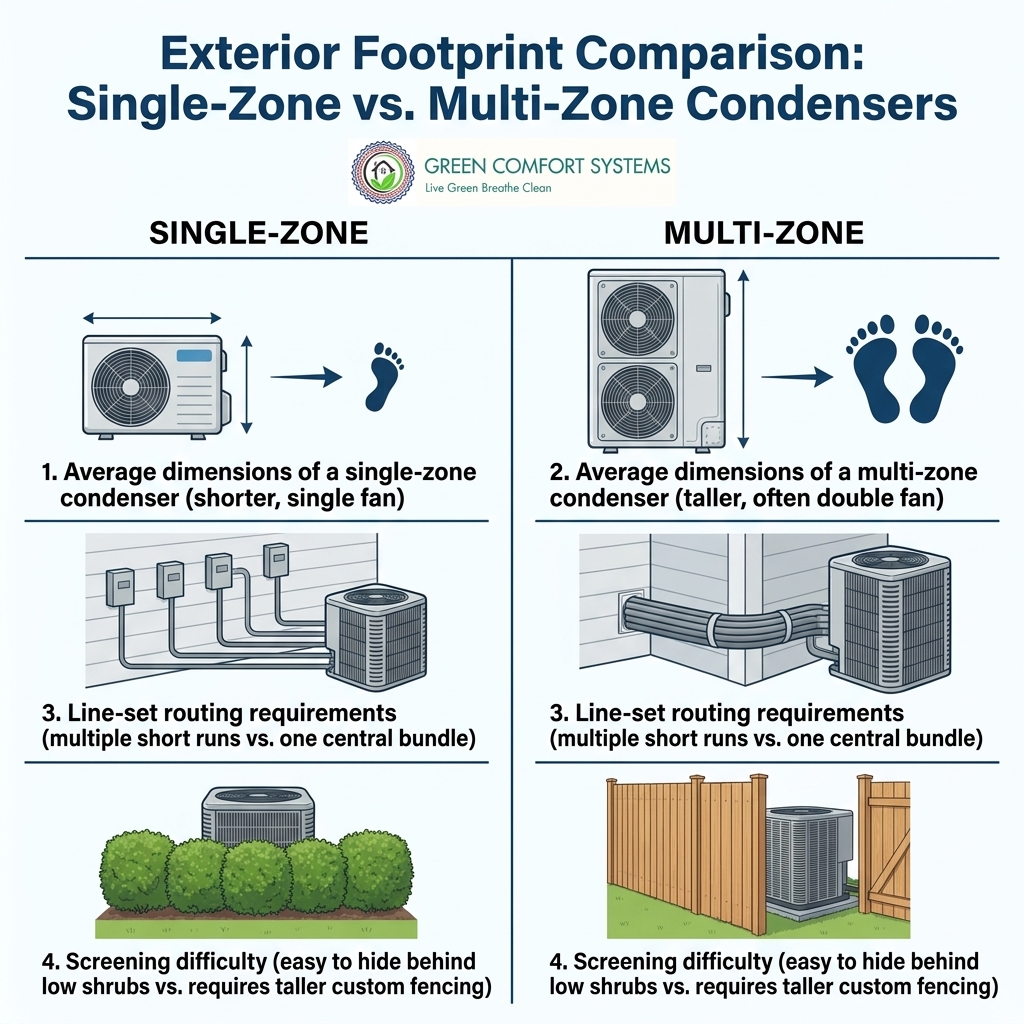
Side-by-Side Comparison: Visual Impact and Line-Hide Routing
To make the best decision for your historic property, you have to look at the concrete differences in how these systems will alter your home's exterior. The choice often comes down to managing the physical bulk of the unit versus managing the visual clutter of the line-sets.
• Condenser Height — Single-Zone Strategy: Shorter (typically single-fan), easy to conceal behind standard landscaping. — Multi-Zone Strategy: Taller (often double-fan), requires custom fencing or tall mature shrubs to hide.
• Line-Set Routing — Single-Zone Strategy: Short, direct runs. Very little piping exposed on the exterior siding. — Multi-Zone Strategy: Long, bundled runs wrapping around the house to reach distant rooms.
• Visual Impact on Masonry — Single-Zone Strategy: Minimal. Small footprint per room cooled. — Multi-Zone Strategy: High potential for clutter if line-hides aren't carefully color-matched and routed along natural architectural lines.
• Electrical Footprint — Single-Zone Strategy: Requires multiple disconnect boxes and circuits around the property perimeter. — Multi-Zone Strategy: Requires only one main disconnect box in a single centralized location.
Mastering the Line-Hide
Regardless of which system you choose, the refrigerant lines, electrical wires, and condensate drains must be protected by a line-hide cover on the exterior of the house. On modern homes, a standard white plastic cover is fine. On a historic brick or stone home, a bright white stripe running up the facade is an eyesore. Our installers know that the key to preserving your home's aesthetic is routing these covers along natural architectural breaks—like abutting a chimney or tucking under an eave—and painting them to perfectly match the original masonry or siding.
Meeting Local Preservation and Permit Requirements
Altering the exterior of a home in Historic Baltimore County districts is not as simple as buying a unit and bolting it to the wall. The Baltimore County Landmarks Preservation Commission (LPC) and similar local historical boards have strict guidelines designed to maintain the neighborhood's historical character. Their primary rule regarding modern mechanical equipment is simple: it must be installed out of public view whenever possible.
Navigating the Approval Process
When you submit a plan to a historical commission, the physical dimensions and placement of the outdoor unit are the primary compliance factors. A massive double-fan multi-zone unit sitting in a side yard visible from the street will almost certainly be rejected. Conversely, a small single-zone unit tucked behind a historically accurate fence or mature plantings is much more likely to gain swift approval.
You will also need to submit clear line-hide routing plans. Preservation boards want to see that you are actively avoiding damage to historic masonry. Drilling through original 18th-century brick must be minimized, and routing lines across primary facades is strictly prohibited. Because navigating these rules can be complex, it is vital to understand the permit requirements for mini split installations in Maryland and work with professionals who respect architectural preservation standards.
Managing Late-Summer Humidity in Older Structures
In our experience servicing classic properties across the region, we've found that beyond aesthetics, there is a very practical, climate-driven reason to carefully consider your mini-split zoning strategy. Older homes were built to "breathe." They lack the modern vapor barriers, tight insulation, and sealed envelopes of new construction. During intense August late-summer cooling periods, the humidity in Baltimore County can easily penetrate these older structures, leading to damp interiors, warped antique wood, and musty odors.
The Power of Variable-Speed Dehumidification
Whether you choose a single-zone or multi-zone setup, modern ductless mini splits utilize variable-speed inverter technology. Unlike old window units that blast cold air and then shut off, inverter-driven compressors run continuously at lower speeds. This constant air circulation is incredibly effective at pulling moisture out of the air without overcooling the room.
Proper zoning is critical here. If you install a multi-zone system that is too large for your home's actual heat load, it will cool the space too quickly and shut off before it has a chance to dehumidify the air—leaving your historic home cold but clammy. Protecting the building envelope from interior moisture damage is just as critical as preserving the exterior brickwork. Integrating proper indoor air quality solutions through precise zoning ensures your home stays dry, comfortable, and structurally sound for decades to come.
Protecting Your Home's Aesthetic and Comfort
Ultimately, there is no one-size-fits-all answer. The right choice depends entirely on your specific lot layout, your existing landscaping, and the strict architectural guidelines governing your neighborhood. Single-zone units offer a smaller footprint that is easier to conceal, while multi-zone systems consolidate your equipment but require careful management of bundled exterior lines.
A clear comparison of visual footprints, line-hide routing, and placement flexibility is the key to a successful, historically compliant upgrade. You don't have to navigate this delicate balance alone. If you are ready to bring modern comfort to your classic home without compromising its character, reach out to consult with our experts at Green Comfort Systems. We can evaluate your historic property, review local guidelines, and design a system that keeps you perfectly comfortable while honoring your home's legacy. Keep in mind that federal tax credits or local utility incentives may also apply to qualifying heat pump installations, so be sure to verify current programs with your utility provider or a tax professional to maximize your investment.
Frequently Asked Questions
Can you put a mini split on a historic home in Maryland?
Yes, you can absolutely install a mini split on a historic Maryland home, provided you follow local preservation guidelines. Ductless systems are highly recommended for older properties because they only require a 3-inch hole through the wall, avoiding the massive structural damage caused by traditional ductwork. The key to approval is placing the exterior equipment out of public view and painting line-hides to match the original siding or masonry.
Are multi-zone mini splits bigger on the outside?
Multi-zone mini splits are significantly larger on the outside than single-zone units. Because they house a more powerful compressor to handle multiple indoor air handlers, they are often taller, wider, and frequently feature a double-fan design. This larger footprint makes them harder to conceal behind standard low shrubs, which is a major consideration for historic preservation compliance.
How do you hide mini split lines on an old house with plaster walls?
You hide mini split lines by routing them strategically along the exterior and covering them with a paintable line-hide casing. Instead of running lines diagonally across a historic facade, professionals route them vertically alongside natural architectural features like chimneys, downspouts, or corner boards. Once installed, the casing is painted to perfectly match the exterior brick, stone, or wood, rendering it nearly invisible from the street.
Is a single-zone better than a multi-zone mini split for architectural preservation?
Single-zone systems are often better for architectural preservation because their compact outdoor units are much easier to hide. A single-fan unit can easily sit behind a small boxwood bush, keeping it completely out of sight from historic district inspectors. While it requires placing multiple units around the property, the smaller individual footprint is usually much easier to get approved than one massive multi-zone compressor.
Can I install ductless AC in a Baltimore County historic district?
You can install ductless AC in a Baltimore County historic district, but you must submit your plans to the Landmarks Preservation Commission (LPC) for approval first. The commission will review where you plan to place the outdoor condenser and how you intend to route the exterior line-sets. As long as the equipment is screened from public rights-of-way and does not damage primary historic facades, approval is highly likely.
What are the Landmarks Preservation Commission rules for HVAC condensers?
The Landmarks Preservation Commission generally requires that all modern HVAC condensers be installed where they are not visible from the public right-of-way. If the unit must be placed in a visible side yard, it must be adequately screened using historically appropriate fencing or dense landscaping. Additionally, any structural penetrations must be minimized to avoid irreversible damage to original historic building materials.
Book Expert Service Or Contact Us
Other Blogs


Get Financing Today
Get the comfort you deserve, without the financial stress.

Latest Blogs

Troubleshooting Your October Heating Startup in Rosedale: What's Normal and What's Not

Home Maintenance Tips and Troubleshooting: Answering Your Fall Heating Startup FAQs

Understanding the Senior HVAC Initiative & Fall Heating Startups: Common Questions Answered
