





The Danger of Closing Vents in Unused Rooms During the Rosedale Heating Season

Preparing for the Cold: Why Closing Vents Is a Risky Fall Habit
The September pre-heating season is officially here, and as you prepare your home for the upcoming chill, you might be tempted to try a popular energy-saving trick. However, the danger of closing vents in unused rooms during the Rosedale heating season is a serious threat to your equipment that most homeowners never see coming. Before Maryland's unpredictable cold fronts arrive, our team at Green Comfort Systems often sees homeowners walking through their homes and shutting the registers in guest bedrooms, storage spaces, or unused offices. The logic seems perfectly sound: if you block the warm air from entering an empty room, that heat will automatically redirect to the living room or master bedroom where you actually need it, saving you energy on your utility bills.
Unfortunately, modern forced-air systems do not operate like a plumbing network where you can simply turn off a faucet to redirect water pressure. Instead of saving energy, blocking these registers creates a significant roadblock for the conditioned air your system works so hard to produce. You are now faced with a crucial decision point: continue this widespread habit in hopes of lowering your heating bills, or keep those vents open to protect the long-term health of your equipment. When it comes to your home's heating services, proper airflow is non-negotiable. In our years of servicing local HVAC equipment, the counter-intuitive reality we constantly explain to customers is that restricting airflow actually forces your furnace to work harder, consumes more energy, and can lead to catastrophic mechanical failures right when you need your heat the most.
The Money-Saving Myth: How Forced-Air Systems Actually Work
To understand why shutting registers is harmful, you first have to understand the basic physics of how a modern forced-air system operates. When a professional installs a furnace in your home, they perform what is known as a load calculation. This calculation determines the exact size and capacity of the equipment needed to heat your specific home, taking into account the total square footage, the number of windows, the quality of the insulation, and the layout of the ductwork. The entire system is carefully balanced to distribute a specific volume of air throughout the entire house.
Your furnace only has one speed for producing heat. It does not know that you closed a vent in the guest bedroom. It cannot sense that a room is unoccupied. When the thermostat calls for heat, the furnace fires up and the blower motor pushes the exact same volume of heated air into the ductwork every single time. By closing a vent, you do not tell the furnace to work less or produce less heat. You simply create a dead end.
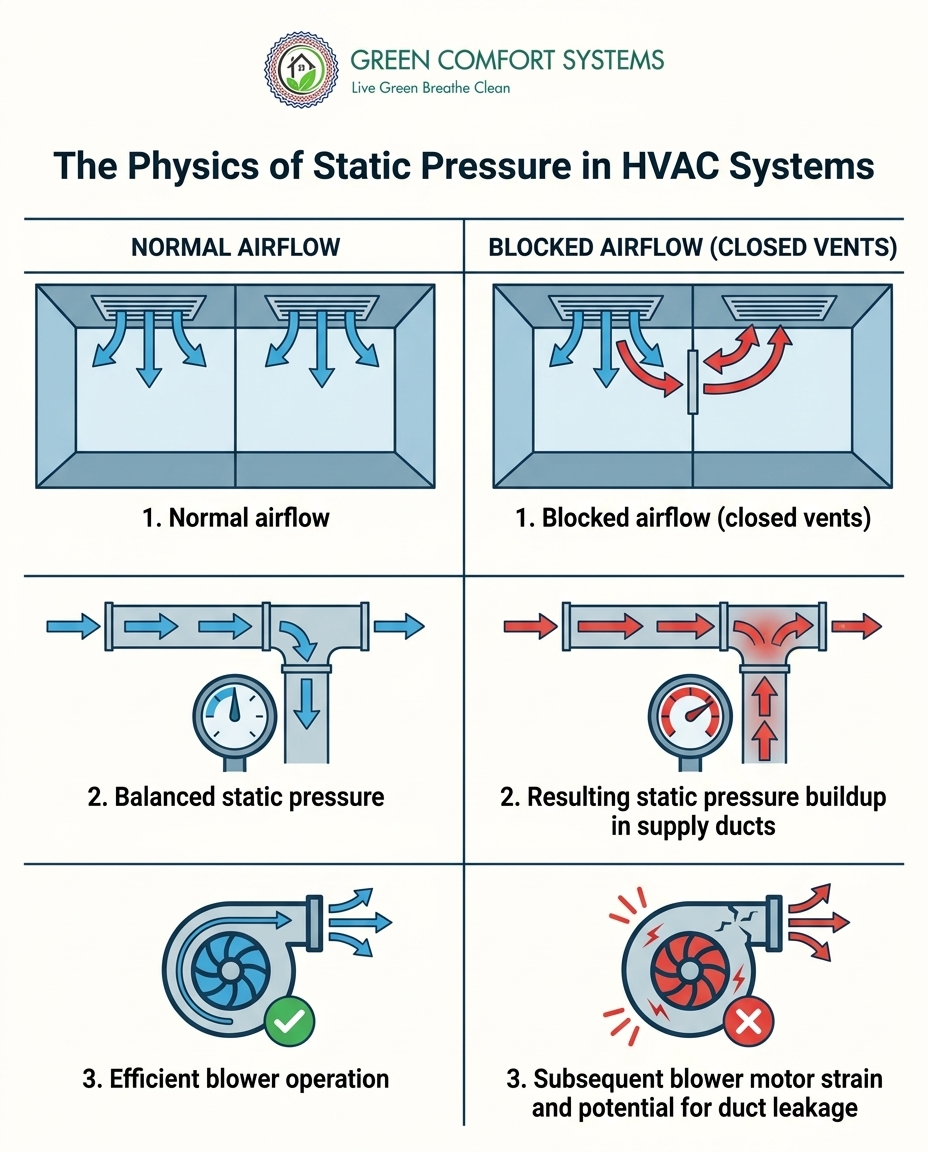
Instead of smoothly flowing into the room, that volume of air crashes into the closed metal louvers of the vent. This disruption immediately leads to increased static pressure inside the ductwork. The air has nowhere to go, so it pushes back against the incoming airflow. This is precisely why Energy Star guidelines strongly advise against closing vents to maintain heating efficiency. Your system was engineered to breathe freely through every open register in your home, and altering that balance throws the entire mechanical process into disarray.
Understanding Increased Static Pressure in Your HVAC System
The most destructive consequence of blocking airflow is a phenomenon known as increased static pressure. You can think of static pressure as the blood pressure of your home's ductwork. Just as high blood pressure forces your heart to work dangerously hard to pump blood through restricted arteries, increased static pressure forces your furnace's blower motor to work against heavy resistance to push air through restricted ducts.
When you close a vent, the air that was supposed to enter that room gets trapped in the supply duct. Because the blower motor is still relentlessly pushing new air behind it, the pressure inside that metal or flexible tube artificially inflates. Studies conducted by the Lawrence Berkeley National Laboratory (LBNL) have shown that this artificial inflation has severe consequences for the integrity of your duct system. Excess pressure always seeks the path of least resistance.
The Hidden Cost of Duct Leakage
As the pressure builds, it searches for a way out. The seams, joints, and connections in your ductwork are not perfectly airtight steel vaults. Under normal operating pressure, they hold the air just fine. But under increased static pressure, those small seams begin to give way. The heated air that you paid to generate is forced out through these micro-leaks before it ever reaches your living spaces. This means your conditioned air escapes into unheated, unoccupied zones like your attic, your crawlspace, or inside your walls.
If you suspect your system is suffering from pressure imbalances, having our team perform a professional ductwork evaluation is the most effective way to identify and seal these hidden leaks. To visualize the impact, consider the differences between a balanced system and a restricted one:
• All Vents Open — Airflow Behavior: Air flows freely into all rooms, maintaining designed static pressure. — Energy Consumption: Normal. The system runs its standard cycle and shuts off. — System Strain: Minimal. The blower motor operates within safe, intended parameters.
• Vents Closed — Airflow Behavior: Air backs up in the supply ducts, forcing leaks at the seams. — Energy Consumption: High. Heated air is lost to the attic, forcing the furnace to run longer. — System Strain: Severe. The motor fights resistance, risking overheating and failure.
Ultimately, the energy you thought you were saving by closing a vent is literally being blown into your attic, resulting in higher utility bills and a colder home.
How Blocked Airflow Damages the Furnace Blower Motor
The physics of increased static pressure directly translate to mechanical strain on your furnace. Your HVAC system relies on a delicate balance of temperature and airflow to operate safely. When you disrupt that balance, you trigger a cascade of mechanical failures that can destroy your equipment. Here is exactly what happens inside your furnace when you block the airflow by closing vents:
1. The Blower Motor Overworks: Depending on the age of your system, you likely have either a PSC (Permanent Split Capacitor) or an ECM (Electronically Commutated Motor) blower. A PSC motor will simply push against the resistance until it overheats and burns out. An ECM motor is designed to adjust its speed to maintain airflow, so when it senses the blockage, it automatically ramps up its RPMs, consuming significantly more electricity and grinding down its internal bearings.
2. The System Suffocates: Because the air cannot escape the supply ducts quickly enough, the cold return air moving over the heat exchanger slows down. The heat exchanger is the metal component that actually gets hot to warm the air. Without a fast, steady stream of air to carry that heat away, the heat exchanger begins to bake.
3. Safety Switches Trigger: As the internal temperature of the furnace skyrockets, a critical safety device called the high limit switch will detect the dangerous heat levels and immediately shut the system down to prevent a fire. If you notice your furnace turning on, running for just a few minutes, and shutting off before the house is warm, this is called short-cycling, and it is a direct symptom of restricted airflow.
4. Premature System Breakdown: Over time, the repeated cycle of overheating and rapid cooling causes the metal of the heat exchanger to expand and contract violently. Eventually, the metal will fatigue and crack. A cracked heat exchanger is a fatal diagnosis for a furnace and poses a severe carbon monoxide risk.
This immense strain often results in a complete breakdown exactly when the system is running continuously during a deep winter freeze. A pattern we see often in our emergency repair calls is that the energy savings homeowners hoped for by closing a vent are quickly erased by the expense of replacing a burnt-out blower motor.
Cold Rooms and Condensation: A Maryland Climate Challenge
Beyond the mechanical damage to your furnace, closing vents creates localized environmental problems inside your home. As local HVAC professionals, we know firsthand that the Rosedale area is known for cold, unpredictable drops in winter temperatures. When you shut the heating register in a spare bedroom during a Maryland winter, the temperature in that room drops drastically compared to the rest of the house.
This temperature difference creates the perfect environment for condensation. The science behind this is straightforward: warm air holds more moisture than cold air. The rest of your home is warm and actively being lived in, which generates humidity from cooking, showering, and simply breathing. Because interior doors are rarely perfectly sealed, that warm, moist air eventually drifts into the freezing cold unused room. When that warm moisture hits the freezing cold exterior walls and windows of the unconditioned room, it instantly condenses into liquid water.
Over the course of a long winter, this constant condensation leads to severe interior wall moisture. Drywall and window sills absorb this water, creating an ideal breeding ground for mold and mildew. What started as an attempt to lower heating costs can quickly turn into a costly remediation project. Furthermore, once mold spores develop in that room, they can easily be pulled back into your return vents, circulating throughout your entire home and severely compromising your indoor air quality. Keeping the vents open ensures that the room remains warm enough to keep the walls above the dew point, preventing condensation from forming in the first place.
Safe Alternatives to Closing Vents for Energy Efficiency
The desire to lower energy bills during the September pre-heating season is completely understandable. Fortunately, there are scientifically sound methods for managing your home's temperatures that do not involve suffocating your furnace. Instead of blocking airflow, focus on these safe, effective alternatives:
• Upgrade to a Smart Thermostat: A programmable or smart thermostat allows you to manage whole-home temperatures efficiently. You can set the system to lower the temperature slightly while you are asleep or away at work, which saves significantly more energy than closing a single vent without causing increased static pressure.
• Improve Room Insulation: If a specific room feels drafty, the solution is not to block the heat, but to stop the cold from entering. Check and improve the weatherstripping around the windows and doors. Adding thermal curtains can also prevent heat loss through the glass.
• Investigate Zoning or Ductless Solutions: If you truly want room-by-room temperature control, central forced-air systems are not the right tool for the job. Instead, consider exploring heat pump systems, specifically ductless mini-splits. These systems provide dedicated, highly efficient heating to specific zones without relying on a central ductwork network.
• Keep Interior Doors Open: Your home's airflow operates in a loop. Conditioned air comes out of the supply vents, and stale air is pulled back into the return vents. If you close a bedroom door, you trap the air inside, forcing the room to pressurize. Keeping interior doors cracked open ensures proper return airflow to the central system.
Why Proper Diagnostics Matter Before the Winter Freeze
When it comes to the health of your HVAC system, relying on internet myths and DIY airflow hacks is a dangerous game. This is why a professional evaluation during the September pre-heating season is vastly superior to guesswork. At Green Comfort Systems, our team's commitment is always to long-term system health and factual HVAC science, prioritizing thorough diagnostics over popular but damaging myths.
During a professional evaluation, our technicians do not just look at the furnace; they measure the exact static pressure of the system using specialized tools called manometers. This tells them precisely how hard the blower motor is working and whether the ductwork is properly sized for the equipment. Having a professional clearly explain this process and demonstrate the true health of your system provides invaluable peace of mind.
Real-world experience proves the value of this approach. Just last winter, our crew responded to a homeowner requiring maintenance on their heating system after noticing poor performance and unusual noises. Our technician arrived on time, thoroughly explained the maintenance process, and restored the system's efficiency by addressing underlying airflow issues rather than just applying a temporary patch. Proper, proactive maintenance is always the best defense against mid-winter blower motor failures. If you are curious about exactly how these diagnostics work, you can review what we inspect during a fall furnace tune-up to see the science in action.
Protect Your Furnace This Winter With Expert Guidance
The bottom line is simple: keeping all of your vents open protects the blower motor, maintains proper system balance, and prevents dangerous heat buildup inside the furnace. The September pre-heating season is the perfect window of opportunity to ensure your system is breathing freely before the severe cold hits Rosedale.
Do not wait until a deep freeze forces your restricted system to work overtime. Take action now to verify that your ductwork is balanced, your static pressure is normal, and your furnace is prepared for the months ahead. Schedule a professional evaluation today to secure a clear, scientifically grounded path forward for a warm, efficient, and safe winter season.
Frequently Asked Questions
Does closing vents save money in winter?
No, closing vents does not save money and often increases your energy bills. Modern furnaces produce the same amount of heat regardless of open or closed vents. Blocking the airflow forces the blower motor to work harder against increased pressure, consuming more electricity and forcing heated air to leak out of your ductwork into unconditioned spaces.
Can closing vents damage my furnace?
Yes, restricting airflow is one of the leading causes of premature furnace failure. The trapped air creates high static pressure that strains the blower motor until it burns out. Furthermore, the lack of airflow causes the heat exchanger to overheat, which can lead to cracks and potential carbon monoxide leaks.
Why does closing a vent make the room colder?
Closing a vent stops the flow of conditioned air into that specific space, allowing the room to rapidly lose heat through the exterior walls and windows. In cold climates, this drastic drop in temperature can create a dew point imbalance, leading to condensation, moisture buildup, and eventually mold growth on the walls.
How many vents can I safely close without causing increased static pressure?
HVAC professionals strongly recommend keeping 100% of your supply and return vents open at all times. Forced-air systems are precisely balanced based on a load calculation of your home's total square footage. Closing even a single vent disrupts this delicate balance and begins to negatively inflate the static pressure inside the ductwork.
What are the early signs that a blower motor is failing due to restricted airflow?
The most common early warning sign is short-cycling, where the furnace runs for only a few minutes before shutting off to protect itself from overheating. You may also hear unusually loud humming or grinding noises coming from the furnace cabinet, notice a burning smell, or experience weak airflow coming from the vents that are still open.
Book Expert Service Or Contact Us
Other Blogs


Get Financing Today
Get the comfort you deserve, without the financial stress.

Latest Blogs
Retrofitting Modern Heating Solutions into Mid-Century Perry Hall Homes
The Danger of Closing Vents in Unused Rooms During the Rosedale Heating Season

Understanding Your Heat Pump's Defrost Cycle During Early Frosts in Maryland
