




How the R-410A Refrigerant Phase-Out Impacts Your Rosedale AC Repair Costs

Surviving the Heat: Why Your AC Breakdown Feels Different This Year
Are you wondering exactly how the R-410A refrigerant phase-out impacts your Rosedale AC repair costs after a sudden breakdown? You are not alone. At Green Comfort Systems, our dispatch team fields calls every day from homeowners confronting unexpected air conditioning failures. It is always frustrating, especially when it happens during the sweltering late-summer August heat just as kids are heading back to school. The house quickly becomes uncomfortable, the air feels heavy, and you just want the system running again. However, if our technicians discover a refrigerant leak, you might be surprised to learn that a standard recharge is no longer a simple, predictable fix.
Because of sweeping federal regulations affecting the HVAC industry, the chemical used to cool most residential homes over the last two decades is becoming increasingly scarce. This regulatory shift changes the entire landscape of home cooling repairs. If you are dealing with a malfunctioning unit, you need professional air conditioning services to accurately diagnose the root cause of the cooling loss. The critical decision you now face with our team is whether it makes logical sense to patch the leak and recharge the system, or if the changing supply chain means it is time to consider a full replacement.
What the AIM Act Means for Aging R-410A Dependent AC Systems
To understand why a simple recharge is changing, we have to look at the federal American Innovation and Manufacturing (AIM) Act. Enacted to phase down the production and consumption of hydrofluorocarbons (HFCs), this legislation directly targets R-410A, the standard refrigerant used in the vast majority of aging R-410A dependent AC systems currently operating in residential neighborhoods.
The AIM Act mandates a staggering 85% reduction in HFC production by the year 2036. This is not a sudden cliff, but rather a gradual step-down process designed to force the industry toward more environmentally friendly alternatives. The most significant recent milestone occurred in 2024, which introduced a massive 40% reduction in the national supply of these refrigerants.
The Economics of Dwindling Supply
When the national supply of a required chemical drops by 40%, the basic economic principles of supply and demand take over. Manufacturers are producing far less R-410A, and stockpiles are shrinking rapidly. For homeowners with aging R-410A dependent AC systems, this means that every time a system develops a leak, acquiring the necessary refrigerant to refill it becomes progressively more difficult. We are seeing firsthand that the days of cheaply topping off a slightly leaky system are over, making the viability of continuous repairs a major concern for household budgets.
• 2022-2023 — Target Reduction Level: 10% Reduction — Impact on R-410A Supply: Minor supply chain adjustments; early warnings to industry.
• 2024-2028 — Target Reduction Level: 40% Reduction — Impact on R-410A Supply: Significant scarcity begins; repair viability drops for older units.
• 2029-2035 — Target Reduction Level: 70% Reduction — Impact on R-410A Supply: Severe restrictions; R-410A largely reserved for critical legacy uses.
• 2036 and Beyond — Target Reduction Level: 85% Reduction — Impact on R-410A Supply: Near-total phase-out of virgin HFC production.
The Hidden Toll of Maryland Humidity on Leaking Refrigerant Lines
The physical impact of a refrigerant leak goes far beyond just a warmer house. In our years of servicing local homes, we’ve seen how the hot, humid Maryland summers require optimal refrigerant levels not just for cooling, but for effective dehumidification. When your system is low on R-410A during the late-summer August heat, the evaporator coil cannot reach the correct temperature to extract moisture from the indoor air. The result is a home that feels sticky and clammy, even if the thermostat says the temperature is dropping.
The accelerated wear and tear: Limping along with a leak forces your compressor to work overtime. The system will run in constant, unending cycles trying to reach the set temperature, which puts immense strain on the electrical components and the compressor motor itself. Our technicians often see this constant cycling lead to catastrophic, unrepairable equipment failure right when you need the cooling most.
One of our Rosedale customers recently experienced this exact scenario when their AC unit developed a significant leak during a peak humidity wave. A Green Comfort Systems technician arrived punctually, accurately identified the compromised refrigerant line, and refilled the system to restore comfort. While this resolved the immediate crisis and our technician performed a great job, situations like this highlight why we emphasize addressing leaks promptly. Continuing to run a compromised system in heavy humidity will only accelerate the demise of the equipment.
The Go/No-Go Decision Framework for R-410A Leaks
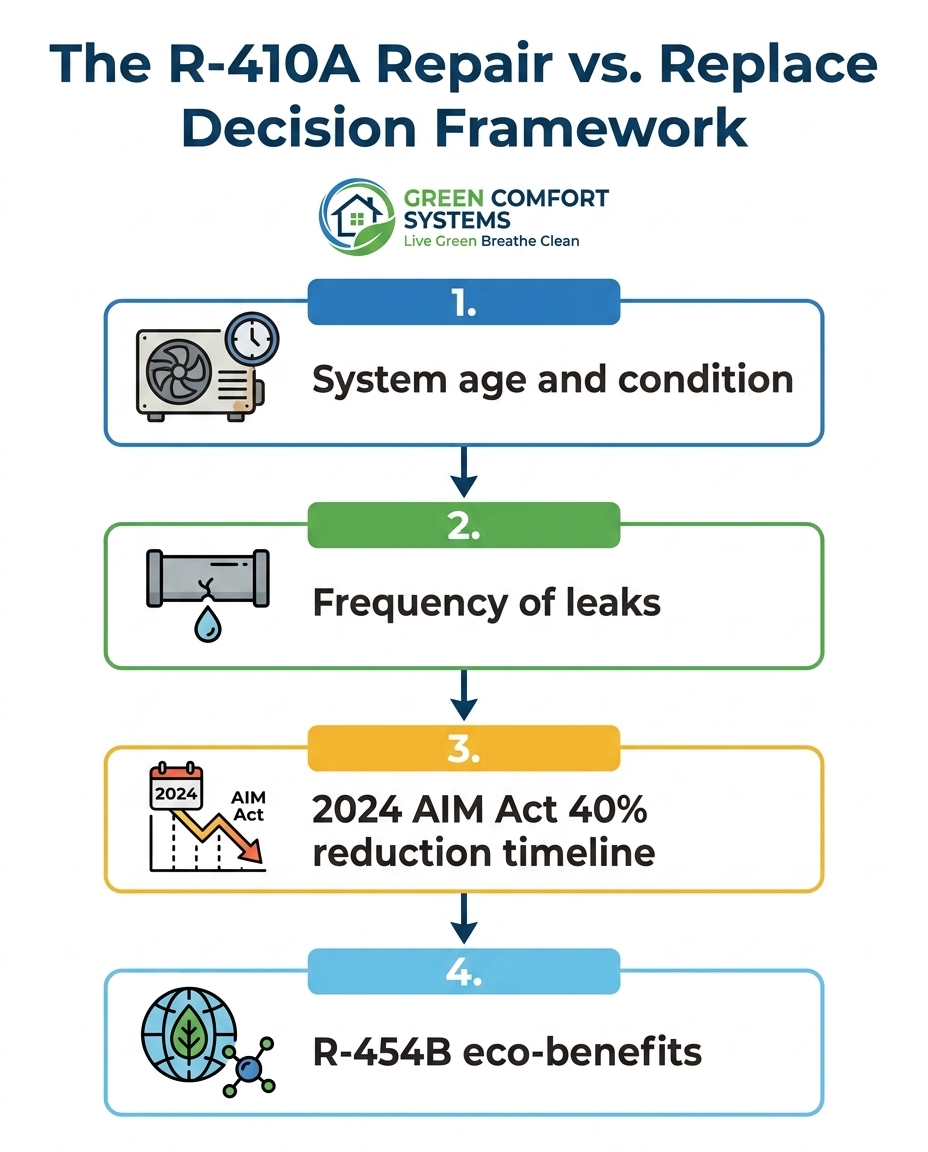
When our technicians diagnose a leak in your system, we walk you through an objective way to decide your next steps. Because of the phase-out, you can no longer just assume a repair is the default choice. We use this go/no-go decision framework to evaluate aging R-410A dependent AC systems and help you determine if upgrading to a new heat pump or AC unit is the smarter path.
1. Assess the overall age of the equipment: Air conditioners generally have a lifespan of 10 to 15 years. If your unit is approaching or has surpassed the decade mark, we typically advise that investing heavily in a refrigerant recharge is a poor long-term strategy, as other major components are likely nearing failure.
2. Evaluate the frequency of previous recharges: Refrigerant operates in a closed loop. It does not get “used up” like gas in a car. If you need a recharge, you have a leak. If this is the second or third time our team has had to add refrigerant to your system, the leak is likely worsening, making continuous patching unsustainable.
3. Determine the severity and location of the leak: Some leaks are small and located at accessible valves, making them relatively simple to seal. However, leaks located deep within the evaporator coil or condenser coil often require replacing the entire coil assembly. Given the dwindling supply of R-410A, we rarely recommend replacing a major coil on an old system because it rarely makes logical sense.
4. Weigh the long-term viability: Consider the trajectory of the AIM Act. Any money spent repairing an R-410A system today is an investment in obsolete technology. Transitioning to a new system utilizes modern refrigerants that will be supported for decades to come.
Eco-Friendly Alternatives: Moving Beyond R-410A
The transition away from older refrigerants is not just a regulatory burden; it is a significant leap forward in environmental stewardship and home energy efficiency. The HVAC industry is moving toward next-generation refrigerants, primarily R-454B and R-32, which are designed to provide excellent cooling performance while drastically reducing environmental harm.
The primary metric used to measure a refrigerant’s environmental impact is its Global Warming Potential (GWP). R-410A has a relatively high GWP, which is exactly why the EPA targeted it for a phase-down. In contrast, modern alternatives like R-454B have a GWP that is roughly 75% lower. This means that upgrading your aging R-410A dependent AC systems to modern equipment directly reduces your household’s carbon footprint.
For homeowners who value sustainable living, this transition aligns perfectly with eco-conscious goals. At Green Comfort Systems, our identity is built around this exact philosophy. Through initiatives like our Green Guardian Club and our Green Legacy Initiative, we view the shift to low-GWP refrigerants as a positive environmental upgrade. Whether you are installing a traditional central system or exploring highly efficient ductless mini splits, moving beyond legacy chemicals ensures your home comfort does not come at the expense of the environment.
Navigating the System Upgrade Without the Stress
Realizing that your current air conditioner is no longer viable can be overwhelming, but managing the transition to a modern system does not have to be stressful. By taking a proactive approach with our team, you can navigate the upgrade smoothly and take advantage of various programs designed to ease the process for replacing aging R-410A dependent AC systems.
Leveraging incentives and smart planning: Because the federal government and local utilities want to encourage the adoption of high-efficiency, eco-friendly HVAC equipment, there are often generally applicable energy rebates and federal tax credits available for qualifying installations. While you should always verify current programs with your utility provider or a tax professional, these incentives can help offset the initial investment. Furthermore, modern systems operate with significantly higher energy efficiency, leading to noticeable long-term energy savings on your monthly utility bills. You can also explore options for financing a new AC unit vs. paying cash to find a payment structure that fits your household budget comfortably.
The quality of the installation is just as important as the equipment itself. Another of our local customers recently faced a situation where their builder’s grade AC system began failing rapidly after years of heavy summer use in a renovated home. After receiving responsive, transparent estimates from our staff, they chose to upgrade. The Green Comfort Systems installation crew carefully removed the failing unit and installed the new, highly efficient system without leaving a trace of debris behind. A seamless, professional installation like this ensures the new equipment operates exactly to manufacturer specifications, maximizing its lifespan and efficiency.
Frequently Asked Questions About the R-410A Phase-Out in Maryland
Do I have to replace my R-410A air conditioner immediately?
No immediate replacement mandate exists for functioning systems. The federal AIM Act does not require homeowners to rip out working air conditioners. The phase-out primarily impacts the availability and production of the refrigerant itself, meaning your current system is perfectly legal to operate, but it will become increasingly difficult for our technicians to repair if it develops a leak.
Why is R-410A becoming harder to find for older AC units?
Federal AIM Act regulations restrict the production of high-GWP hydrofluorocarbons. Because the EPA mandated a 40% reduction in manufacturing in 2024, supply and demand economics naturally constrain availability. As stockpiles shrink, HVAC companies have less access to the chemical needed to service aging R-410A dependent AC systems.
What happens if my AC uses R-410A and develops a leak?
Our technicians must professionally repair the leak before any recharging can occur. It is illegal and environmentally harmful to knowingly vent refrigerant into the atmosphere. Once we seal the leak, recharging the system will be possible, but it will become progressively more difficult and economically challenging as national supplies continue to dwindle.
What refrigerant is replacing R-410A in new HVAC systems?
R-454B and R-32 are the primary modern alternatives adopted by major manufacturers. They offer much better environmental profiles, featuring a significantly lower Global Warming Potential, and ensure full compliance with new federal environmental laws for residential cooling equipment.
Can I put a new refrigerant into my old R-410A system?
No, refrigerants are absolutely not interchangeable. Air conditioning compressors, valves, and coils are engineered for the specific operating pressures of a single chemical. Using the wrong refrigerant in aging R-410A dependent AC systems can cause catastrophic compressor failure and immediately void any remaining manufacturer warranties.
Make an Informed Choice for Your Rosedale Home’s Comfort
Facing an AC breakdown during the late-summer August heat is stressful enough without the added complication of federal regulatory changes. By using an objective go/no-go decision framework, you can evaluate the true condition of your system and make a choice that protects your home comfort and your long-term budget. If your system is struggling to keep up with the humidity, do not wait for a complete failure. Consult our local HVAC experts at Green Comfort Systems to thoroughly inspect your equipment, accurately diagnose any leaks, and help you determine whether a repair or a modern, eco-friendly upgrade is the best path forward for your home.
Book Expert Service Or Contact Us
Other Blogs


Get Financing Today
Get the comfort you deserve, without the financial stress.

Latest Blogs
The Anatomy of a Fast Towson Furnace Repair: How We Diagnose Ignitor Failures
Clearing the Air: How We Handle Lingering Musty Odors During Your October Heating Startup
Furnace Maintenance Tips: Troubleshooting the First October Startup
