





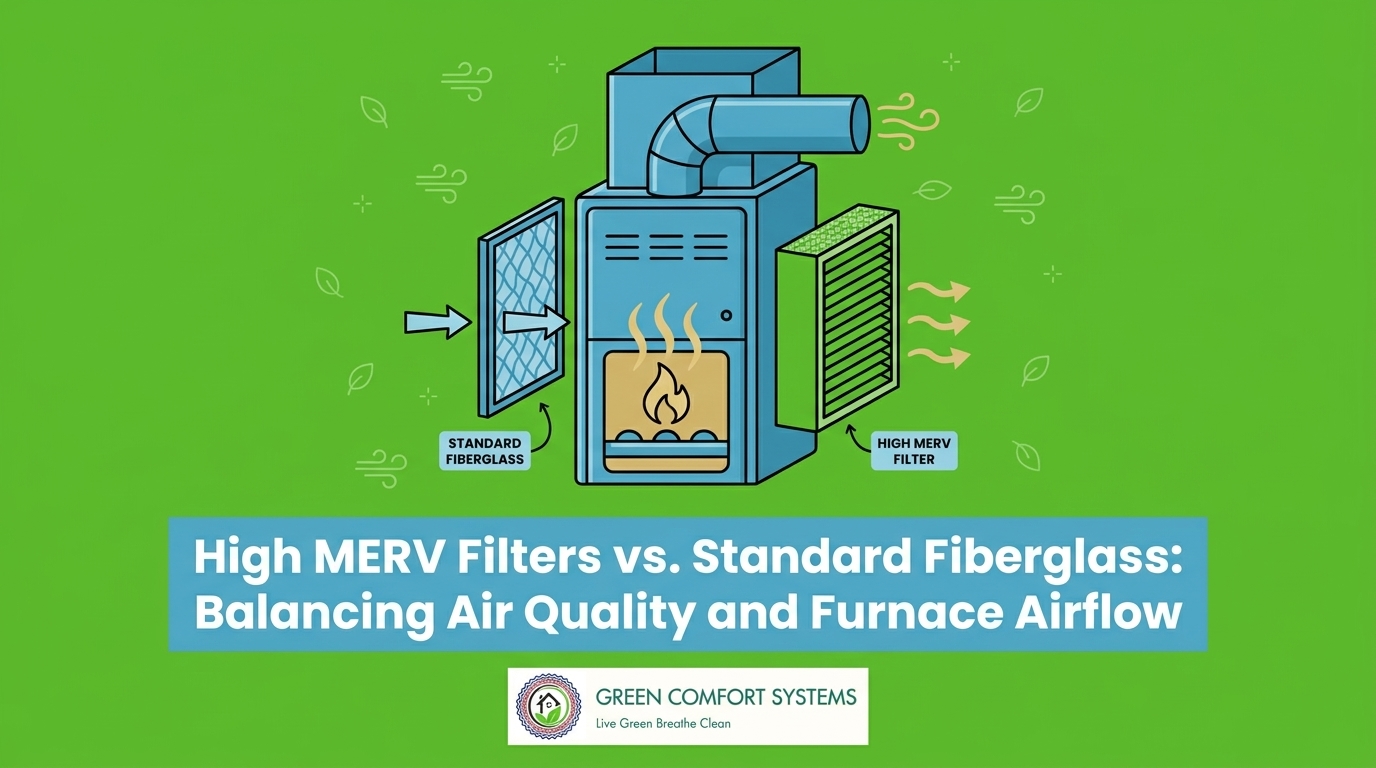
High MERV Filters vs. Standard Fiberglass: Balancing Air Quality and Furnace Airflow

The Fall Filter Myth: Why the Thickest Allergen Filter Isn't Always the Best Choice
Grabbing the most expensive allergen filter off the hardware store shelf doesn't automatically mean cleaner air—in fact, understanding High MERV Filters vs. Standard Fiberglass: Balancing Air Quality and Furnace Airflow is a delicate science that most retail packaging completely ignores. It is a very common ritual during the September pre-heating season: you head to the store to prep your home for winter, see a densely pleated filter promising to trap every microscopic particle, and assume it is the absolute best choice for your family. The glossy packaging makes it sound like a no-brainer. But there is a hidden danger lurking behind those bold promises.
Maximizing allergen capture often comes at a steep, hidden cost to your heating system's health. To truly understand this, we have to look at how your furnace actually breathes. Retail packaging rarely warns you about residential blower motor limitations. Manufacturers sell the filtration benefits, but they do not mention the severe airflow restriction that comes with it. If you install a filter that is too dense, you can silently suffocate your heating system before winter even begins.
That is why finding the right indoor air quality solutions requires looking at the mechanical realities of your HVAC system, not just the label on a cardboard box. Let's break down exactly why this happens, how your furnace operates under pressure, and what you should look for instead.
Understanding Static Pressure: The Invisible Force Inside Your HVAC System
Before we compare specific filter types, we need to talk about static pressure. Think of static pressure drop as the physical resistance air faces when moving through your filter and ductwork. The harder your system has to pull air in, the harder the internal components have to work. Your furnace blower motor operates on this exact principle.
How Airflow Restriction Causes Breakdowns
1. The baseline design: Standard residential blower motors are typically designed to handle a maximum total external static pressure of 0.5 inches of water column. This is the industry standard measurement for healthy airflow resistance.
2. The restriction point: When you slide a highly restrictive, tightly woven barrier into the filter slot, that static pressure spikes well above the 0.5 limit. The motor now has to work twice as hard just to pull the same amount of air into the system.
3. The overheating reaction: Because less air is moving across the internal heat exchanger to cool it down, the internal temperature of your furnace starts to climb rapidly.
4. The safety shutdown: Eventually, the restricted airflow causes the heat exchanger to overheat entirely, tripping the high-limit safety switches and shutting your system down to prevent a fire hazard.
This mechanical chain reaction is especially critical in our local climate. Rosedale, MD winters require furnaces to run in long, sustained cycles to keep up with dropping temperatures. During these heavy heating periods, unrestricted airflow is absolutely vital to prevent heat exchanger overheating when heating demand is at its highest. If your system is constantly struggling against high static pressure, you are looking at increased energy use, higher utility bills, and a much shorter lifespan for your equipment. This is a pattern we see often when providing professional heating services across the area.
Standard Fiberglass Filters: Maximum Airflow, Minimum Filtration
Let's start with the baseline option: standard spun-fiberglass filters. These are the cheap, see-through, blue or green filters you often find sold in multi-packs at the hardware store. During the September pre-heating season, they are usually the most affordable option on the shelf. They typically carry a MERV (Minimum Efficiency Reporting Value) rating of 1 to 4.
The Pros and Cons of Going Basic
• Pro: Maximum airflow. Because they are so thin and porous, standard fiberglass filters offer virtually zero resistance to airflow. Your blower motor will never struggle to pull air through them.
• Pro: Equipment protection. Their primary job is actually just protecting the furnace blower motor from large, damaging debris like pet hair, heavy dust bunnies, and loose carpet fibers.
• Pro: System safety. They keep static pressure well within the safe 0.5 inches of water column limit, preventing overheating.
• Con: Minimum filtration. They do absolutely nothing to improve human health or indoor air quality.
• Con: Microscopic bypass. Microscopic allergens, pollen, pet dander, and fine dust will pass right through the loose fiberglass weave and circulate back into your living space.
Ultimately, a standard fiberglass filter is appropriate if you have an older heating system with a weaker blower motor that simply cannot handle any extra resistance. They are also fine for temporary use if you just need to keep the system running safely. However, if you suffer from allergies or want noticeably cleaner air in your home, this baseline option will leave you disappointed.
1-Inch High MERV Filters: The Danger Zone for Standard Blowers
This is where the most common homeowner mistakes happen. The EPA recommends using filters with a MERV 13 rating for optimal residential indoor air quality. Naturally, people see 1-inch thick, MERV 13 pleated filters at the store and assume they are making the smart, healthy choice for the September pre-heating season.
The Physics of Restricted Airflow
The problem lies in the physical geometry of the filter itself. When manufacturers pack dense, high-MERV filter media into a narrow 1-inch frame, they drastically reduce the physical space available for air to pass through. The pleats are shoved tightly together, creating a massive wall of resistance.
• Blower motor suffocation: A 1-inch MERV 13 filter can easily double or triple the static pressure in your system, starving the blower of the air it needs to function.
• Premature wear: Because it is starved for air, the motor runs hotter and harder, burning out bearings and electrical components long before their expected lifespan.
• System failures: In the summer, this lack of airflow leads to frozen evaporator coils. In the winter, it leads to overheated furnaces and cracked heat exchangers.
• Exponential clogging: You cannot adopt a "set it and forget it" mentality with these filters. Because the media is so dense and the surface area is so small, they clog exponentially faster than standard filters. A 1-inch high MERV filter might need to be replaced every three to four weeks to prevent a total system shutdown.
4-Inch Media Cabinets: Achieving High IAQ Without Choking Airflow
So, how do you capture microscopic allergens without destroying your furnace? The answer lies in structural geometry. A 4-inch or 5-inch thick media cabinet is the professional solution that perfectly balances both air quality and static pressure requirements.
More Surface Area Means Better Breathing
Instead of trying to force air through a dense 1-inch wall, a media cabinet uses increased surface area to solve the static pressure problem. If you were to take a 4-inch pleated filter and stretch the material out flat, it would stretch across an entire room.
• Accordion-like deep pleats: These deep, wide pleats allow a MERV 11 or MERV 13 filter to capture tiny particles while still leaving plenty of physical space for air to flow freely around the trapped debris.
• Extended replacement intervals: Because there is so much more surface area to hold dust and allergens, these thick filters typically only need to be replaced every 6 to 12 months, making them incredibly low maintenance.
• Professional installation: Upgrading to this system requires modifications to your existing return drop. A technician must fabricate a custom sheet metal cabinet to house the thicker filter properly.
As holistic HVAC experts, Green Comfort Systems evaluates your specific blower capacity and ductwork rather than just recommending the thickest retail filter on the market. We ensure that any duct work and airflow modifications are precisely calculated so that homeowners in Rosedale, MD don't have to sacrifice their furnace's health just to breathe cleaner air.
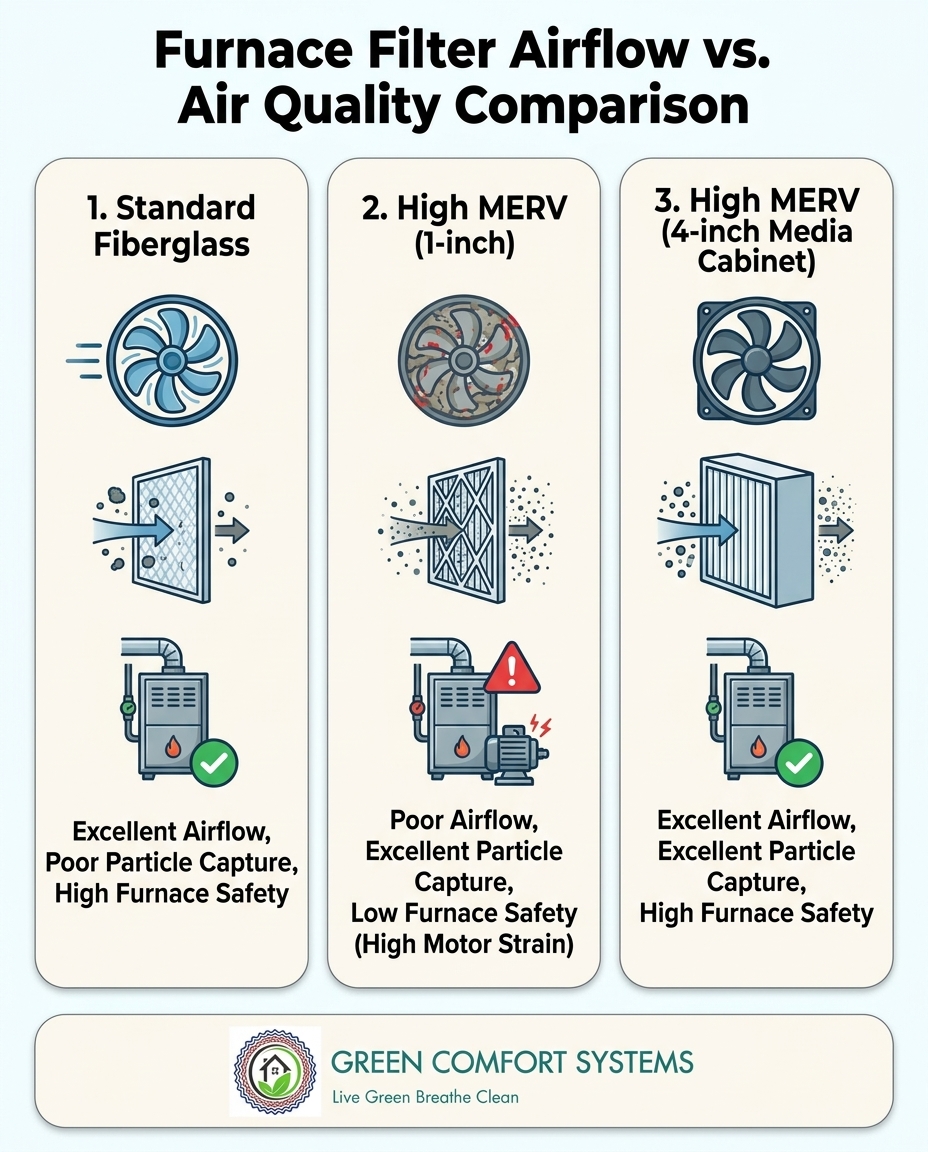
Side-by-Side Comparison: Which Furnace Filter is Right for Your System?
To help you visualize the tradeoffs, here is a quick-reference comparison of the three main options we have discussed for homes in Rosedale, MD. Understanding these differences is the key to protecting your equipment.
• Standard Fiberglass (1-inch) — Airflow & Static Pressure: Excellent (Virtually zero resistance) — Particle Capture: Poor (Only stops large debris) — Furnace Safety: High (Prevents motor strain) — Ideal Use Case: Older systems with weak blowers or temporary use.
• High MERV Pleated (1-inch) — Airflow & Static Pressure: Poor (Creates high static pressure) — Particle Capture: Excellent (Traps fine allergens) — Furnace Safety: Low (Causes severe motor strain) — Ideal Use Case: Systems specifically designed with oversized blowers.
• High MERV Media Cabinet (4-inch) — Airflow & Static Pressure: Excellent (Large surface area allows flow) — Particle Capture: Excellent (Traps fine allergens) — Furnace Safety: High (Maintains safe static pressure) — Ideal Use Case: Homeowners wanting maximum IAQ without damaging equipment.
Pre-Season Prep: Finding the Perfect Balance Before Winter Hits
As the September pre-heating season gets underway, transitioning your system from summer cooling to winter heating requires more than just swapping out a dirty filter. It is the perfect time to verify your specific furnace's maximum static pressure rating before you commit to upgrading to a high MERV filter.
We strongly recommend having a technician measure your system's airflow during a routine fall tune-up. They can use specialized tools to read the exact static pressure drop across your current filter. This data takes the guesswork out of your indoor air quality decisions. Furthermore, routine maintenance ensures the blower motor itself is clean—a dust-caked blower wheel cannot move air efficiently, regardless of which filter you slide into the slot.
This proactive approach makes a huge difference when the freezing weather arrives. For example, one local homeowner recently scheduled routine winter heating maintenance to ensure their system was ready for the heavy workload. The technician arrived on time, thoroughly explained the maintenance process—including how the filter impacts overall airflow—and completed the service smoothly. By addressing these mechanical details early, the heating system was prepared to perform flawlessly all season.
You can learn more about maintaining this balance in our guide to simple furnace fixes and filter replacements. Remember to check your filter monthly during the heavy heating months, even if you do not replace it that often. Staying vigilant is the key to a healthy, efficient furnace.
Frequently Asked Questions
Can a high MERV filter damage my furnace?
Yes, a high MERV filter can severely damage your furnace if your system is not designed to handle the airflow restriction. The dense material acts like a wall, causing the blower motor to work harder and the internal heat exchanger to overheat. Over time, this leads to cracked heat exchangers and burnt-out blower motors.
Does a higher MERV rating restrict airflow?
Generally, yes, a higher MERV rating in a standard 1-inch filter will significantly restrict airflow. Because the filter media is woven tighter to catch microscopic particles, it leaves less physical space for air to pass through. This increases the static pressure within your ductwork and forces your system to work much harder.
Is MERV 13 too high for a standard furnace?
A 1-inch MERV 13 filter is almost always too restrictive for a standard residential furnace blower. While the EPA recommends MERV 13 for optimal air quality, it must be installed in a system with adequate blower capacity or utilized within a 4-inch media cabinet to prevent overheating.
What is the best MERV rating for airflow?
For maximum airflow and the lowest static pressure, a MERV 1 to MERV 4 standard fiberglass filter is the best option. However, if you want a balance of good airflow and decent air quality, a MERV 8 pleated filter is often the safest middle ground for standard 1-inch filter slots.
How do I know if my furnace blower is struggling with high static pressure?
You might notice your furnace running in very short cycles, shutting down before the house actually reaches the set temperature. You may also hear the blower motor whining loudly, or notice that the airflow coming out of your room vents feels unusually weak and restricted.
Can modifying my ductwork allow me to use a higher MERV filter safely?
Absolutely, modifying your return ductwork to accommodate a 4-inch or 5-inch media cabinet is the best way to use high MERV filters safely. The larger cabinet provides massive surface area, allowing the system to capture microscopic allergens without increasing static pressure or straining the blower motor.
Finding the right balance between clean air and a healthy furnace doesn't have to be a guessing game. If you are unsure whether your current filter is suffocating your system, our team is here to help measure your static pressure and find the perfect fit. Reach out today for a clear, plain-English explanation of exactly how your system is breathing, and enjoy total peace of mind this winter.
Book Expert Service Or Contact Us
Other Blogs


Get Financing Today
Get the comfort you deserve, without the financial stress.

Latest Blogs
High MERV Filters vs. Standard Fiberglass: Balancing Air Quality and Furnace Airflow

Why We Insist on Carbon Monoxide Testing During Every Rosedale Heating Inspection

Upgrading to a Smart Thermostat in Glen Burnie: Navigating C-Wire Requirements
