





The Reality of Switching to a Green HVAC System in an Older Rosedale Home

Facing Late-Summer AC Failures Without Tearing Down Your Walls
At Green Comfort Systems, a pattern we see often is a central air conditioner running nonstop, but the living room still feels uncomfortably warm. The reality of switching to a green HVAC system in an older Rosedale home often starts exactly like this—with a failing cooling unit during the late-summer August cooling transition as families prepare for the back-to-school season. You know the system is on its last legs, but the thought of replacing it brings up a major fear we hear constantly from our local clients: the assumption that a modern upgrade requires tearing apart beautiful historic walls to install massive new ductwork.
If you are ready to explore non-invasive, eco-friendly cooling options, learn more about our heat pump services.
Dealing with a struggling air conditioner is stressful enough without worrying about invasive demolition. During the peak humidity of August, an aging system works twice as hard just to remove moisture from the air, often failing right when you need it most. Many owners of historic properties simply accept poor cooling performance because they believe their home's architecture cannot support a modern, high-efficiency system.
Here is the good news our team shares with homeowners every day: modern green HVAC solutions offer a completely non-destructive path for historic properties. You do not have to choose between keeping your home comfortable and preserving its original charm. Advanced ductless technology serves as the perfect bridge between eco-friendly energy efficiency and strict architectural preservation, allowing you to upgrade your cooling without touching a single piece of your original plaster.
The Structural Hurdles of Pre-1950s Maryland Architecture
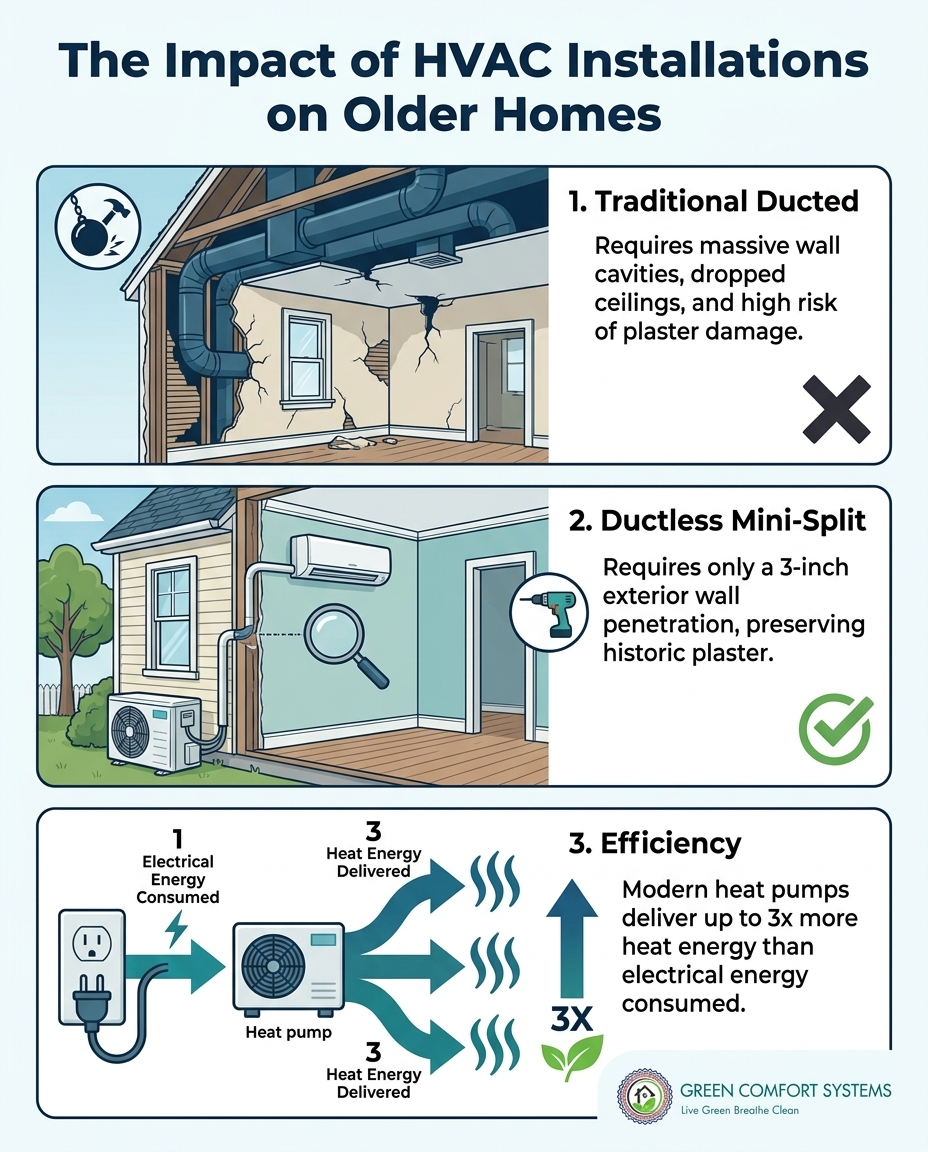
Traditional ducted HVAC systems were designed for modern homes built with drywall and wide-open wall cavities. In our years of working on older Rosedale residential architecture, our team has seen firsthand that the construction methods are entirely different. Homes built before the 1950s were constructed to last, but they were not built with hidden ductwork in mind.
The baseline structural challenge comes down to the materials used. Older homes rely heavily on traditional plaster-and-lath construction. Unlike modern sheets of drywall that can be easily cut, patched, and painted, plaster is essentially a thick layer of hardened material spread over thin wooden strips (the lath). This creates a highly durable, sound-dampening wall, but as we often warn our clients, it is incredibly fragile when subjected to modern power tools.
Why Plaster and Traditional Ducts Don't Mix
Forcing traditional ductwork into these historic spaces usually results in serious structural compromises. The hurdles are significant:
• Vibration damage: The heavy vibration from cutting tools can cause widespread cracking across an entire plaster wall, not just at the cut site.
• Lack of wall cavities: Older framing often features solid masonry or narrow stud bays that physically cannot accommodate standard 6-inch or 8-inch metal ducts.
• Dropped ceilings: To hide bulky ductwork, contractors often resort to building unsightly dropped ceilings or bulky soffits, which ruin the historical aesthetic of the rooms.
• Compounding repair costs: Repairing cracked plaster requires specialized masonry skills that are hard to find and expensive to hire, turning a simple HVAC upgrade into a massive interior restoration project.
Because of these factors, trying to install a conventional central air system in a historic home often creates more problems than it solves. The architecture simply pushes back against invasive retrofits.
Bypassing Demolition with Modern Ductless Technology
If traditional ducts are out of the question, how do you cool a historic property? We recommend modern ductless mini-split heat pumps. These systems completely bypass the structural barriers of older Rosedale residential architecture, providing a realistic, non-invasive upgrade path that respects the home's original design.
A ductless system operates using two main components: an outdoor compressor and one or more indoor air handlers. Instead of pushing air through a massive network of hidden metal tubes, these systems move refrigerant directly to the rooms that need cooling. This completely eliminates the need to tear open ceilings or walls.
The 3-Inch Solution to Historic Upgrades
The mechanics of a ductless installation are surprisingly simple and highly respectful of historic materials. The connection between the outdoor unit and the indoor air handler requires only a single, 3-inch hole drilled through the exterior wall.
1. Minimal penetration: This small opening is just large enough to pass the refrigerant lines, power cables, and a condensation drain.
2. Discreet routing: The lines are routed carefully along the exterior of the home and covered with slim, color-matched line-hide tubing to preserve the home's curb appeal.
3. Permanent comfort: Inside, the sleek air handler mounts securely to the wall, replacing loud, inefficient, and insecure window units with whisper-quiet, permanent climate control.
These systems are incredibly reliable, even in extreme weather. For example, our technicians recently helped a local homeowner who reached out during a late-summer heat wave when their existing ductless unit started throwing error codes. Our team was able to quickly diagnose the issue, recharge the refrigerant, and perform a preventative check on their other units, restoring comfort rapidly. This highlights how easily these systems can be serviced without disrupting the home.
Because these systems provide both high-efficiency cooling and heating, they can replace multiple outdated appliances at once. If you are considering this upgrade, you might want to review the local permit requirements for mini split installation in Maryland to ensure your project stays compliant with local regulations.
Conquering Humidity: Indoor Comfort During Seasonal Transitions
Cooling an older home is only half the battle; managing moisture is just as critical. With summer temperatures regularly bringing sustained high humidity to the region, our crew knows how Rosedale's thick, humid air places maximum strain on aging traditional AC units. This is especially true during the late-summer August cooling transition, when poorly insulated historic homes trap moisture indoors.
High humidity exacerbates the feeling of heat. When the air inside your home is saturated with moisture, your body cannot cool itself efficiently. Older, single-speed air conditioners often cool a room too quickly and shut off before they have a chance to draw the humidity out of the air. This leaves the house feeling cold but uncomfortably clammy.
Modern variable-speed heat pumps solve this exact climate gap. Instead of blasting at 100% capacity and shutting off, green HVAC systems run continuously at lower speeds. This advanced dehumidification capability constantly wrings moisture out of the air while maintaining a precise temperature.
The benefits of advanced moisture control include:
• Eliminating hot and cold spots: Consistent, zoned climate control prevents the drastic temperature swings typical of older multi-story homes.
• Protecting historic materials: Lower indoor humidity prevents original wood floors, plaster, and antique furnishings from warping or swelling.
• Healthier breathing environments: Keeping indoor humidity below 50% prevents the growth of mold and mildew in damp basements and older wall cavities.
Better moisture control directly connects to improved overall home preservation. If your current system is leaving your home feeling sticky and damp, exploring dedicated indoor air quality solutions alongside a modern heat pump can completely transform how your historic home feels.
Weighing Your Options: Eco-Friendly Heat Pumps vs. Traditional Replacements
When an aging air conditioner finally fails, you face a critical decision point: do you replace it with another traditional, like-for-like AC unit, or do you upgrade to a green heat pump system? For homes with older Rosedale residential architecture, we find the choice often comes down to efficiency, safety, and long-term value.
The urgency of this decision usually peaks during extreme weather. Another recent situation our team handled involved a family whose traditional AC unit failed entirely during the peak of summer heat while they had an infant at home. We dispatched a technician quickly to diagnose and resolve the problem, restoring safe cooling. However, emergencies like this highlight why we strongly recommend evaluating your replacement options before your old unit completely breaks down.
Comparing Your HVAC Replacement Options
• Energy Efficiency — Traditional AC Replacement: Standard efficiency; consumes high electricity during peak summer hours. — Modern Eco-Friendly Heat Pump: Ultra-high efficiency; delivers up to 3x more heat energy than it consumes.
• Structural Impact — Traditional AC Replacement: Requires existing, intact ductwork or invasive new duct installation. — Modern Eco-Friendly Heat Pump: Non-invasive; requires only a 3-inch wall penetration per zone.
• Climate Control — Traditional AC Replacement: Single-zone cooling; often leaves upstairs rooms hot and stuffy. — Modern Eco-Friendly Heat Pump: Zoned cooling and heating; customizes temperature room by room.
• Carbon Footprint — Traditional AC Replacement: Higher long-term environmental impact due to energy consumption. — Modern Eco-Friendly Heat Pump: Significantly reduced carbon footprint; operates entirely on electricity.
The long-term operational savings of going green are substantial. Because heat pumps transfer heat rather than generating it from combustible fuels, they use a fraction of the energy. The consultation process is vital here; our professionals will evaluate your home's specific layout to weigh the pros and cons of each system type based on your floor plan.
Additionally, while upfront costs are a consideration, generic energy rebates and federal tax credits may apply to qualifying high-efficiency installations. We always advise homeowners to verify current incentive programs with their utility providers or tax professionals, as these can make green heating system upgrades highly accessible.
Preserving Your Home's Integrity While Going Green
Synthesizing all these factors reveals a clear truth: "going green" does not mandate tearing a historic house apart. In fact, modern HVAC technology acts as a powerful tool for both environmental efficiency and architectural preservation.
Older Rosedale residential architecture requires a delicate touch. You need professionals who understand local architectural nuances—teams who know exactly how plaster behaves, where load-bearing beams sit in 1940s construction, and how to route equipment discreetly. At Green Comfort Systems, our team prides itself on being a definitive local authority that knows how to seamlessly integrate eco-friendly HVAC solutions into older homes without ever compromising structural integrity.
The dual benefits are undeniable. You achieve a significantly lower carbon footprint, drastically reduced monthly utility usage, and a completely untouched historic interior. If you are ready to modernize your home's comfort without sacrificing its history, a ductless mini split installation is often the smartest investment you can make.
Common Questions About Green Upgrades in Historic Properties
Are heat pumps good for older homes?
Yes, in our experience, heat pumps are exceptionally well-suited for older homes. Because they provide both heating and cooling in a highly efficient manner, they easily replace aging, inefficient window units and outdated boilers. Their ability to provide zoned comfort means they can effectively manage the drafts and temperature inconsistencies commonly found in historic properties.
Do ductless mini splits ruin historic walls?
No, ductless mini splits are designed specifically to preserve your walls. The installation requires only a small, 3-inch hole drilled through the exterior wall to connect the indoor and outdoor units. This completely avoids the need to cut large channels into fragile plaster and lath, keeping the structural and visual integrity of your historic walls intact.
Can you install a green HVAC system in an older home without ductwork?
Absolutely. Ductless heat pumps are the premier green HVAC solution for homes lacking existing ductwork. Instead of relying on a centralized network of metal tubes, these systems use individual air handlers mounted directly in the rooms you want to condition, delivering targeted, high-efficiency comfort without requiring massive wall cavities.
How do you upgrade HVAC in a house with no ductwork?
The most effective way to upgrade is by installing a multi-zone ductless mini-split system. An outdoor compressor is placed discreetly in your yard, and small refrigerant lines are routed to indoor air handlers located throughout the home. This provides comprehensive, whole-house climate control without the need to build dropped ceilings or tear open walls to add ducts.
Will a modern heat pump adequately cool a multi-story historic home in August?
Yes, modern variable-speed heat pumps are incredibly powerful and specifically designed to handle extreme heat and humidity. By utilizing a zoned approach, you can place air handlers on the upper floors where heat naturally rises. This ensures that even during the hottest, most humid days of August, the entire multi-story home remains consistently cool and dry.
Explore Realistic Cooling Solutions for Your Historic Home
A comfortable, efficiently cooled home is entirely possible without enduring major renovations or losing your property's historic charm. As you navigate the late-summer August cooling transition, do not settle for a struggling, inefficient air conditioner just because you fear the installation process. The reality of switching to a green HVAC system in an older Rosedale home is that it is cleaner, quieter, and far less invasive than you might think. We at Green Comfort Systems encourage you to reach out for a professional evaluation of your home's unique layout and explore your non-invasive upgrade options before the cooling season ends.
Book Expert Service Or Contact Us
Other Blogs


Get Financing Today
Get the comfort you deserve, without the financial stress.

Latest Blogs
Why We Insist on Carbon Monoxide Testing During Every Rosedale Heating Inspection
Upgrading to a Smart Thermostat in Glen Burnie: Navigating C-Wire Requirements

Introducing the Green Legacy Initiative: How Green Comfort Systems Gives Back to Maryland's Forests
