





Addressing Frequent Power Surges and AC Damage in Abingdon Neighborhoods

The Hidden Cost of Late-Summer Grid Instability
If you are staring at a blank thermostat while your home rapidly heats up, addressing frequent power surges and AC damage in Abingdon neighborhoods becomes an immediate, pressing priority. The sudden loss of cooling during the hottest parts of the year is incredibly frustrating, especially when your system seemed to be running perfectly just hours before. Many homeowners assume that a sudden breakdown is the result of mechanical wear and tear—a worn-out motor, a failing compressor, or a refrigerant leak. However, during the peak heat of late summer, our team at Green Comfort Systems has found that the culprit is often entirely different: electrical damage caused by local grid instability.
When August late-summer storms and peak grid load put immense pressure on the local electrical infrastructure, the power flowing into your home becomes inconsistent. These fluctuations can instantly fry the delicate electronics that govern your cooling system. This leaves you facing a critical decision: simply replace the damaged components and risk another sudden failure the next time the grid fluctuates, or invest in preventative whole-home surge protection to shield your entire HVAC system from unpredictable power spikes.
Whether you are looking for comprehensive air conditioning services to diagnose a sudden failure or you are considering a complete AC installation in Abingdon with built-in protection, understanding the root cause of these electrical failures is the first step toward securing reliable, uninterrupted cooling.
Why Peak Electrical Demand Triggers HVAC-Damaging Surges
The problem: Most people associate electrical surges exclusively with dramatic lightning strikes. While a direct hit will certainly destroy an air conditioner, our technicians typically see that the vast majority of electrical damage is far less spectacular and far more common.
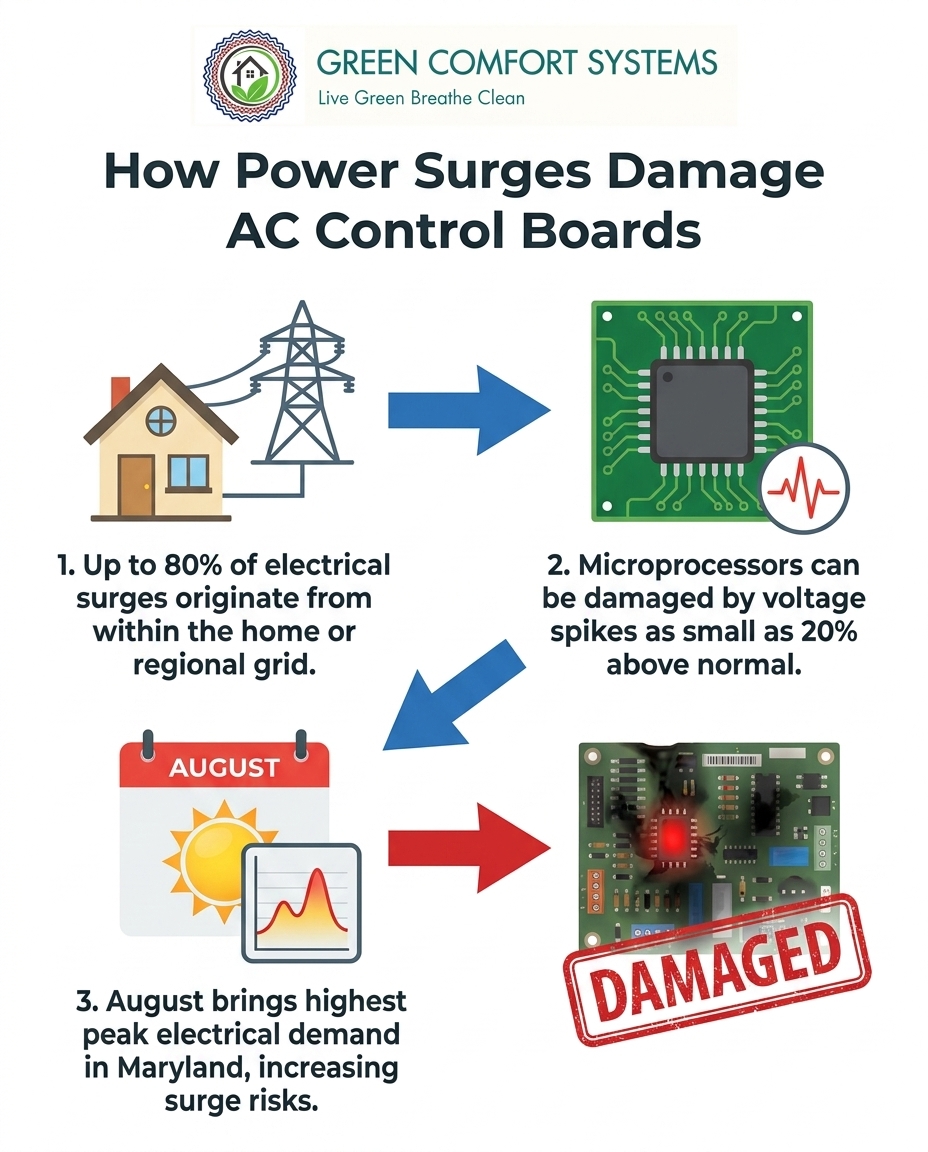
The cause: The real threat comes from the daily strain placed on the power grid. Maryland's intense late-summer heatwaves combine with afternoon thunderstorms to create dual threats: peak grid load fluctuations and lightning-induced surges. When thousands of homes in Abingdon simultaneously crank up their air conditioners to combat the August heat, the local utility grid is pushed to its limits. To manage this massive electrical demand, utility companies frequently perform grid switching, rerouting power to balance the load. This process can cause temporary voltage drops—commonly known as brownouts—followed by sudden, powerful surges when the voltage violently snaps back to normal.
The solution: Understanding the origin of these surges is essential for protecting your equipment. According to data from the National Electrical Manufacturers Association (NEMA) and the Insurance Institute for Business & Home Safety (IBHS), up to 80% of electrical surges originate from within the home itself or from these regional grid fluctuations, not from lightning. Every time a major appliance cycles on or the local grid adjusts to peak demand, a minor voltage spike ripples through your home's wiring. These everyday voltage spikes act as a silent killer for HVAC systems, slowly degrading the internal components until the equipment finally gives out.
The Impact of Brownouts on Compressor Motors
While power surges are devastating, the brownouts that often precede them are equally dangerous. When the voltage drops below the required level, your air conditioner's compressor motor has to work significantly harder to draw the amperage it needs to keep spinning. This excess current generates immense heat, baking the motor's internal insulation. When the power suddenly surges back to normal, the already-stressed components are hit with a massive spike, frequently resulting in a catastrophic electrical failure.
The Vulnerability of Modern AC Control Boards
To understand why air conditioners are so susceptible to these grid fluctuations, you have to look inside the cabinet. Older, purely mechanical air conditioners were relatively resilient to minor electrical anomalies. However, modern HVAC systems rely on highly sensitive microprocessors and complex control boards to maximize energy efficiency, variable-speed cooling, and smart thermostat communication. These advanced electronics are the brain of your cooling system, but they are also its Achilles' heel.
These sensitive control boards can be permanently damaged by voltage spikes as small as 20% above normal. Because August late-summer storms and peak grid load create an environment ripe for continuous electrical anomalies, your AC unit is constantly under attack. The damage is not always immediate. Instead, repeated minor surges cause dielectric breakdown, degrading the microscopic pathways on the circuit board over time. The components become weaker and weaker until one final, seemingly minor spike causes total failure.
Our technicians saw this firsthand just last August when a local homeowner's ductless AC unit started throwing confusing error codes during a severe late-summer heatwave. The system was receiving power, but the erratic behavior pointed directly to electrical stress inside the unit's brain. We dispatched a technician the next day, quickly pinpointing the electronic stress, clearing the faults, and recharging the unit to restore comfort. This scenario is a pattern we see often in our daily service calls: when a control board begins to fail due to surge degradation, the system will often miscommunicate, freeze up, or display bizarre error codes before shutting down entirely.
Signs Your Air Conditioner Suffered Storm Damage
If a severe storm has recently rolled through Abingdon, or if your neighborhood experienced a power flicker during a heatwave, you need to know what to look for. Diagnosing an electrical failure quickly can prevent further damage to the system. If you suspect your AC not cooling after a storm is due to a surge, watch for these specific symptoms:
• The system refuses to turn on: If you have reset the breaker at the main electrical panel and the unit still remains completely lifeless, the internal control board or the disconnect box fuse has likely blown.
• The thermostat is blank or unresponsive: Because the thermostat draws its low-voltage power directly from the air handler's control board, a fried board will instantly kill power to the thermostat on your wall.
• A clicking sound with no cooling: If you hear a distinct clicking noise coming from the outdoor cabinet but the compressor will not engage, the contactor is trying to close the circuit, but the damaged control board cannot send the proper signal to start the motor.
• A distinct burning smell: An acrid, ozone-like burning smell coming from the outdoor unit or the indoor air handler is a major red flag. This indicates melted wires or a scorched circuit board.
• Inconsistent cooling or strange error codes: If the unit turns on and off rapidly (short cycling) or flashes unusual error codes on its diagnostic display, the microprocessor has been corrupted by electrical stress.
When to Keep the Power Off
Safety warning: If you notice a burning smell, hear loud buzzing, or see scorch marks on the exterior of the unit, turn the system off at the thermostat and flip the breaker to the "off" position immediately. Do not attempt to run the system, as a compromised electrical component can cause further short circuits or even pose a fire hazard.
Responding to Sudden AC Failures During a Heatwave
When an electrical surge takes down your cooling system during peak summer heat, the situation escalates from an inconvenience to an emergency very quickly. The urgency of restoring cooling is especially critical when vulnerable family members, such as the elderly or infants, are in the home. We recently responded to a local family who realized the severity of this when their AC unit failed during a hot back-to-school week while they had a newborn baby at home. Because the situation was urgent, our dispatch team scheduled a technician immediately, arriving promptly to diagnose the electrical fault and safely resolve the issue, restoring a safe environment for the infant.
If you find yourself in a similar situation, taking the right immediate steps can protect your equipment from further harm. First, turn off the thermostat entirely. If the grid is still fluctuating or the power is flickering, leaving the thermostat calling for cooling will subject the system to repeated, damaging start-up attempts under low-voltage conditions. Next, check your main electrical panel to see if the dedicated HVAC breaker has tripped. If it has, you can attempt to reset it once. If it trips again immediately, stop. This is the breaker doing its job to protect your home from a dead short.
Crucial advice: Never attempt DIY electrical repairs on high-voltage HVAC components. The capacitors inside an air conditioner store lethal amounts of energy, even when the power is turned off at the breaker. When you call for emergency service, explain that the failure occurred after a power flicker or storm. During a professional diagnostic visit for a suspected fried control board, our technicians use a multimeter to trace the voltage from the disconnect box, through the contactor, and into the board itself to isolate exactly where the surge broke the circuit.
Whole-Home Surge Protectors vs. Basic Power Strips
When homeowners hear the word "surge protector," they usually picture the basic, multi-outlet power strips used for televisions and computers. While those are fine for small electronics, they offer absolutely zero protection for hardwired, high-voltage equipment like your air conditioning system. To truly defend your HVAC investment against grid instability, we highly recommend a different class of protection.
• Installation Location — Basic Plug-In Power Strip: Plugged into a standard wall outlet. — Whole-Home Surge Protector: Hardwired directly into the main electrical panel.
• HVAC Protection — Basic Plug-In Power Strip: None. Cannot connect to hardwired AC units. — Whole-Home Surge Protector: Comprehensive. Protects all hardwired appliances, including the AC and furnace.
• Voltage Capacity — Basic Plug-In Power Strip: Low. Designed for minor spikes on 120V circuits. — Whole-Home Surge Protector: High. Capable of intercepting massive external surges before they enter the home's wiring.
• Mechanism of Action — Basic Plug-In Power Strip: Absorbs small amounts of excess voltage until the internal fuse blows. — Whole-Home Surge Protector: Uses heavy-duty Metal Oxide Varistors (MOVs) to instantly redirect excess voltage safely into the earth ground.
How Whole-Home Protection Works
Whole-home surge protectors are installed directly at your main electrical panel by a licensed professional. When a massive voltage spike travels down the utility line toward your house, the whole-home unit acts as a gatekeeper. In a fraction of a millisecond, it detects the overvoltage and intercepts it, shunting the dangerous excess electrical current safely into the home's grounding system before it can ever reach your AC control board.
In areas with known grid instability, positioning this upgrade as a necessary defense rather than an optional luxury is vital. The cost of installing a whole-home surge protector is significantly less than the cost of emergency diagnostics, labor, and a replacement OEM control board for a modern, high-efficiency air conditioner.
Preventative Protection for Maryland Homeowners
Dealing with a broken air conditioner in the sweltering heat of August is a miserable experience, especially when the failure could have been prevented. Proactive defense is always more cost-effective and far less stressful than reactive emergency control board replacements. By acknowledging the reality of local grid fluctuations, you can take the necessary steps to shield your home's most expensive mechanical systems.
This is why working with a local team that understands regional electrical and weather challenges makes a massive difference. At Green Comfort Systems, our years of experience mean we understand Abingdon's specific grid challenges inside and out. We provide targeted preventative solutions like whole-home surge protection to save homeowners from costly control board replacements. We know exactly how the late-summer storms impact the local infrastructure, and we know how to properly defend your equipment against it.
Installing a whole-home surge protector doesn't just save your air conditioner; it also safeguards your refrigerator, washing machine, smart home devices, and every other sensitive appliance in the house. Whether you need an emergency diagnostic today or you are looking for preventative AC services in Bel Air and the surrounding neighborhoods, upgrading your home's electrical defense is the smartest investment you can make for long-term comfort and peace of mind.
Frequently Asked Questions
Can a power surge damage an air conditioner?
Yes, a power surge can severely damage an air conditioner. Modern AC units rely on sensitive microprocessors and electronic control boards that are highly vulnerable to voltage spikes. Even a minor surge can degrade these components over time, while a major spike can instantly fry the board, blow fuses, or permanently damage the compressor motor.
How do I know if my AC control board is fried?
The most common sign of a fried AC control board is a completely unresponsive system paired with a blank thermostat. Because the thermostat gets its power from the control board, a dead board means a dead screen. You might also notice a burning electrical smell near the indoor air handler, clicking noises with no startup, or erratic error codes flashing on the unit's diagnostic display.
Will a whole house surge protector protect my HVAC?
Yes, a whole-house surge protector is specifically designed to protect hardwired appliances like your HVAC system. Installed directly at your main electrical panel, it intercepts dangerous voltage spikes coming from the utility grid and redirects them safely into the ground before they can travel through your home's wiring and reach your air conditioner's sensitive electronics.
What should I do if my AC stops working after a power outage?
If your AC stops working after a power outage, first turn the thermostat to the "off" position to prevent the system from trying to start under low voltage conditions. Next, check your main electrical panel and reset the dedicated HVAC breaker if it has tripped. If the system still does not turn on, leave it off and call a professional, as the internal control board or fuses may have been damaged by the surge when power was restored.
Are HVAC surge protectors worth the investment?
HVAC surge protectors are absolutely worth the investment, particularly in areas prone to summer storms or grid fluctuations. The cost of replacing a fried control board or a damaged compressor is significantly higher than the cost of installing preventative surge protection. It acts as an insurance policy for your home's most expensive mechanical system.
How long does it take to replace a damaged AC control board?
Replacing a damaged AC control board typically takes a professional technician about one to two hours once the proper part is in hand. The complexity of the job involves safely disconnecting the high-voltage power, carefully mapping and transferring all the low-voltage communication wires to the new board, and testing the system to ensure the original surge didn't damage secondary components.
Book Expert Service Or Contact Us
Other Blogs


Get Financing Today
Get the comfort you deserve, without the financial stress.

Latest Blogs
Troubleshooting Your October Heating Startup in Rosedale: What's Normal and What's Not
Home Maintenance Tips and Troubleshooting: Answering Your Fall Heating Startup FAQs
Understanding the Senior HVAC Initiative & Fall Heating Startups: Common Questions Answered
