





UV Lights vs. Air Scrubbers: Choosing the Right IAQ Upgrade for Your Rosedale Home

The Myth of the 'Cure-All' Air Purifier
A persistent myth our team at Green Comfort Systems frequently encounters is that a single, heavily marketed air purifier will magically solve every indoor air problem, from lingering pet odors to seasonal airborne illnesses. In reality, there is no universal quick fix. When you are comparing UV Lights vs. Air Scrubbers: Choosing the Right IAQ Upgrade for Your Rosedale Home requires understanding exactly what is floating in your air. We often find that many homeowners mistakenly believe any standard filter will fix all indoor air issues, but standard filtration only traps physical particles like dust and hair. It does nothing to neutralize volatile organic compounds (VOCs), trapped household odors, or microscopic airborne viruses. Deciding whether a UV light or an air scrubber is the right investment means identifying your specific household needs first. You must determine if your primary goal is neutralizing trapped odors and chemical gases, or if you need to target airborne viruses and prevent mold growth directly on your cooling coils.
To ensure your air conditioning systems are truly supporting your health, you need the right indoor air quality upgrades.
Why Late Summer Traps Pollutants Indoors
As summer drags on, your home's natural ventilation drops to zero. Our technicians see firsthand how hot, humid late-summer weather forces Rosedale residents to keep windows tightly sealed and rely entirely on their central cooling systems. While this keeps the heat out, it creates a closed loop inside your living space. Everything generated indoors stays indoors. This environmental context is the primary driver behind the need for active indoor air quality (IAQ) intervention.
Maryland's high summer humidity levels, which regularly exceed 70 percent, create the perfect storm for trapped indoor pollutants. When the air outside is thick and heavy with moisture, your air conditioner works overtime to dehumidify your home. However, the tightly sealed nature of modern, energy-efficient homes means that while the air is cooled, it is just the same stale air being recirculated over and over. This recirculation traps volatile organic compounds (VOCs) from cleaning supplies, allergens from pets, and biological contaminants.
The urgency spikes during the August back-to-school transition. As children return to crowded classrooms, they inevitably bring new germs and viruses back into this tightly sealed home environment. Without a way to actively neutralize these threats, the closed-loop HVAC system simply distributes them into every room. Under these conditions, we regularly see indoor air become two to five times more polluted than outdoor air.
The Impact of Tightly Sealed Homes
Modern building standards prioritize energy efficiency, which is great for your utility bills but challenging for your lungs. On our service calls, we regularly observe a distinct trade-off between energy efficiency and fresh air circulation.
• Trapped daily odors: Cooking smells from dinner, pet dander from the dog bed, and moisture from hot showers have nowhere to vent, leading to a stale-smelling house.
• Chemical accumulation: The VOCs off-gassing from new furniture, fresh paint, and daily household cleaning chemicals build up in the air you breathe every day.
• Biological breeding grounds: Without fresh air exchange, the dark, damp spaces inside your ductwork and air handler become highly susceptible to microbial growth.
UV Lights: Targeting Biological Growth at the Source
If your primary concern is biological contaminants—such as mold, mildew, bacteria, and viruses—ultraviolet (UV) light technology is the most effective targeted solution. UV-C light works by penetrating the cellular walls of biological contaminants and destroying their DNA. Once the DNA is scrambled, these microorganisms can no longer reproduce or cause illness, rendering them harmless.
The effectiveness of a UV purifier depends entirely on where it is placed. We recommend mounting it directly over the indoor evaporator coil. Your evaporator coil gets incredibly cold during the summer, naturally pulling moisture out of the humid Rosedale air. This creates a constantly wet, dark environment inside your air handler—the exact conditions mold spores need to thrive.
One local rental property owner we recently worked with discovered this the hard way when their split units developed black mold and a deeply unpleasant smell after years without proper cleaning. Our technicians had to perform a deep cleaning, complete a full disassembly, and install replacement parts just to resolve the biological buildup. A properly installed UV light prevents this exact scenario from ever taking root by bathing the coil in continuous, germicidal light.
1. Installation: A professional technician mounts the UV-C bulb inside the air handler, focusing the light directly on the evaporator coil and drain pan.
2. Continuous Exposure: As the system runs, the coil remains irradiated, preventing any mold spores from taking hold on the wet metal surfaces.
3. Airborne Disruption: As air passes through the system, airborne viruses and bacteria are exposed to the light, neutralizing them before they can be circulated back into your living space.
Best Use Cases for UV Purifiers
Because Maryland's regional humidity necessitates active UV intervention to keep cooling coils free of biological growth, we find this technology is highly specific in its benefits.
• Homes with a history of HVAC mold: If you have ever experienced "dirty sock syndrome" (a musty, locker-room smell coming from your vents), a UV light will eliminate the bacterial growth causing it.
• Health-focused households: Families focused on neutralizing airborne viruses during the back-to-school season benefit greatly from the germicidal properties of UV-C light.
Air Scrubbers: Active Odor and VOC Neutralization
While UV lights are stationary guardians protecting your HVAC equipment, our team considers air scrubbers to be active hunters that clean the air throughout your entire home. An air scrubber utilizes a process called photocatalytic oxidation (PCO). Instead of passively waiting for polluted air to pass through a dense filter, an air scrubber generates highly reactive, air-cleansing molecules—often referred to as "scrubber ions."
These purifying molecules are pushed out through your ductwork and into your living spaces. Once in the room, they actively seek out and break down volatile organic compounds, cooking gases, and microscopic odor-causing particles at the molecular level.
Installation mechanics differ significantly from UV lights. An air scrubber is typically mounted in the supply side of the ductwork, just after the air leaves the heating and cooling equipment. Because the technology relies on pushing purifying molecules throughout the house, effective scrubbers rely on clean, well-maintained ductwork to distribute purified air efficiently. If your ducts are leaking or heavily congested with debris, the scrubber's effectiveness drops, which is why we often recommend pairing this upgrade with our professional ductwork services to yield the best results.
Best Use Cases for Air Scrubbers
In our experience, air scrubbers shine when the problem is chemical or odor-based rather than strictly biological.
• Homes with multiple indoor pets: Active scrubbers neutralize the lingering odors of wet dogs, litter boxes, and pet dander that settle into fabrics.
• Persistent cooking odors: If the smell of last night's dinner lingers in the kitchen until the next afternoon, an air scrubber will break down those airborne grease and spice molecules.
• Allergy sufferers: Households heavily impacted by seasonal allergens and dust benefit from the way scrubber molecules clump microscopic particles together, making them large enough for standard filters to finally catch.
Side-by-Side Comparison: Which Technology Wins?
When Rosedale homeowners ask us to choose between these two systems, we explain that it requires a clear understanding of their primary strengths. Neither technology is inherently "better" than the other; they simply do different jobs. It is also vital to clarify that neither technology replaces the need for standard particulate air filters. You will always need a physical filter to catch large dust, hair, and debris.
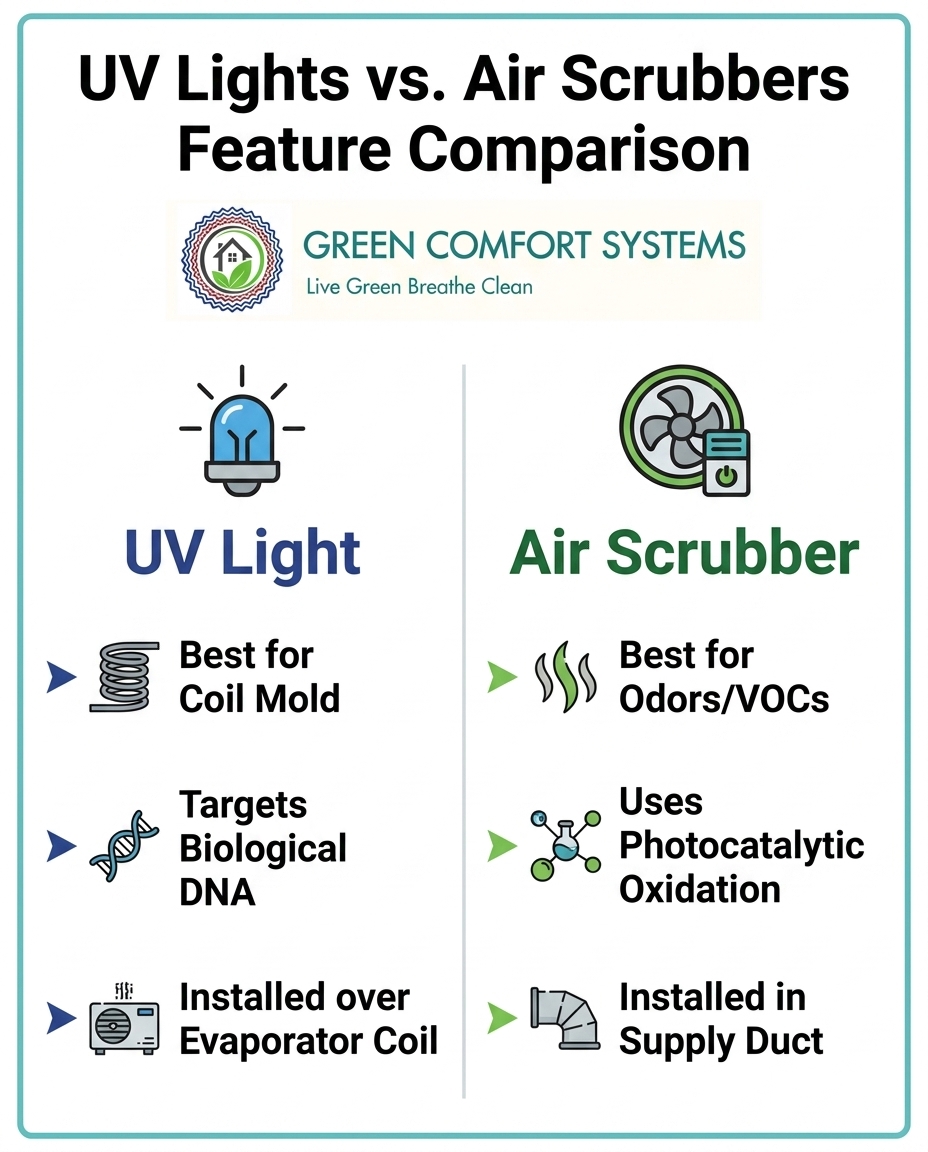
• Primary Target — UV Lights (Coil Purifiers): Biological contaminants (mold, bacteria, viruses) — Air Scrubbers (PCO Technology): Odors, VOCs, chemical gases, and fine allergens
• Coverage Area — UV Lights (Coil Purifiers): Coil-specific (protects the internal HVAC equipment) — Air Scrubbers (PCO Technology): Whole-home active distribution (cleans air inside the rooms)
• Installation Point — UV Lights (Coil Purifiers): Directly over the indoor evaporator coil — Air Scrubbers (PCO Technology): Inside the main supply ductwork plenum
• Maintenance Needs — UV Lights (Coil Purifiers): Annual UV-C bulb replacements — Air Scrubbers (PCO Technology): Periodic PCO cell replacements (typically every 1-2 years)
• Best For... — UV Lights (Coil Purifiers): Preventing HVAC mold and neutralizing airborne illnesses — Air Scrubbers (PCO Technology): Eliminating pet smells, stale air, and household chemicals
Field-Tested Performance in Local Homes
Manufacturer claims often overstate capabilities, presenting data gathered in perfect, sterile lab conditions. In a laboratory setting, a single device might seem capable of solving every air quality issue on earth. However, real-world application is much different.
At Green Comfort Systems, our recommendations are rooted in decades of local field-testing experience to provide definitive guidance based on actual performance in Maryland homes. Through years of installing and servicing these units in Rosedale basements, attics, and utility closets, our technicians see exactly how they perform against local environmental stress.
Our field insights show that UV lights are unparalleled for keeping coils clean in humid local environments. When a home struggles with a damp basement or an attic unit that sweats during August heat waves, we find a UV light is the only reliable way to keep the system from turning into a mold factory. On the other hand, our local installations show that air scrubbers provide the most noticeable, immediate difference for homeowners complaining of stale air, lingering pet smells, or allergy flare-ups.
Ultimately, the "best" choice depends entirely on the homeowner's primary complaint. If your goal is protecting the equipment and stopping mold, we recommend UV. If your goal is changing how the air in your living room smells and feels, we recommend a scrubber.
Why Humidity Control Matters for Both Systems
No indoor air quality technology operates in a vacuum. As HVAC professionals, we always emphasize that the overall health of your home's air is deeply tied to your broader HVAC performance and humidity management. Neither UV lights nor air scrubbers will function at peak efficiency if your indoor humidity is spiraling out of control.
When relative humidity rises above 60 percent indoors, the air becomes heavy and saturated. This excess moisture fuels mold growth faster than a UV light can neutralize it. If the biological load is too high because the environment is constantly wet, the UV light will be overwhelmed. Similarly, high humidity makes the air feel sticky and causes odors to linger longer, forcing an air scrubber to work much harder to achieve the same neutralizing effect.
Your air conditioner is your first line of defense against humidity, but sometimes it needs help, especially during the peak heat of late summer. Taking proactive steps in managing indoor humidity ensures that your newly installed IAQ upgrades have the right environment to do their jobs effectively.
Frequently Asked Questions About IAQ Upgrades
Which is better for HVAC: UV light or air scrubber?
The short answer we give our customers is that neither is universally better; they serve different purposes. A UV light is better for protecting your HVAC equipment from mold and neutralizing biological threats like viruses. An air scrubber is better for actively cleaning the air in your living spaces, neutralizing odors, and breaking down chemical VOCs. Your choice should be based on your specific air quality concerns.
Do UV lights eliminate household odors?
UV lights do not eliminate general household odors like cooking smells, pet dander, or chemical off-gassing. However, if you have a musty, moldy odor coming from your vents (often called "dirty sock syndrome"), a UV light will eliminate that specific smell by killing the bacteria causing it on your cooling coil. For all other odors, we recommend installing an air scrubber.
What is the difference between an air scrubber and a UV purifier?
A UV purifier is a stationary light that shines on your indoor cooling coil, destroying the DNA of mold and bacteria that try to grow there. An air scrubber is an active device placed in your ductwork that creates purifying molecules and sends them out into your home to hunt down and neutralize odors, VOCs, and allergens in the air you breathe.
Do air scrubbers really work to reduce VOCs?
Yes, air scrubbers are highly effective at reducing volatile organic compounds (VOCs). They use a process called photocatalytic oxidation to break down complex chemical gases into harmless byproducts like water vapor and carbon dioxide. Our field testing consistently shows a significant reduction in the chemical smells associated with cleaning supplies, fresh paint, and new furniture.
Where should a UV light be installed in an HVAC system?
For maximum effectiveness, our technicians install a UV-C light directly inside the indoor air handler, positioned to shine continuously on the evaporator coil and the condensate drain pan. This is the darkest, wettest part of your HVAC system and the most likely place for mold and bacteria to breed if left unprotected.
Can I use both a UV light and an air scrubber in the same home?
Absolutely. In fact, combining both technologies provides the most comprehensive indoor air quality protection available. The UV light will protect your physical equipment and stop biological growth at the source, while the air scrubber will actively clean the air in your living spaces and neutralize daily household odors.
Secure Your Home's Air Quality Before Fall
As the August back-to-school transition approaches, securing your home's air quality has never been more important. At Green Comfort Systems, we know that matching the right technology to your specific household concern is the only way to ensure lasting satisfaction. Whether you need the biological protection of a UV light to combat mold and viruses, or the active odor-neutralizing power of an air scrubber to handle VOCs and allergens, taking action now will prepare your home for the months ahead. Do not wait until the windows are sealed tight for the season. Schedule a professional assessment with our team today to determine which of these indoor air quality upgrades is the perfect fit for your system, giving you the clear, field-tested results you deserve.
Book Expert Service Or Contact Us
Other Blogs


Get Financing Today
Get the comfort you deserve, without the financial stress.

Latest Blogs
Diagnosing a Blower Motor Failure When Your Furnace Runs but Produces No Air
The Anatomy of a Fast Towson Furnace Repair: How We Diagnose Ignitor Failures
Clearing the Air: How We Handle Lingering Musty Odors During Your October Heating Startup
