





Why Your Attic Ductwork is Sweating During Maryland's Humid August Days

Unexplained Ceiling Water Spots: The Late-Summer Attic Condensation Problem
At Green Comfort Systems, our team fields countless panic calls right around the back-to-school season from local homeowners staring at a spreading brown water stain on their ceiling. If you are dealing with this right now, you might be wondering exactly why your attic ductwork is sweating during Maryland's humid August days. That sudden drip of water falling from a ceiling vent, or the appearance of unexplained damp patches on your drywall, usually triggers immediate panic about a severe roof leak. However, if the weather has been dry and your air conditioner has been running non-stop to combat the late-summer heatwave, your roof is likely perfectly fine. Instead, a pattern we see often is condensation forming on uninsulated or poorly sealed ductwork hidden just above your ceiling.
The late-summer peak: This alarming scenario typically peaks right at the end of the season. When August peak humidity rolls in, attic temperatures skyrocket, creating a brutally hot and moisture-heavy environment right next to your freezing cold air conditioning components. As your system works overtime to keep your living space comfortable, the drastic temperature difference between the inside of the ducts and the outside attic air forces water to condense rapidly.
Addressing this hidden moisture quickly is absolutely critical before it compromises your drywall and leads to expensive structural damage. Ignoring a sweaty duct system won't make the problem disappear once the weather cools down; it simply delays the inevitable mold growth and energy waste. That is precisely why investing in professional ductwork services is the smartest way to protect your home's interior while ensuring your cooling system operates safely and efficiently through the harshest parts of the summer.
The Science of Sweating Ducts: Understanding Dew Point Physics
To understand why water is suddenly pooling above your ceiling, we have to look at the basic science of how temperature and moisture interact. The short answer is that sweating ducts are a solvable physics problem, not necessarily a sign of catastrophic mechanical failure within your AC unit itself. It all comes down to a concept called the dew point.
What is the Dew Point?
The dew point is the specific temperature at which air can no longer hold all of its invisible water vapor. When air cools down to this exact temperature, it is forced to release that excess moisture, which then condenses into liquid water droplets. You see this exact same scientific principle in action every time you take a freezing cold glass of ice water outside on a sweltering summer afternoon. Within seconds, the outside of the glass is dripping wet. The glass isn't leaking; the hot, humid air hitting the cold glass is reaching its dew point.
The Temperature Clash in Your Attic
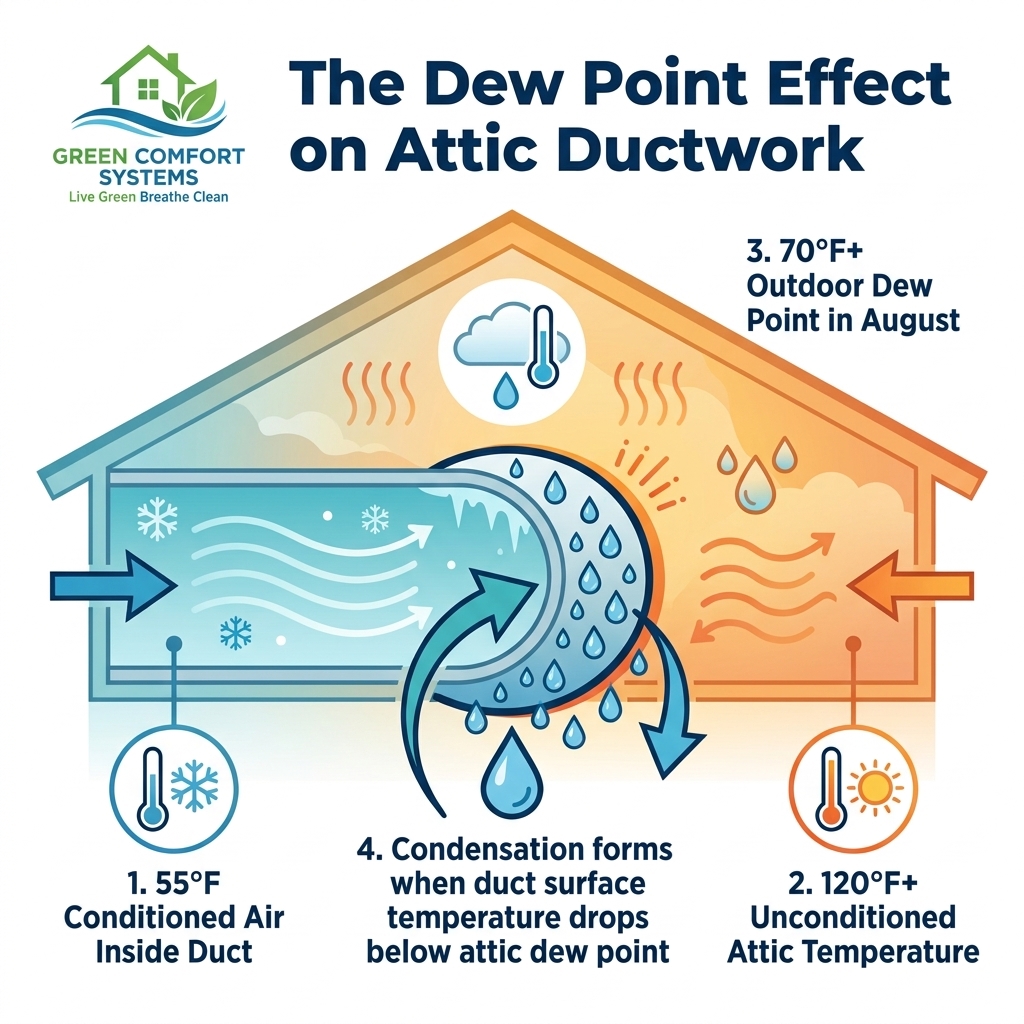
The underlying cause: Now, apply that same ice-water logic to the ductwork running through your home. Inside those metal or flexible tubes, your air conditioner is pushing beautifully chilled, 55-degree conditioned air. But outside those tubes, the unconditioned attic air surrounding them is often baking at 120 degrees or higher. When the outer surface temperature of the ductwork falls below the dew point of that blistering attic air, water droplets rapidly form across the entire surface of the duct.
The ultimate solution: This severe condensation is a classic symptom of a thermal boundary failure. In simple terms, there is not enough insulation separating the freezing cold metal from the boiling hot air. Dew point physics in unconditioned attics dictate that unless a proper thermal barrier is established, the sweating will continue as long as the AC is running. Stopping the sweat requires re-establishing that barrier so the humid air never actually touches the cold surface of the duct.
Why Maryland's August Climate Creates the Perfect Storm for Condensation
While duct condensation can happen anywhere, our technicians know from years of experience that homes in Rosedale MD and surrounding Maryland communities are particularly vulnerable due to our specific regional weather patterns. Maryland sits in a humid subtropical climate zone, which means our late summers are defined by thick, heavy moisture moving up the East Coast. During August, it is incredibly common for outdoor dew points to frequently exceed 70 degrees—a level that meteorologists classify as "oppressive."
The trapped moisture effect: When these tropical moisture surges hit our region, that heavy, wet air inevitably finds its way into your unconditioned attic through soffits and ridge vents. While attic ventilation is necessary for the health of your roof, it also means your attic is constantly inhaling that 70-plus degree dew point air. Because heat rises and gets trapped beneath the roof deck, the moisture load inside the attic becomes highly concentrated. The air up there isn't just hot; it is practically a steam room.
Why standard insulation fails: In milder, drier climates out West, standard or aging duct insulation might be enough to prevent condensation. But under Maryland's extreme East Coast humidity levels, that basic protection quickly fails. We routinely find that local homes require significantly higher R-value insulation and perfectly intact vapor barriers to withstand these specific regional extremes. If your home's ductwork was installed decades ago, or if it was built using builder-grade materials meant for a less demanding climate, it is simply outmatched by a Maryland August.
Diagnosing the Drip: Sweating Ducts vs. Other Ceiling Leaks
When you notice water damage on your ceiling, correctly identifying the source is the crucial first step toward a permanent fix. Because the symptoms can look surprisingly similar to the untrained eye, homeowners often misdiagnose the problem. Here is how you can distinguish between sweating ducts, a malfunctioning AC component, and a traditional roof leak.
• Sweating Ductwork — Visual Signs & Symptoms: Widespread, localized dampness that follows the linear path of the ductwork. Water drips directly from ceiling vents. — Timing & Context: Occurs during hot, humid weather when the AC is running continuously. No rain required.
• Clogged Condensate Drain — Visual Signs & Symptoms: A heavy, concentrated overflow in one specific area, usually directly beneath the indoor air handler unit. — Timing & Context: Happens when the AC is running, but the drip is much heavier and more localized than duct sweat.
• Late-Summer Roof Leak — Visual Signs & Symptoms: Brown stains that can appear anywhere, often running down walls or pooling away from HVAC equipment. — Timing & Context: Directly correlates with recent thunderstorms or heavy rainfall, regardless of AC usage.
If you suspect the issue is coming from the air conditioning equipment itself rather than the ductwork, you might be dealing with a backed-up drain pan or a frozen evaporator coil. Differentiating between these issues is vital. For a deeper dive into diagnosing equipment-specific drips, you can review our guide on an AC leaking water from the ceiling to help pinpoint the exact mechanical failure.
The Hidden Dangers of Ignoring Attic Condensation
It is tempting to place a bucket under a dripping vent and hope the problem resolves itself when autumn arrives. But ignoring sweating ducts introduces secondary risks that go far beyond cosmetic water stains. When moisture is allowed to persist in a dark, enclosed space, the consequences escalate rapidly.
The progression of drywall damage: Drywall acts like a giant sponge. What starts as minor, yellowish discoloration quickly progresses to sagging and softening. Because duct sweat often spans the entire length of a duct run, it can saturate large sections of the ceiling simultaneously. If left unchecked, the weight of the waterlogged drywall will eventually cause a complete ceiling collapse, bringing wet insulation and debris down into your living room.
Mold and indoor air quality: Chronic moisture in a dark, 120-degree attic creates the ultimate breeding ground for mold and mildew. As mold colonies multiply on the wet ductwork and surrounding wood framing, they release spores into the air. If your duct seams are unsealed—which is incredibly common in older Rosedale MD and surrounding Maryland homes—the negative pressure of the HVAC system can actively pull those mold spores inside the ducts and blow them directly into your living space. Addressing the moisture is a critical component of effective indoor air quality solutions.
The hidden energy penalty: Beyond the structural and health risks, sweating ducts are quietly driving up your utility bills. Leaky, wet ducts lose their thermal resistance. According to energy experts, compromised ductwork in unconditioned spaces can lose up to 20 percent of its cooling efficiency. You are paying to air condition your attic while your living room struggles to stay cool.
Why Slapping Insulation Over Sweating Ducts is a Costly Mistake
When homeowners discover bare, sweating metal ducts in their attic, the immediate instinct is often to head to the hardware store, buy a few rolls of fiberglass insulation, and wrap the wet ducts tightly. Unfortunately, this is one of the most frequent and costly mistakes our team sees in the field.
The problem with unsealed wrapping: Slapping new insulation over unsealed, sweating ducts traps existing moisture inside the fiberglass. Fiberglass loses its insulating properties when it gets wet, rendering your efforts entirely useless. Worse, trapping that moisture against the metal accelerates rust and creates a perfect, undisturbed environment for severe mold growth hidden beneath the shiny new outer layer.
The cause of the failure: The core issue isn't just a lack of insulation; it is a lack of an airtight seal. Ductwork is assembled in sections, and the joints between those sections often leak cold air. If you insulate over a leak, the cold air still escapes, hits the humid air trapped under the insulation, and reaches the dew point anyway.
The comprehensive solution: At Green Comfort Systems, our comprehensive approach involves sealing leaks prior to insulation. The professional process requires that the ducts be completely dried out first. Then, every single seam, joint, and connection must be properly sealed with professional-grade mastic—a thick, rubbery sealant that stops air leaks permanently. Only after the duct system is entirely airtight can we apply high R-value insulation and a secure vapor barrier. This two-step process (seal, then insulate) is the only way to achieve true energy efficiency and permanent moisture control.
Comprehensive Professional Solutions for Dry, Efficient Ductwork
Solving dew point physics in unconditioned attics requires more than just tape and fiberglass; it requires a holistic understanding of how your home's airflow, ventilation, and cooling systems interact. Professional assessment and intervention solve the root cause of the problem while optimizing your system's overall performance.
Here is what a comprehensive professional ductwork solution actually looks like:
1. System and Airflow Diagnostics: A licensed technician will first evaluate the overall health of your HVAC system. This includes checking the static pressure to ensure the air handler is pushing the right volume of air, inspecting the existing vapor barrier for tears, and evaluating the overall attic ventilation to see if excess heat is being properly exhausted.
2. Mastic Sealing and Leak Prevention: Once the ducts are dried, technicians apply professional mastic sealant to every joint, collar, and plenum connection. Unlike standard duct tape, which dries out and peels away in extreme attic heat, mastic creates a permanent, flexible bond that prevents cold air from escaping and humid air from entering.
3. High R-Value Insulation Wrapping: Finally, the sealed ducts are wrapped in high R-value insulation equipped with a durable, integrated vapor barrier. This creates the essential thermal boundary needed to keep the cold surface of the duct completely isolated from the hot attic air.
When one local homeowner recently faced a persistent cooling issue with their AC unit, technician Eric provided thorough service. Instead of just pushing a quick fix, he offered practical efficiency suggestions to resolve the underlying airflow problems without being pushy. That comprehensive approach is exactly what is needed to ensure your home stays quiet, cool, and dry.
As an added benefit, resolving severe ductwork leaks often improves the overall cooling performance of your AC unit so dramatically that it can lower your monthly utility costs. In many cases, upgrading your home's energy efficiency through professional duct sealing can even qualify for general energy rebates or tax credits (we always recommend verifying current incentive programs with your local utility provider or tax professional).
Frequently Asked Questions About Attic Duct Condensation
Why is there condensation on my attic ductwork?
Condensation forms when hot, humid attic air comes into contact with the cold surface of uninsulated or poorly insulated AC ducts, reaching the dew point. Because the air inside the duct is around 55 degrees and the attic air can exceed 120 degrees, the drastic temperature difference forces moisture in the air to turn into liquid water. This is the exact same physical reaction that causes a cold glass of water to sweat on a hot summer day.
Is it normal for air ducts to sweat?
While minor condensation can occur in extremely humid environments, excessive sweating that drips or causes ceiling damage is not normal and indicates a failure in insulation or vapor barriers. A properly sealed and insulated duct system creates a thermal boundary that prevents the humid air from ever touching the cold metal. If your ducts are dripping continuously, our technicians advise that your system requires professional attention.
Can sweating ducts damage my ceiling?
Yes, persistent dripping from sweating ducts can cause drywall discoloration, sagging, mold growth, and eventually structural failure of the ceiling. Because drywall absorbs water like a sponge, a small drip can quickly saturate a large area. Addressing the condensation early is critical to preventing expensive drywall repairs and keeping mold spores out of your living space.
How do you fix sweating AC ducts?
The permanent fix involves drying the ducts, professionally sealing all seams with mastic to prevent air leaks, and wrapping them in adequate insulation with a proper vapor barrier. Attempting to wrap wet or unsealed ducts with fiberglass will only trap the moisture inside, rendering the insulation useless and accelerating rust and mold. This two-step process of sealing followed by insulating must be done meticulously.
Will running a dehumidifier in the attic stop duct sweat?
Running a dehumidifier in an unconditioned, ventilated attic is highly inefficient and ineffective; the correct solution is insulating and sealing the ductwork itself. Because attic vents constantly pull in new outside air, a dehumidifier would essentially be trying to dry out the entire neighborhood. Fixing the thermal boundary on the ducts is the only scientifically sound way to stop the condensation.
Protect Your Ceilings and Lower Your Cooling Costs This Summer
Sweating ducts are a solvable physics problem, not a sign of catastrophic AC failure. When August peak humidity pushes your attic temperatures to the limit, that drastic clash between cold conditioned air and sweltering attic heat will always produce condensation if your thermal boundary is compromised. The good news is that by addressing the issue promptly, you can permanently prevent costly drywall repairs, stop dangerous mold remediation in its tracks, and restore your system's lost efficiency.
Don't wait for a small water spot to turn into a collapsed ceiling. By investing in professional air conditioning maintenance and comprehensive duct sealing, you can secure your home's efficiency for the remainder of the summer. Ensure your ductwork is properly sealed, heavily insulated, and ready to keep you comfortable without wasting your energy dollars.
Book Expert Service Or Contact Us
Other Blogs


Get Financing Today
Get the comfort you deserve, without the financial stress.

Latest Blogs
Diagnosing a Blower Motor Failure When Your Furnace Runs but Produces No Air
The Anatomy of a Fast Towson Furnace Repair: How We Diagnose Ignitor Failures
Clearing the Air: How We Handle Lingering Musty Odors During Your October Heating Startup
