





Adding a Mini Split to Your Rosedale Sunroom: Cooling Spaces Your Main AC Can't Reach

The Challenge of Cooling a Sunroom Without Overburdening Your Main AC
Your sunroom is supposed to be a relaxing retreat, but right now, it feels more like a greenhouse. The afternoon sun beats through the glass, raising the temperature until the space becomes completely unusable during peak summer heat. If you are researching adding a mini split to your Rosedale sunroom: cooling spaces your main AC can't reach, you have likely realized that keeping this room comfortable requires a targeted approach. When our technicians visit homes across the area, the core dilemma we see most homeowners face is whether to tap into the home's existing central ductwork or treat the addition as a completely independent climate zone.
For comprehensive whole-home solutions, explore our Air Conditioning Services, or learn more about dedicated Ductless Mini Split Installation.
Sunrooms are architecturally unique spaces. Unlike a standard bedroom or living room, a sunroom features massive glass exposures, minimal wall insulation, and often lacks the attic space necessary for traditional ductwork routing. These structural differences mean the room absorbs heat at a drastically different rate than the rest of your house. When the summer sun hits those windows, the temperature inside can spike rapidly, creating an uncomfortable environment that forces you back into the main living areas.
Many homeowners initially assume the cheapest and easiest fix is to simply cut a hole in an existing duct and run a new vent into the sunroom. On paper, this seems logical. You already have a central air conditioner, so why not use it? However, as we consistently remind our customers, residential HVAC systems are not designed to accommodate sudden additions. Your central unit was sized specifically for the original square footage of your home.
Treating the sunroom as an independent climate zone is almost always the most effective solution. By separating the sunroom from the main central air system, you avoid disrupting the carefully calibrated airflow of your house. An independent system allows you to cool the sunroom only when you are actively using it, rather than forcing your main unit to run non-stop to compensate for a room made entirely of glass.
Why Extending Central Ductwork Ruins Your Home's Airflow Balance
To understand why tapping into existing ductwork is problematic, we always explain the physics of residential airflow to our clients. A perfectly balanced central AC system relies on precise duct sizing and carefully calculated static pressure. Think of static pressure like blood pressure for your home's HVAC system. The blower motor is designed to push a specific volume of air against a specific amount of resistance.
When you alter that system by extending central ductwork to a new room, you disrupt that delicate balance. Here is exactly how adding a sunroom vent compromises your entire system:
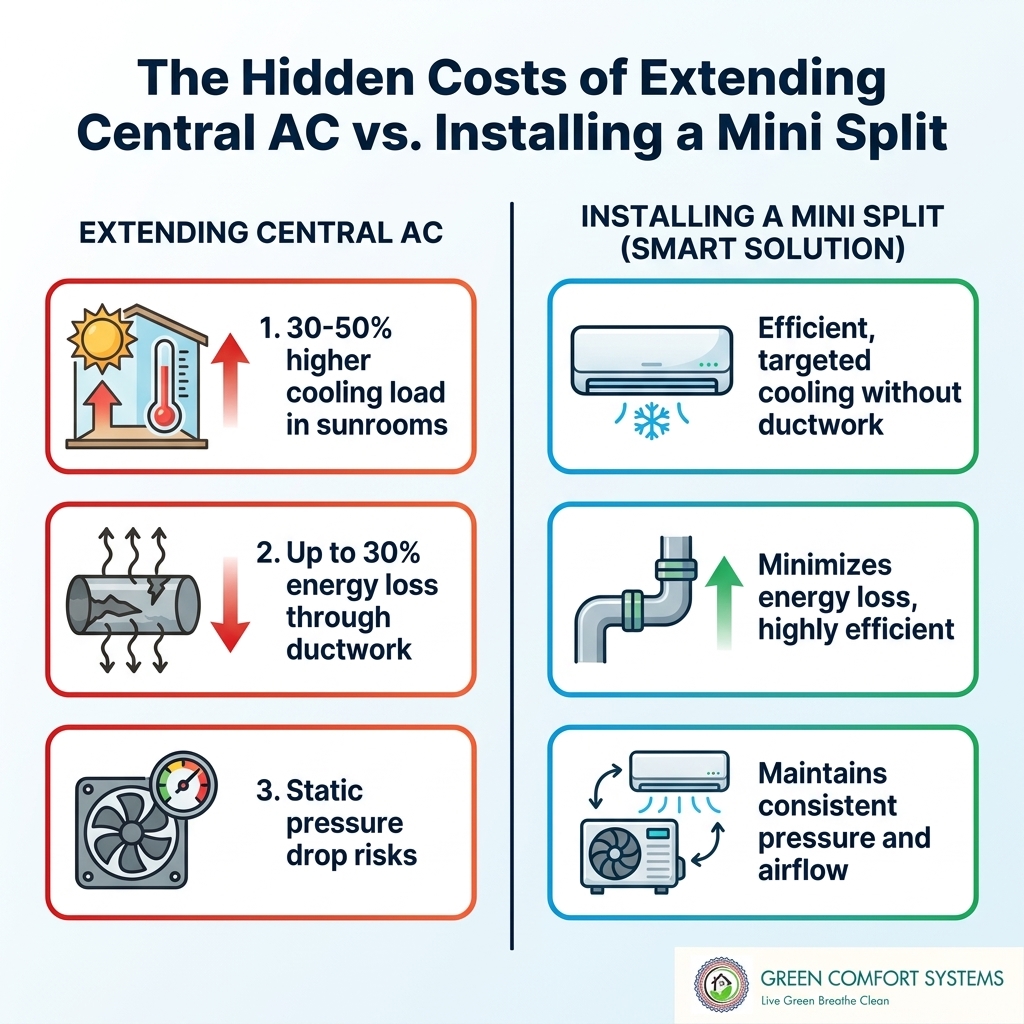
1. The static pressure drop: Adding new duct runs to a sunroom acts like poking a hole in a balloon. The air pressure drops across the entire system. Your blower motor now has to work significantly harder to push air to the furthest rooms in your house, resulting in weak airflow in bedrooms and living spaces.
2. The thermostat mismatch: Your central thermostat is likely located in a shaded, interior hallway. It reads the temperature of the main house, not the sunroom. When the hallway reaches 72 degrees, the AC shuts off. Meanwhile, the sunroom experiencing extreme solar heat gain might still be 85 degrees. The system simply does not know the sunroom needs more cooling.
3. Increased wear and tear: Because the sunroom stays hot, many homeowners crank the central thermostat down to 68 degrees just to make the sunroom bearable. This forces the compressor to run far beyond its intended duty cycle, drastically reducing the lifespan of the equipment and increasing the risk of premature failure.
4. Significant energy loss: Ductwork is notoriously inefficient. Even in well-sealed systems, pushing conditioned air through long stretches of ductwork results in thermal loss. In fact, ductwork alone can account for more than 30 percent of energy consumption for space conditioning.
The bottom line: Forcing your central AC to cool a space it was never designed to handle will leave your main living areas freezing, your sunroom uncomfortably warm, and your energy bills higher than ever.
Tackling Solar Heat Gain and Latent Heat in Glass-Heavy Rooms
In our years of servicing Maryland homes, we've found that cooling a sunroom is not just about lowering the temperature; it is about managing the specific type of heat that glass rooms generate. Sunrooms can experience 30 to 50 percent higher cooling loads than standard rooms due to solar heat gain. When sunlight passes through the glass, it heats the floors, furniture, and air inside. Because heat does not easily escape back through the glass, the room acts exactly like a greenhouse.
This greenhouse effect introduces a major challenge regarding humidity. In the HVAC industry, we measure two types of heat: sensible heat (the actual temperature you read on a thermometer) and latent heat (the amount of moisture or humidity in the air). Managing latent heat is critical for indoor comfort, which is why exploring dedicated Indoor Air Quality Solutions is often necessary for unique spaces.
The Challenge of Humid Maryland Summers
July in Rosedale brings high relative humidity, requiring severe latent heat load management that a central AC simply is not zoned to handle. When the air is thick with moisture, your body cannot sweat efficiently, making a 78-degree sunroom feel like a swamp. To remove this humidity, warm air must pass over the cold evaporator coils of an air conditioner for a sustained period.
Here is where the central AC fails the sunroom again. Because the central thermostat is in the cooler main house, the AC cycles on, quickly cools the hallway, and shuts off after 10 or 15 minutes. This short cycle is not nearly enough time for the system to pull the heavy July humidity out of the sunroom air. The result is a room that feels cold but clammy—a breeding ground for musty odors and discomfort.
The independent zoning advantage: An independent ductless system features its own air handler and its own thermostat located right inside the sunroom. It monitors the exact temperature and humidity of that specific space. It runs exactly as long as needed to properly dehumidify the room, providing dedicated latent heat removal without freezing out the rest of your house.
Ductless vs. Window Units: The Eco-Friendly Upgrade
Once homeowners realize that extending central ductwork is a bad idea, the decision usually comes down to two independent options: a traditional window AC unit or a ductless mini-split system. While window units are cheap upfront, they come with significant long-term drawbacks regarding noise, security, and energy waste.
Window units are notoriously loud because the compressor—the noisiest part of an air conditioner—sits right inside the window frame. They also block your view, create security vulnerabilities, and are notorious for developing mold and dirt buildup over time. Recently, our team at Green Comfort Systems helped a Rosedale homeowner who had relied on aging window units for years finally make the switch to a ductless system right in the middle of a July heatwave. The old window units were becoming moldy, noisy, and failing to keep up with the peak summer heat. After we completed the installation, they found the new mini-split to be exceptionally quiet, cool, and cost-efficient, finally giving them the high-performance cooling and improved IAQ they needed.
Comparing Sunroom Cooling Options
• Window Unit — Energy Efficiency: Low (High electricity draw) — Noise Level: Loud (Compressor in window) — IAQ Impact: Poor (Prone to mold/dirt buildup)
• Central AC Extension — Energy Efficiency: Poor (30% duct loss) — Noise Level: Moderate (Airflow noise) — IAQ Impact: Moderate (Pulls dust from main house)
• Ductless Mini-Split — Energy Efficiency: High (Inverter technology) — Noise Level: Whisper Quiet — IAQ Impact: Excellent (Multi-stage filtration)
At Green Comfort Systems, our team consistently prioritizes eco-friendly solutions, and independent ductless systems use significantly less energy than overworked central units or standard window ACs. This incredible efficiency comes from inverter-driven compressor technology. Standard air conditioners blast on at 100 percent capacity, run until the room is cold, and then shut off completely. This constant on-and-off cycling draws massive amounts of electricity.
A ductless system operates differently. The inverter compressor can speed up or slow down smoothly, like the gas pedal on a car. It ramps up to cool the sunroom down quickly, and then dials back to a low, energy-sipping speed to maintain the temperature perfectly. This eliminates power spikes and provides whisper-quiet operation. For a deeper look at how this technology operates under heavy summer loads, you can review modern Heat Pump Systems.
Frequently Asked Questions About Sunroom Cooling in Maryland
Before finalizing your sunroom cooling strategy, you may want to review local regulations, such as whether you need a permit to install a mini split in Maryland. Homeowners in Rosedale often ask our technicians specific questions about managing the climate in their additions. Here are detailed answers to the most common queries we receive.
Why shouldn't I extend my central AC to my sunroom?
We strongly advise against this because extending your central AC disrupts the static pressure and carefully balanced airflow of your entire home. Your existing unit was sized for the original square footage, not an addition made entirely of glass. Adding ductwork causes a pressure drop that reduces airflow to other rooms, leaving your bedrooms warm while the system struggles. Furthermore, because the central thermostat is not located in the sunroom, it cannot accurately read or respond to the intense heat building up in the glass enclosure.
What is the most energy-efficient way to cool a sunroom in summer?
In our experience, independent ductless mini-splits are the most energy-efficient solution for sunroom cooling. They bypass the massive energy losses associated with traditional ductwork, which can waste up to 30 percent of conditioned air. By utilizing inverter-driven compressors, mini-splits adjust their output to match the exact cooling demand of the room in real-time. This allows you to provide targeted cooling only when the room is in use, saving significant electricity compared to a central system running constantly.
Will extending ductwork ruin my central AC?
Yes, extending ductwork to a high-heat addition can lead to premature system failure. When you add a sunroom to an existing central system, you force the equipment to work significantly harder than its rated capacity. The blower motor strains against compromised static pressure, and the compressor runs longer cycles trying to satisfy the demand. Over time, this constant overworking leads to overheating, increased wear and tear, and often premature compressor failure, which is the most expensive repair on an AC unit.
How many BTUs do I need to cool a sunroom?
Sizing a system for a sunroom requires a specific load calculation known as a Manual J, rather than a simple square-footage estimate. Because sunrooms feature extensive glass walls and ceilings, they suffer from intense solar heat gain. A 200-square-foot standard bedroom might only need 6,000 BTUs, but a 200-square-foot sunroom facing the afternoon sun might require 12,000 BTUs or more to overcome the greenhouse effect. Our technicians at Green Comfort Systems always account for window quality, insulation levels, and compass orientation to size the unit correctly.
Why is my sunroom so hot even when the rest of the house is cool?
Your sunroom is hot because of the greenhouse effect and a severe lack of structural insulation. Sunlight enters through the glass, heating the surfaces inside, but that thermal energy cannot easily escape back out. While the rest of your house is protected by insulated walls, attics, and shaded roofs, the sunroom absorbs direct solar radiation. Because your central AC thermostat is located in the cooler main house, it shuts the cooling off long before the trapped heat in the sunroom can be addressed.
Take Control of Your Sunroom's Comfort Today
In our experience at Green Comfort Systems, trying to cool a glass-heavy addition by stretching your existing central air conditioner is a recipe for high energy bills, uneven temperatures, and premature equipment failure. An independent system is the smartest choice for maintaining whole-home airflow balance while effectively managing the extreme solar heat gain of a sunroom.
By treating the space as a dedicated climate zone, you gain precise temperature control, superior dehumidification, and whisper-quiet operation. You deserve to enjoy your sunroom comfortably, even during the hottest, most humid days of a Maryland summer. Speak with an expert today to evaluate your space and learn more about professional Ductless Mini Split Installation.
Book Expert Service Or Contact Us
Other Blogs


Get Financing Today
Get the comfort you deserve, without the financial stress.

Latest Blogs
Decoding the Clanking and Banging Noises from Your Rosedale Radiators This Fall
Addressing Drafty Windows and Heating Inefficiencies in Older Forest Hill Homes

Managing the September Swing: Keeping Your Rosedale Home Comfortable When Days Are Hot and Nights Are Cold
