





Diagnosing the Damp Basement Smell Coming from Your HVAC Vents in August

Why Late Summer Triggers That Unmistakable Odor in Your Home
Here at Green Comfort Systems, we know that August in Maryland brings peak late-summer heat and humidity. In our years of serving the local community, we've found there is nothing quite as frustrating as diagnosing the damp basement smell coming from your HVAC vents in August just as back-to-school season begins. You walk into your home expecting a refreshing blast of cool air, but instead, you are greeted by a heavy, musty odor that smells like an old locker room or a wet dog. This sudden drop in indoor air quality is not just a minor nuisance; it is a clear signal that something biological is happening inside your cooling system.
By the time late summer arrives, your air conditioner has been working tirelessly for months. The cumulative strain of battling high temperatures and constant humidity places immense stress on the internal components of your HVAC system. As the system cycles on and off day after day, moisture management becomes increasingly difficult. The critical decision point for most homeowners is figuring out whether this damp basement smell from HVAC vents is a basic maintenance issue that can be fixed with a quick trip to the hardware store, or a sign of deep coil contamination that requires a professional assessment from our team.
Before the problem worsens and the odor spreads permanently into your home's fabrics and carpets, it is important to understand exactly what is happening inside your ductwork. Whether you need standard air conditioning services to address a mechanical drainage failure, or advanced indoor air quality solutions to neutralize microbial growth, identifying the root cause is the first step toward breathing clean, fresh air again.
The Mechanics of Dirty Sock Syndrome in August
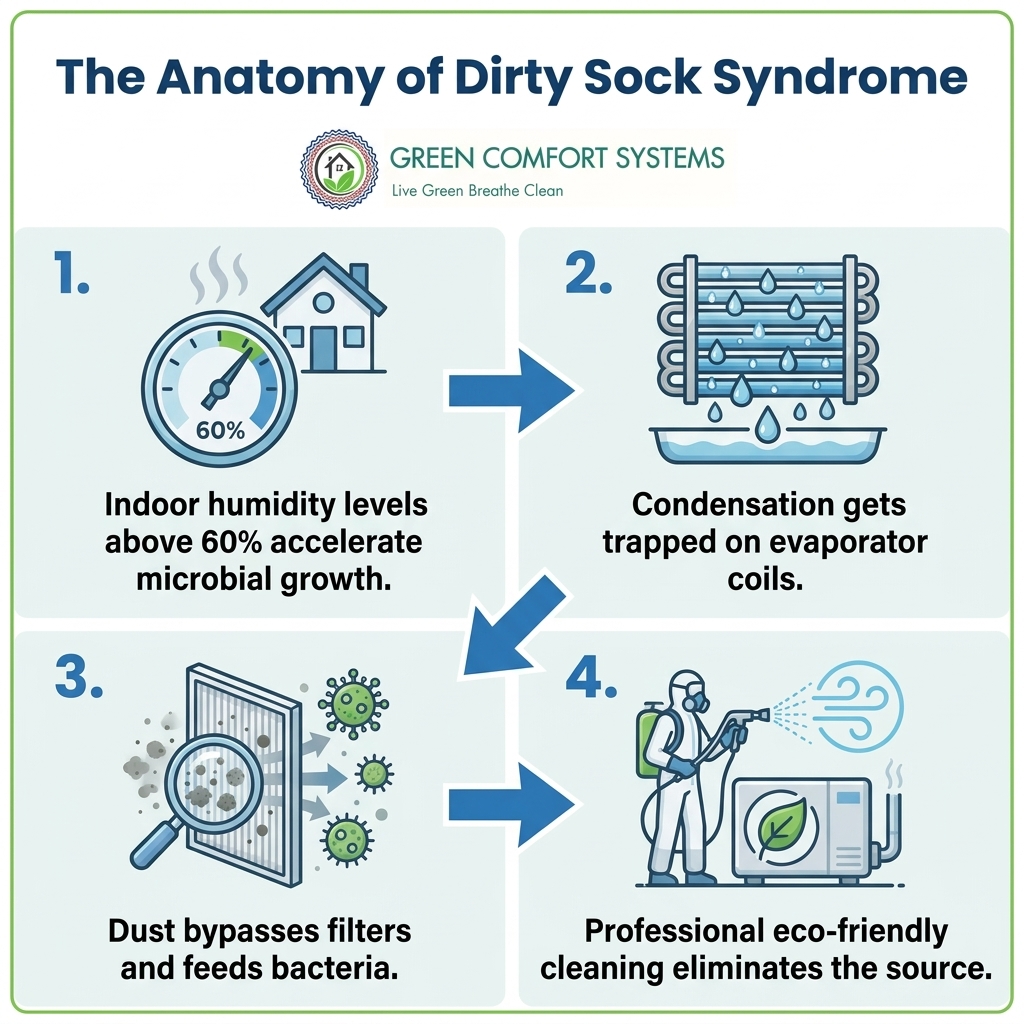
In the HVAC industry, our technicians commonly refer to that foul, musty odor as "dirty sock syndrome." While the name sounds slightly comical, the underlying cause is a very real biological process occurring on your indoor evaporator coil. Dirty sock syndrome happens when a specific type of microbial buildup—usually a combination of bacteria, mold, and mildew—takes root on the dark, damp surfaces inside your air handler.
Late August / end-of-summer Maryland humidity plays a massive role in accelerating this process. The prolonged humidity creates consistently high dew points, meaning the air holds a tremendous amount of moisture. As your air conditioner runs, it pulls this humid indoor air across the freezing cold evaporator coil. The rapid temperature drop causes the moisture in the air to condense into liquid water on the coil's metal fins. Because the system is cycling so frequently to combat the intense late-summer heat, these coils never get the opportunity to fully dry out between cooling cycles.
The biological chain reaction: Even with a good filter in place, microscopic dust particles, pet dander, and organic matter eventually bypass the filter media. When these organic particles hit the continuously wet evaporator coil, they stick. The combination of darkness, constant moisture, and organic food creates the perfect breeding ground for bacteria. When the system cycles on, the blower fan pushes air right through this microbial slime, distributing that unmistakable damp basement smell from HVAC vents throughout your entire home.
How Moisture Gets Trapped on the Evaporator Coil
Understanding the heat exchange process helps explain why this is a systemic issue requiring targeted intervention, rather than just a surface-level annoyance. During a normal cooling cycle, the condensation that forms on the coil is supposed to drip down into a drain pan and flow harmlessly out of your home. However, high ambient humidity can overwhelm standard drainage systems.
When the volume of water condensing on the coil exceeds the rate at which it drips away, a thin film of moisture permanently coats the aluminum or copper fins. Over the course of the summer, this constant wetness allows biofilm to anchor itself securely to the metal. This is not a problem you can simply wipe away; the bacteria embed themselves deep within the microscopic crevices of the coil fins.
• Coil Moisture — Normal AC Operation: Dries out between cycles — Dirty Sock Syndrome: Remains permanently damp
• Odor Profile — Normal AC Operation: Neutral, fresh air — Dirty Sock Syndrome: Musty, sour, or like wet laundry
• Airflow Impact — Normal AC Operation: Unrestricted and efficient — Dirty Sock Syndrome: Slightly restricted by biofilm buildup
• Timing of Smell — Normal AC Operation: None — Dirty Sock Syndrome: Strongest right when the AC first kicks on
First Step: Ruling Out the Air Filter Safely
Before assuming that your evaporator coil is covered in biological growth, it is crucial to rule out the simplest and most common culprit: a severely clogged air filter. After a long summer of trapping pollen, dust, and pet hair, an overloaded filter can actually mimic or exacerbate musty odors. When a filter is completely choked with debris, it restricts airflow, forcing the system to work harder and sometimes drawing unfiltered, dusty air through tiny gaps in the ductwork.
Checking and replacing your air filter is the safest and most effective first step you can take as a homeowner to troubleshoot a damp basement smell from HVAC vents.
1. Locate your return vent or air handler: Find where your system pulls air in. This is usually a large grille in a hallway, ceiling, or directly on the side of the indoor air handler unit.
2. Turn off the thermostat: Always switch your AC to the "off" position before removing a filter to prevent the system from sucking loose dust directly into the blower motor.
3. Inspect the filter media: Pull the filter out and hold it up to a light source. If you cannot see light shining through the pleats, or if it is coated in a thick, grey blanket of dust, it is time for a replacement.
4. Check for moisture on the filter: If the cardboard edges of the filter feel damp or show signs of water damage, you likely have a drainage issue backing up into the return plenum.
5. Install the new filter correctly: Ensure the arrows printed on the side of the new filter point toward the HVAC unit (the direction of airflow).
A strict safety warning: If you replace the filter and the musty smell persists after a few hours of operation, the issue is deeper within the air handler. Never attempt to open the sealed air handler cabinet, remove access panels, or clean internal evaporator coils yourself. The internal components operate under high electrical voltage and contain pressurized refrigerant. Touching delicate coil fins with improper tools can cause extensive damage in an instant. Internal cleaning strictly requires a licensed HVAC professional.
Condensate Drain Lines and Trapped Moisture
If the air filter is clean but the Late August / end-of-summer Maryland humidity is still making its presence known through your vents, a pattern we see often on our late-summer service calls is a failure in the condensate drain line. As we discussed, your air conditioner extracts gallons of water from your indoor air every single day during the summer.
This water drips into a shallow drain pan located beneath the evaporator coil and flows outside through a white PVC pipe called the condensate drain line. Over months of heavy use, the combination of standing water, darkness, and warmth turns this drain line into a prime habitat for algae and mold. Eventually, this biological growth forms a thick, jelly-like clog that blocks the pipe entirely.
When the pipe clogs, the water has nowhere to go. It backs up into the drain pan, creating a pool of stagnant, dirty water right inside your air handler. As the blower fan operates, it sweeps over this stagnant pool, picking up the musty odor and distributing it through your home. Symptoms of a clogged drain line include a persistent damp smell, water pooling around the base of your indoor unit, or your AC suddenly shutting down completely (many modern systems have a safety switch that cuts power when the drain pan overflows to prevent property damage).
Addressing standing water in your HVAC system is critical because it directly elevates the moisture levels in your home, completely counteracting the AC's dehumidification efforts. If you want to effectively manage indoor humidity in your home, ensuring that your condensate drainage system is flowing freely is non-negotiable.
Eco-Friendly Coil Cleaning: The Professional Solution
When dirty sock syndrome has firmly established itself on your evaporator coil or within your drain pan, standard DIY chemical sprays from a hardware store are both ineffective and potentially harmful. Many over-the-counter foaming cleaners contain harsh acids or heavy bleach concentrations. While these might temporarily mask the odor, they can rapidly corrode the delicate aluminum fins of your coil, leading to microscopic refrigerant leaks and premature system failure. Furthermore, spraying harsh chemicals into your air handler means those chemical fumes will be blown directly into your living spaces, severely compromising your indoor air quality.
This is where professional intervention becomes necessary. Our team at Green Comfort Systems is committed to eco-friendly HVAC solutions, emphasizing safe, non-toxic cleaning methods over harsh, corrosive chemicals. Our licensed technicians use specialized, biodegradable enzymatic cleaners that are specifically formulated to break down biological slime without damaging the metal coil or introducing volatile organic compounds (VOCs) into your home's air.
The professional remediation process typically involves:
• Safe disassembly: Carefully accessing the sealed evaporator coil without risking refrigerant leaks.
• Enzymatic treatment: Applying eco-friendly solutions that safely digest mold, bacteria, and biofilm at the microscopic level.
• Drain line flushing: Clearing out algae clogs using high-pressure nitrogen or specialized vacuums to ensure water flows freely away from the unit.
For example, during a recent late-summer heatwave, one of our Rosedale customers required deep cleaning for two aging wall-mounted split AC units that were emitting a strong mold odor. Our technician Felipe was dispatched to perform a thorough, multi-step cleaning and replace a broken component, ultimately restoring fresh airflow and eliminating the smell completely using our safe, professional methods.
To prevent the damp basement smell from HVAC vents from returning next summer, many homeowners opt to have a UV-C light installed inside the air handler. These ultraviolet lights shine directly on the evaporator coil 24/7, destroying the DNA of any mold spores or bacteria before they can establish a colony, keeping the coil sterile and operating at peak efficiency.
Assessing Your Ductwork for Hidden Mildew
Sometimes, the air conditioner itself is perfectly clean, but the odor originates from the delivery system: your ductwork. In our experience servicing homes in Rosedale MD, we frequently find that ductwork runs through unconditioned spaces like crawlspaces, attics, or unfinished basements. The temperature differentials in these humid regional basements can cause significant problems.
When freezing cold air rushes through thin metal ducts located in a warm, humid basement, the outside of the ductwork sweats, just like a glass of ice water on a hot day. If the ductwork is poorly insulated, this condensation can soak into the surrounding insulation, creating a hidden breeding ground for mildew. Worse, if the ductwork has cracks, gaps, or failed tape joints, the negative pressure of the HVAC system acts like a vacuum. It will literally suck the musty, mildew-laden air from your damp basement directly into the air stream and blow it into your living room.
Signs that your ductwork might be the source of the problem include:
• Localized smells: The odor is much stronger in one specific room rather than the whole house.
• Visible condensation: Water droplets forming on the outside of exposed ductwork in your basement.
• Sagging insulation: Duct insulation that looks heavy, wet, or is falling away from the metal pipe.
• Dust buildup around vents: Dark streaks or excessive dust accumulating on the ceiling right around your supply registers, indicating dirty air is being pulled in from an unconditioned space.
If you suspect your duct system is compromised, professional duct work inspections are essential. One of our technicians can identify leaks, seal gaps with specialized mastic, and ensure your ducts are properly insulated to prevent condensation, keeping basement air out of your living spaces.
Frequently Asked Questions About Musty AC Odors
Why does my AC smell like a damp basement in late summer?
The smell is usually caused by microbial growth on the indoor evaporator coil, a condition known as dirty sock syndrome. By late summer, months of continuous condensation and trapped moisture create an ideal environment for bacteria and mold to thrive inside the air handler. When the AC turns on, the blower pushes air through this bacterial buildup, spreading the odor.
How do you fix dirty sock syndrome?
Fixing dirty sock syndrome requires a professional deep cleaning of the evaporator coil using specialized, non-toxic enzymatic cleaners. A technician will safely access the sealed air handler, neutralize the biological growth, and clear the condensate drain line. For a permanent fix, installing a UV-C light over the coil prevents the bacteria from returning.
Is dirty sock syndrome dangerous to my family's health?
While dirty sock syndrome is primarily a nuisance odor, it does indicate the presence of biological growth, which can aggravate allergies and asthma in sensitive individuals. Breathing in air that has passed over mold or bacterial slime is not ideal for respiratory health. Resolving the issue promptly ensures your home's indoor air quality remains safe and comfortable.
Can a dirty AC filter cause a musty smell?
Yes, a severely clogged air filter can contribute to a musty smell by restricting airflow and trapping damp, organic debris right at the return vent. A dirty filter also forces the system to run longer, increasing condensation issues inside the unit. Checking and replacing your filter is the first troubleshooting step you should take.
Why shouldn't I use harsh chemicals or bleach to clean my AC coils?
Harsh chemicals like bleach or heavy acids are highly corrosive and can quickly eat away at the thin aluminum fins of your evaporator coil, causing expensive refrigerant leaks. Additionally, spraying toxic chemicals into your air handler means those dangerous fumes will be circulated directly into the air your family breathes. Always rely on eco-friendly, professional-grade cleaners.
How does UV light prevent mold in HVAC systems?
UV-C lights emit a specific wavelength of ultraviolet light that penetrates the cellular walls of mold spores, bacteria, and viruses, destroying their DNA. When mounted inside the air handler shining directly on the evaporator coil, the UV light acts as a continuous, chemical-free sterilization system, preventing biological colonies from ever forming.
Restore Your Home's Air Quality Before the Fall
Ignoring a musty smell coming from your vents will not make it go away; it only allows the microbial growth to spread further into your system. The combination of Late August / end-of-summer Maryland humidity and constant cooling demand means your AC needs a clean, sterile environment to operate safely and efficiently.
You do not have to live with poor indoor air quality or worry about what your family is breathing as you transition into the busy school year. Reassure yourself that our safe, thorough, eco-friendly cleaning methods can permanently resolve dirty sock syndrome without risking damage to your equipment. If you are ready to eliminate that damp basement smell from HVAC vents for good, schedule a professional inspection with Green Comfort Systems today to restore fresh, healthy air to your entire home.
Book Expert Service Or Contact Us
Other Blogs


Get Financing Today
Get the comfort you deserve, without the financial stress.

Latest Blogs
Troubleshooting Your October Heating Startup in Rosedale: What's Normal and What's Not
Home Maintenance Tips and Troubleshooting: Answering Your Fall Heating Startup FAQs
Understanding the Senior HVAC Initiative & Fall Heating Startups: Common Questions Answered
