





Navigating Crownsville's Humidity: Why Your AC Struggles During Peak July Heat

The Frustration of Clammy Indoor Air
Your air conditioner has been running for three hours straight, yet your living room still feels like a damp towel. If your thermostat says 72 degrees but you are still sweating indoors, navigating Crownsville's humidity: why your AC struggles during peak July heat becomes a matter of daily comfort. The physical discomfort of a home that feels sticky and warm despite a constantly running system is incredibly frustrating. You are left wondering if your equipment is completely broken, or if it is simply overwhelmed by the dense, moisture-heavy air outside.
Here is the thing: standard cooling systems are tasked with a dual mandate. They must lower the physical temperature of the air, and they must extract the heavy moisture trapped within it. When extreme summer weather hits, that balance is thrown entirely off kilter. If you are trying to figure out your next steps, securing professional air conditioning services is the most reliable way to determine if your unit has suffered a mechanical failure or if it just needs help managing the oppressive indoor climate.
The core decision point: Before you panic and assume your compressor has failed, you need to understand what your system is actually fighting against. Often, an air conditioner that feels like it is blowing warm air is actually functioning exactly as designed, but it is losing the battle against an invisible enemy: latent heat.
Understanding the Crownsville Microclimate Effect
Not all summer heat is created equal. The specific geographical location of your home plays a massive role in how your HVAC system performs. The Crownsville microclimate presents unique, intense challenges that homes further inland simply do not face with the same severity.
Because of the close proximity to the Chesapeake Bay and the Severn River, the ambient moisture in the air is drastically higher here. Large bodies of water evaporate rapidly under the summer sun, pushing massive amounts of water vapor into the surrounding atmosphere. This creates an oppressive moisture load that settles directly over local neighborhoods.
Why dew point matters more than temperature:
• Under 55°F: Feels dry and comfortable. Your AC cools the house quickly.
• 60°F to 65°F: Noticeably humid. Your system works harder to keep up.
• Over 70°F: Oppressive and sticky. This is where local systems struggle the most.
During peak July weather, outdoor dew points in this region frequently exceed 70 degrees. This creates an oppressive heat index that maximizes the load on residential cooling systems. Your air conditioner is not just fighting the 95-degree air; it is fighting the sheer weight of the water suspended in that air. This regional weather pattern forces your equipment to work overtime just to make the indoor environment tolerable, let alone perfectly cool.
Latent Heat vs. Sensible Heat: The Physics of Cooling
To understand why your home feels so uncomfortable during peak July heat, you have to look at the physics of how an air conditioner processes humid air. Cooling a home involves two entirely different types of heat.
The Two Types of Heat Your AC Battles
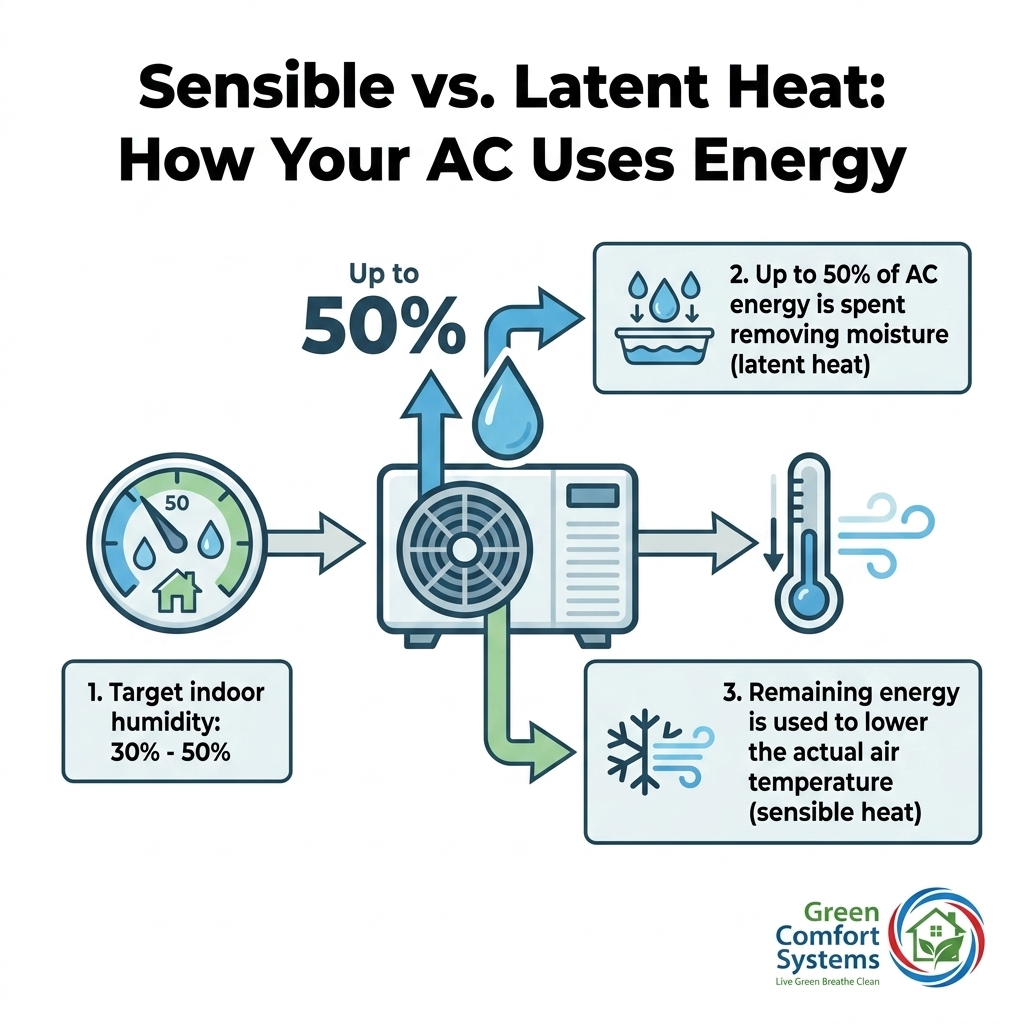
Sensible heat is the heat you can actually feel and measure with a standard thermometer. When your thermostat reads 75 degrees, it is measuring sensible heat. Latent heat, on the other hand, is the hidden heat energy trapped inside water vapor. You cannot measure latent heat with a standard thermometer, but your body certainly feels it as sticky, clammy humidity.
According to data from the U.S. Department of Energy, air conditioners can expend up to 50% of their energy capacity just removing moisture (latent heat) before they can even begin to effectively lower the physical air temperature (sensible heat). If your system is spending half its power just wringing water out of the air, it has very little capacity left to actually cool the room.
The Evaporator Coil Condensation Process
Your AC removes moisture through condensation. Warm, humid indoor air is blown over the freezing cold evaporator coil inside your indoor unit. As the air hits the cold metal, the moisture condenses into liquid water, drips into a drain pan, and flows out of your house.
However, when the humidity is exceptionally high, the sheer volume of moisture overwhelms the coil. The system spends its entire run cycle extracting water. Because high humidity limits the coil's ability to lower the physical air temperature, the air blowing out of your vents might feel lukewarm. The system is working furiously, but the physics of latent heat are preventing it from dropping the sensible temperature in your living room.
Is Your System Broken or Just Overwhelmed?
When the house is hot and the AC is running constantly, most homeowners immediately assume the worst. However, struggling during extreme heat waves is common for residential systems. The key is knowing how to read the symptoms to determine if you need an emergency repair or just better humidity management strategies for the Crownsville microclimate.
One local family experienced this exact panic when their system began having issues during the intense summer heat. With a new baby in the house, they were understandably worried about the rising indoor temperatures. A technician was dispatched quickly, accurately identified the underlying performance issue, and restored a cool, comfortable environment. Prompt, professional assessment is always the safest route when safety and comfort are on the line.
If you are unsure where your system stands, use this breakdown to evaluate its performance before troubleshooting an AC that is not cooling:
• Air Temperature at Vents — Likely Overwhelmed (Moisture Load): Air feels cool, but airflow seems weak or insufficient to cool the room. — Likely Broken (Mechanical Failure): Air feels completely warm, matching the room temperature.
• Indoor Humidity Levels — Likely Overwhelmed (Moisture Load): Humidity remains stubbornly above 50%, feeling clammy. — Likely Broken (Mechanical Failure): Humidity is high, but accompanied by zero temperature drop.
• System Run Times — Likely Overwhelmed (Moisture Load): Running constantly during the hottest part of the afternoon. — Likely Broken (Mechanical Failure): Short cycling (turning on and off every 5-10 minutes).
• Unusual Noises — Likely Overwhelmed (Moisture Load): Normal humming and blowing sounds. — Likely Broken (Mechanical Failure): Grinding, squealing, or loud banging noises from the unit.
• Thermostat Behavior — Likely Overwhelmed (Moisture Load): Struggles to reach the set temperature by 2-3 degrees. — Likely Broken (Mechanical Failure): Completely unresponsive or blank screen.
Reassure yourself that if your system is blowing cool air but just cannot seem to hit that crisp 70-degree mark on a 95-degree day with high humidity, it is likely just overwhelmed by the latent heat load. However, persistent issues, warm air, or strange noises always require professional assessment.
Why Modern Systems Excel at Humidity Management
If your system is frequently overwhelmed by humidity, the age and technology of your equipment play a massive role. Older units and basic builder-grade systems operate on a very simple on/off cycle. They run at 100% capacity until the thermostat reaches the set temperature, and then they shut off completely.
The problem with this single-stage operation is that the system often cools the sensible temperature too quickly, shutting off before it has had enough time to extract the latent heat (moisture) from the air. This leaves you with a cold but clammy house.
Modern, high-efficiency systems solve this problem using variable-speed technology. Instead of blasting at 100% capacity, a variable-speed compressor can run at lower capacities (like 40% or 60%) for much longer periods. This continuous, low-and-slow operation is the secret to pulling maximum moisture from the air without overcooling the house. Green Comfort Systems specializes in eco-friendly, highly efficient solutions engineered specifically to handle Maryland's extreme latent heat loads, ensuring your home stays crisp and dry.
The IAQ Advantage: Sometimes, even a great AC needs backup. Dedicated indoor air quality solutions, such as whole-home dehumidifiers, work in tandem with your main cooling unit. The dehumidifier tackles the heavy moisture load, freeing up your air conditioner to focus entirely on lowering the temperature.
One area homeowner living in a 1940s property struggled for years with extremely hot, humid summers, even after installing a new basic system. It was not until they upgraded to a modern, highly efficient setup tailored for their specific layout that they finally achieved a quiet, cool home that handled the intense moisture load cost-efficiently.
Targeted Cooling Strategies for Stubborn Hot Spots
Even with a highly efficient central air system, certain architectural styles naturally trap humidity and heat in specific zones. Older homes, multi-level houses, and properties with large sunrooms or additions often suffer from stubborn hot spots. The upstairs master bedroom might feel like a tropical rainforest while the downstairs living room feels like a refrigerator.
When ductwork cannot deliver balanced airflow to these challenging areas, localized solutions are required. This is where ductless mini splits provide an incredible advantage. These systems offer targeted, highly efficient dehumidification and cooling exactly where you need it, without requiring any major ductwork modifications to your home.
Benefits of localized cooling strategies:
1. Independent Zone Control: You can set the upstairs bedroom to a crisp, dry 68 degrees without freezing out the rest of the house.
2. Dedicated Dehumidification: Many mini splits feature a specific "dry mode" designed exclusively to extract moisture from the air during the muggiest days of the Crownsville microclimate.
3. Whisper-Quiet Operation: Unlike noisy window units, modern ductless systems operate so quietly you barely know they are running, making them perfect for bedrooms and home offices.
Of course, keeping these targeted systems running efficiently requires proper care. One local customer found this out firsthand when two wall-mounted split units in their home developed mold and an unpleasant smell after going uncleaned for years. A technician performed a deep cleaning, disassembled the unit for repair, and installed a replacement part, restoring fresh, odor-free cooling to the space. Regular maintenance ensures these systems can handle heavy moisture without developing biological growth.
Restore Your Home's Comfort This Summer
Battling extreme indoor humidity is ultimately a matter of physics, not just a faulty thermostat. When the dense moisture of peak July heat settles over the region, your air conditioner is forced to work twice as hard to extract the latent heat before it can even begin to cool the air you feel. Understanding this process is the first step in reclaiming your indoor comfort.
Whether your system is simply overwhelmed and needs the support of dedicated dehumidification, or it has suffered a mechanical setback that requires immediate repair, a professional assessment will give you the clear answers you need. Do not spend another afternoon sweating in your own living room. Take action today to ensure your cooling system is properly equipped to handle whatever the summer weather throws its way.
Frequently Asked Questions
Why is my AC running but the house feels humid?
Your system is likely expending all its energy battling latent heat (moisture) rather than sensible heat (temperature). When humidity is exceptionally high, the AC can run continuously just to extract water from the air, leaving little capacity to actually cool the room. Upgrading to a variable-speed system or adding a dehumidifier can resolve this.
Does high humidity make an air conditioner work harder?
Yes, high humidity forces an air conditioner to work significantly harder. The system must remove the heavy water vapor from the air before it can effectively drop the physical temperature. This extended workload increases energy consumption and puts extra wear and tear on your compressor and blower motor.
How do I reduce humidity in my house during summer?
The most effective method is utilizing a whole-home dehumidifier that works alongside your HVAC system. Additionally, ensure your AC is not oversized (which causes short-cycling), use exhaust fans in bathrooms and kitchens, and keep windows tightly closed during the muggiest parts of the day.
Why does my AC feel like it is blowing warm air?
If the air feels warm, the evaporator coil may be completely overwhelmed by moisture, or you could be dealing with a mechanical issue like a refrigerant leak or a failing compressor. If the airflow is strong but the air is not crisp, the system is likely struggling with the latent heat load. A professional diagnostic is the best way to confirm the exact cause.
What is the ideal indoor humidity level for a Maryland home in the summer?
The ideal indoor relative humidity should be kept between 30% and 50%. This range prevents mold growth, deters pests, and allows your body's natural cooling mechanism (sweating) to function properly. Keeping humidity below 50% ensures your home feels crisp and comfortable.
Can a whole-home dehumidifier reduce my air conditioning costs?
Yes, a whole-home dehumidifier can actively lower your cooling bills. Because dry air feels naturally cooler than humid air, you can comfortably set your thermostat a few degrees higher. This reduces the runtime of your main air conditioner, saving significant energy over the course of the summer.
Book Expert Service Or Contact Us
Other Blogs


Get Financing Today
Get the comfort you deserve, without the financial stress.

Latest Blogs
Decoding the Clanking and Banging Noises from Your Rosedale Radiators This Fall
Addressing Drafty Windows and Heating Inefficiencies in Older Forest Hill Homes
Managing the September Swing: Keeping Your Rosedale Home Comfortable When Days Are Hot and Nights Are Cold
