




Upgrading to a Smart Thermostat in Glen Burnie: Navigating C-Wire Requirements

The Hidden Hurdle of Smart Thermostat Upgrades in Older Homes
When you decide on upgrading to a smart thermostat in Glen Burnie: navigating C-wire requirements is rarely the first step you anticipate. Most homeowners purchase these sleek, Wi-Fi-enabled devices to improve their home's energy efficiency and gain better control over their indoor climate. The packaging often advertises a simple, fifteen-minute setup process, leading you to believe that swapping out your old temperature control unit will be a quick weekend project. However, the reality of working with legacy electrical systems quickly shatters that expectation.
At Green Comfort Systems, our team frequently sees this exact scenario. If you need assistance navigating these technical challenges, partnering with us for professional HVAC services ensures your new device operates safely and efficiently. The DIY project typically halts the moment you remove the old analog unit from the wall. Instead of finding a neat row of five wires ready to connect to your new digital interface, you are greeted by only two to four wires—and no common wire in sight. This missing connection is the hidden hurdle that stops countless home improvement projects in their tracks.
During the early fall pre-heating season, many homeowners attempt this exact upgrade to prepare for the dropping temperatures. Unfortunately, older housing stock presents unique electrical realities that modern smart devices simply were not designed to accommodate out of the box. Addressing this missing wire safely and correctly is absolutely critical before you need to rely on your heating system for winter comfort.
The Expectation vs. Reality of Thermostat Upgrades
To understand why this issue is so prevalent, it helps to look at the stark contrast between what modern thermostat manufacturers expect and what our technicians actually find inside the walls of older properties.
• Wiring Configuration — Modern Smart Thermostat Expectation: 18/5 (5-wire) standard cable bundle — Legacy Home Reality: 18/2, 18/3, or 18/4 (2 to 4 wires)
• Power Source — Modern Smart Thermostat Expectation: Continuous 24V AC from the C-wire — Legacy Home Reality: Battery powered or power-stealing only
• System Communication — Modern Smart Thermostat Expectation: Digital two-way communication with the board — Legacy Home Reality: Simple open/close analog circuit switches
• Installation Time — Modern Smart Thermostat Expectation: 15 to 30 minutes — Legacy Home Reality: Requires professional wire pulling or adapters
This disconnect between modern expectations and legacy infrastructure means that a seemingly simple upgrade requires a deeper understanding of your home's electrical framework.
Understanding the C-Wire's Role in Modern HVAC Systems
Modern smart thermostats are not just simple temperature switches; they are essentially small computers mounted to your wall. Because they feature high-resolution LED screens, continuous Wi-Fi connectivity, and advanced occupancy sensors, they require a constant, uninterrupted 24V power supply to function correctly. This is a significant departure from how temperature controls operated in the past.
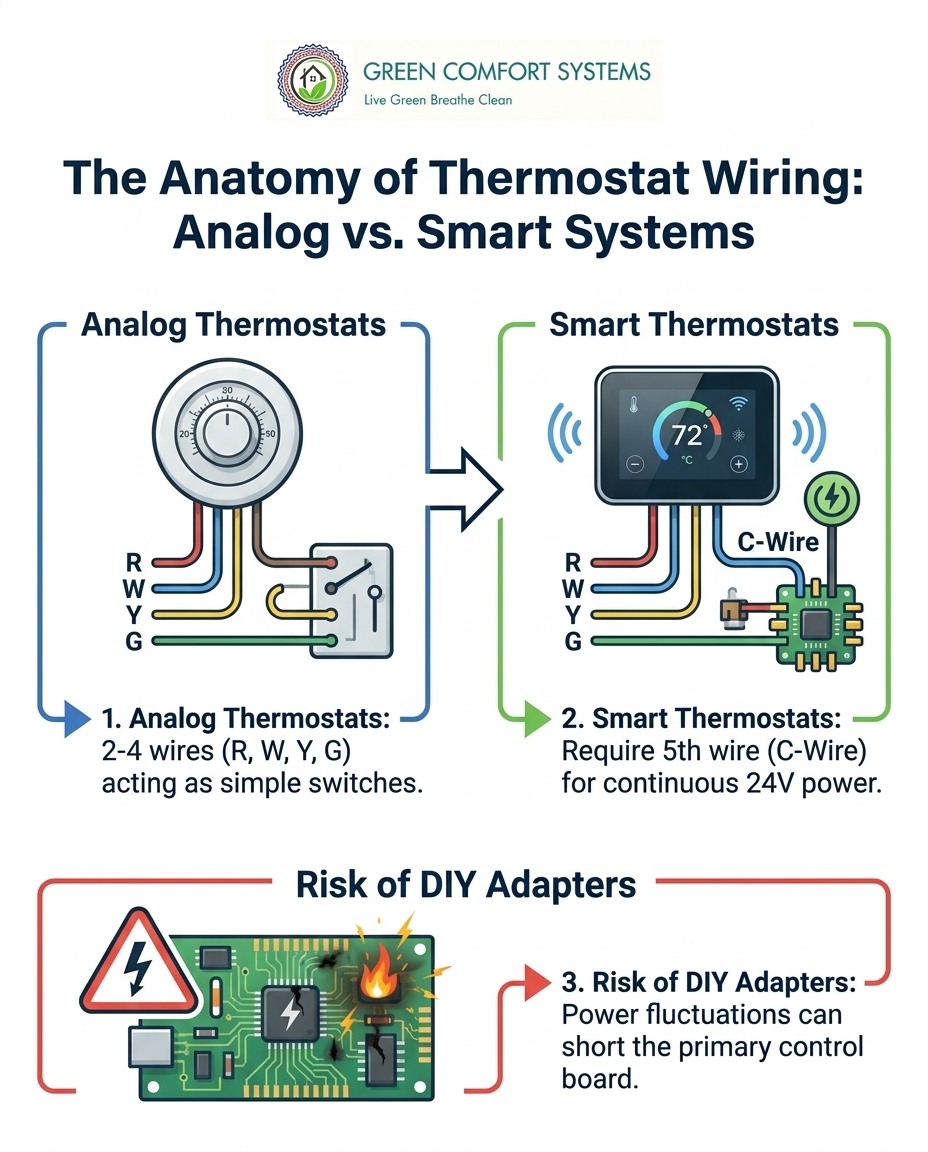
Older analog thermostats only needed basic wires—typically labeled R for power, W for heat, Y for cooling, and G for the fan—to simply open and close the heating or cooling circuits. They acted exactly like a standard light switch. When the room got too cold, a mechanical switch inside the unit closed the circuit, telling the furnace to turn on. Because they did not have digital displays or internet connections, they did not need continuous electrical power to run their own internal systems.
The C-wire (common wire) is the critical component that completes the continuous power circuit necessary for modern digital functionality. It provides the return path for the 24V electrical current originating from the HVAC control board's transformer. Without it, the smart device cannot power its internal battery, maintain a connection to your home network, or execute advanced features like adjusting your thermostat schedule based on your daily routines.
Why Legacy Homes Lack Common Wires
If you live in one of the older Glen Burnie or Rosedale MD neighborhoods, your home was likely built long before smart home technology was even a concept. In our years of servicing these communities, we've noticed that homes constructed before the 1980s were rarely wired with 18/5 (5-wire) thermostat cables simply because the technology of the era did not require it. Builders used the most cost-effective materials available that met the standards of the time, which meant running 18/4 or even 18/2 wire bundles.
• Technological era: Analog dials required zero continuous voltage to operate.
• Construction standards: 4-wire bundles were the industry standard for decades.
• System simplicity: Older furnaces lacked the complex digital control boards that interface with modern 5-wire setups.
The Dangers of DIY Add-a-Wire Kits and Power Stealers
The Problem: Bypassing the Missing Wire
Faced with a missing common wire, we frequently see homeowners turn to the internet for a quick workaround. The market is flooded with "power-stealing" adapters, add-a-wire kits, and online tutorials promising to solve the issue without the need to pull new cables through your walls. These kits are often marketed as DIY-friendly solutions that can magically create a C-wire out of thin air.
The Cause: Electrical Imbalance
These adapters work by "stealing" small amounts of power from the heating or cooling circuits (the W or Y wires) when the system is not actively running. While this sounds clever in theory, improperly wired adapters or generic power stealers can cause significant power fluctuations and voltage drops across your entire HVAC system. In older Glen Burnie neighborhoods, where the existing electrical transformers and control boards we service may already be aging, introducing this kind of electrical resistance is highly risky.
The Solution: Avoiding Voided Warranties and Damage
These voltage irregularities frequently damage sensitive modern HVAC control boards. A control board is designed to receive clean, consistent signals. When a power-stealing thermostat pulses current through a circuit not designed for continuous load, it can confuse the board, causing the system to short-cycle (turn on and off rapidly), chatter the contactors, or ultimately burn out the primary transformer. At Green Comfort Systems, we strongly advise against attempting to alter your furnace's control board wiring without a proper license, as this almost universally voids manufacturer warranties, leaving you entirely responsible for the cost of any resulting damages.
Cascading Failures: Protecting Your Furnace Control Board
Our team knows firsthand that the worst-case scenario of a botched DIY wiring job is a cascading failure that destroys your system's primary control board. The control board is the brain of your entire heating and cooling infrastructure. It manages not only the heating cycles but also safety limits, blower motor speeds, and air conditioning integration. If an improper C-wire workaround sends a surge or a dead short to this board, the result is an immediate and total loss of all climate control capabilities.
Experiencing this type of catastrophic failure during a cold weather event creates an urgent safety and comfort crisis. Maryland's cold winter nights make a sudden loss of heating due to a blown control board a serious home emergency. A house can lose its retained heat rapidly, putting plumbing at risk of freezing and leaving your family in deep discomfort.
Professional diagnostics prevent these cascading electrical failures from occurring in the first place. We recently helped a local customer who reached out during a severe winter heating issue when their system lost power entirely due to a sudden component failure tied to unstable smart thermostat wiring. We dispatched a technician quickly, sourced the necessary control parts, and restored their heat safely without relying on unstable workarounds. Taking care of these upgrades during the early fall pre-heating season ensures that your system is stable, tested, and ready long before the freezing temperatures arrive.
Code-Compliant Solutions for Legacy Wiring
When an older HVAC system lacks a C-wire, we always recommend implementing a code-compliant, professional solution. Relying on licensed technicians ensures that your new thermostat receives the correct voltage without putting the rest of your system at risk. There are specific, industry-standard methods used to bridge the gap between legacy infrastructure and modern digital controls.
What Our Technicians Do: The Professional Process
1. Comprehensive Continuity Testing: Before any wires are moved, our technicians test the existing 24V transformer to ensure it produces enough amperage to support a smart thermostat. Older transformers may need to be upgraded to handle the new continuous load.
2. Pulling New 18/5 Cable: The most reliable and permanent solution we offer is pulling brand new 18/5 (five-wire) thermostat cable through the walls, directly from the thermostat baseplate to the furnace control board. This establishes a true, dedicated common wire.
3. Installing Hardwired Commercial Adapters: In situations where running new wire is physically impossible due to finished walls or complex architecture, our professionals can install commercial-grade, hardwired adapters. Unlike cheap DIY kits, these are wired directly at the control board to safely multiplex the signal without voltage drops.
4. System Verification: Once the wiring is complete, our technician verifies the integrity of the entire 24V circuit, ensuring proper communication between the thermostat and the heating unit before fully powering the system.
These professional methods are particularly vital in older Glen Burnie neighborhoods, where decades of previous modifications might complicate the electrical layout. Choosing professional heating system upgrades guarantees that the work is performed strictly up to local electrical codes, protecting your home and your equipment.
Why Pre-Season Upgrades Are Critical for Maryland Homeowners
We constantly remind our customers that timing is everything when it comes to upgrading your home's climate controls. Transition seasons, such as the early fall pre-heating season, offer a brief but vital window to test system communication safely. When the weather is mild, you have the flexibility to take your system offline for a few hours to complete necessary wiring upgrades without suffering through extreme indoor temperatures.
Resolving thermostat wiring issues now ensures the system is completely ready for heavy winter demand. When a smart thermostat is installed correctly, it can begin learning your home's thermal profile and your family's schedule immediately. This learning phase is much more effective when it occurs before the furnace is forced to run continuously to combat freezing outdoor temperatures.
Furthermore, upgrading your controls alongside other primary equipment, such as a new heat pump installation, maximizes your overall energy efficiency. A modern system paired with a properly wired smart thermostat can drastically reduce energy waste. Early preparation avoids the stress of emergency service calls when temperatures suddenly drop and you discover your heating system won't respond to your new wall unit.
Partnering with Local Experts for Older Home HVAC Needs
Older homes require specialized care, immense attention to detail, and a deep understanding of legacy electrical frameworks. Cookie-cutter solutions and generic DIY guides found online often fail to account for decades of previous system modifications, spliced wires, or aging transformers hidden inside your walls.
Our team at Green Comfort Systems brings specific expertise in safely navigating complex legacy HVAC wiring in older Maryland homes. Our expert technicians assess the entire HVAC ecosystem—from the transformer to the control board to the ductwork—to recommend the safest, most effective control upgrades. We frequently see the benefits of this comprehensive approach when upgrading older properties. For example, during a recent early fall install, we evaluated an older home requiring a more efficient cooling and heating solution. After our team thoroughly assessed the legacy framework, a modern system was installed. The homeowner reported the house provided perfect comfort throughout the transition season and was fully prepped for the winter, all while operating quietly and efficiently.
Investing in professional service ensures reliable, long-term efficiency and comfort. In older Glen Burnie neighborhoods, having a local expert who understands the specific architectural quirks of the area makes the difference between a frustrating, drawn-out DIY disaster and a seamless technological upgrade.
Secure Your Home's Comfort Before the Cold Arrives
Don't risk your system's primary control board with risky DIY workarounds or cheap power-stealing kits. Ensuring your smart thermostat is wired correctly and safely is the most important step in modernizing your home's climate control. Reach out to our local experts at Green Comfort Systems during this early fall pre-heating season to prepare your home for the changing weather. A professionally installed, code-compliant C-wire solution gives you the peace of mind that your heating system will perform flawlessly exactly when you need it most.
Frequently Asked Questions
What happens if I don't have a C wire for my smart thermostat?
Without a C-wire, a smart thermostat cannot draw the continuous 24V power required to run its Wi-Fi connection and digital display. Some models will drain their internal backup batteries rapidly, while others will attempt to steal power from the heating or cooling circuits. This power-stealing can lead to system short-cycling, erratic behavior, and potential damage to your furnace's control board.
Can you install a smart thermostat without a C wire?
Yes, it is technically possible to install certain models using a C-wire adapter kit or by choosing a thermostat specifically designed for older systems. However, these solutions are often less reliable than a dedicated wire. For optimal performance and safety, our HVAC professionals strongly recommend pulling a new 18/5 wire to establish a true common connection.
Is it safe to use a C wire adapter on an older furnace?
Using a C-wire adapter on an older furnace carries inherent risks if not installed correctly. Cheap or generic adapters can cause voltage drops that stress aging transformers and sensitive control boards. A licensed technician from Green Comfort Systems should evaluate your legacy system to determine if an adapter is safe, or if a hardwired commercial solution is required to protect your equipment.
What color is the C wire on a furnace control board?
The C-wire is traditionally blue or black, but wire colors are never a guaranteed indicator of function in residential HVAC systems. In older homes, previous installers may have used whatever wire color was available to make the connection. You must always trace the wire back to the "C" terminal on the furnace control board to verify its true purpose.
How do professionals handle missing C-wires in older homes?
Our professionals handle missing C-wires by first testing the system's voltage and continuity to assess the safest path forward. The preferred method is pulling a new, dedicated 5-wire cable from the wall directly to the furnace. If structural barriers prevent new wiring, we install commercial-grade, hardwired adapters at the control board to ensure safe, code-compliant power delivery.
Book Expert Service Or Contact Us
Other Blogs


Get Financing Today
Get the comfort you deserve, without the financial stress.

Latest Blogs
Upgrading to a Smart Thermostat in Glen Burnie: Navigating C-Wire Requirements
Introducing the Green Legacy Initiative: How Green Comfort Systems Gives Back to Maryland's Forests
What We Actually Inspect During a Fall Furnace Tune-Up (And Why It Prevents Mid-Winter Breakdowns)
