





Why We Insist on Carbon Monoxide Testing During Every Rosedale Heating Inspection

Are Quick Furnace Checks Putting Your Home at Risk This Fall?
With the early fall pre-heating season approaching, do you ever wonder why we insist on carbon monoxide testing during every Rosedale heating inspection, rather than just giving your system a quick 15-minute look? Over our years of servicing local heating equipment, our technicians at Green Comfort Systems hear this common question from busy homeowners who just want to check a chore off their list. You want your furnace ready for the cold, and you want the service call to be as fast as possible. However, there is a massive difference between a rushed visual check and a thorough safety inspection that identifies invisible, life-threatening risks.
When you schedule professional heating services, you are making an investment in your family's comfort and safety. A technician who rushes through a tune-up might change your air filter, wipe down the exterior cabinet, and confirm the thermostat turns the heat on. But our team typically sees that this surface-level approach completely misses the internal components where real dangers hide.
The Decision Point: Speed vs. Safety
As a homeowner, you face a critical choice before the winter weather sets in. Do you accept a fast, superficial check that leaves structural vulnerabilities undetected, or do you opt for a comprehensive inspection that verifies the integrity of your combustion chamber? Understanding this trade-off is the first step in protecting your household from silent threats.
• Focus — The 15-Minute "Quick Check": Basic operation and superficial cleaning — Comprehensive Safety Inspection: Structural integrity and toxic gas containment
• Tools Used — The 15-Minute "Quick Check": Flashlight, basic hand tools — Comprehensive Safety Inspection: Digital combustion analyzers, visual cameras
• System State — The 15-Minute "Quick Check": Tested briefly while cold or warming up — Comprehensive Safety Inspection: Tested under full operating temperature
• Safety Outcome — The 15-Minute "Quick Check": Assumes the system is safe if it turns on — Comprehensive Safety Inspection: Proves the system is safe through measured data
Taking the extra time to properly test your heating equipment is not an inconvenience—it is a mandatory safeguard. The risks associated with compromised gas appliances are simply too high to ignore.
Addressing the Pushback: Why Our Rosedale MD Inspections Take Extra Time
It is completely normal to ask, "Why is the HVAC technician taking so long?" Our team hears this pushback frequently during the early fall pre-heating season. You have a busy schedule, and waiting around for a service technician is rarely your preferred way to spend an afternoon. However, having seen the real-world dangers of neglected furnaces in Rosedale, we know that understanding what happens during those extra minutes changes the perspective entirely.
A superficial 15-minute check is physically incapable of verifying the safety of your furnace. It takes time for a heating system to reach its full operating temperature. It takes time to calibrate digital sensors and measure the ambient air. When a technician rushes, they are forced to skip the rigorous testing required to keep toxic gases out of your home's breathing air. We reframe this time spent as a vital investment in your family's safety rather than a scheduling inconvenience.
The Connection to Your Breathing Air
Your furnace does not operate in a vacuum; it is the heart of your home's ventilation system. If a compromised component allows exhaust gases to leak, your blower motor will distribute those toxins into every room through your ductwork. This is why comprehensive safety checks tie directly into broader indoor air quality solutions. You cannot have truly healthy indoor air if your primary heating source is actively introducing carbon monoxide into the environment.
Taking the time to do things right always pays off. For example, just last fall, our Green Comfort Systems team was called out to a Rosedale home for routine pre-season maintenance. The homeowner was initially surprised by how long the appointment was taking. However, our technician took the time to walk them through the entire process, explaining exactly why we test the internal components and how we measure for gas leaks. By the end of the visit, the heating system was perfectly serviced, and the homeowner had complete peace of mind knowing their family was safe. That level of confidence is exactly what we aim to deliver at every single home we visit.
The Threat Invisible to the Naked Eye: Micro-Fractures in Your Furnace
To understand why testing takes time, you have to look at the physical mechanics of a gas furnace. At the center of your heating system lies the combustion chamber and the heat exchanger. This is where the actual fire burns. The heat exchanger is a series of metal tubes or coils that act as a strict barrier. Inside the tubes, toxic combustion gases (like carbon monoxide) are safely vented outside. Outside the tubes, your indoor air blows across the hot metal, warming up before circulating through your home.
The Problem: Thermal Stress and Metal Fatigue
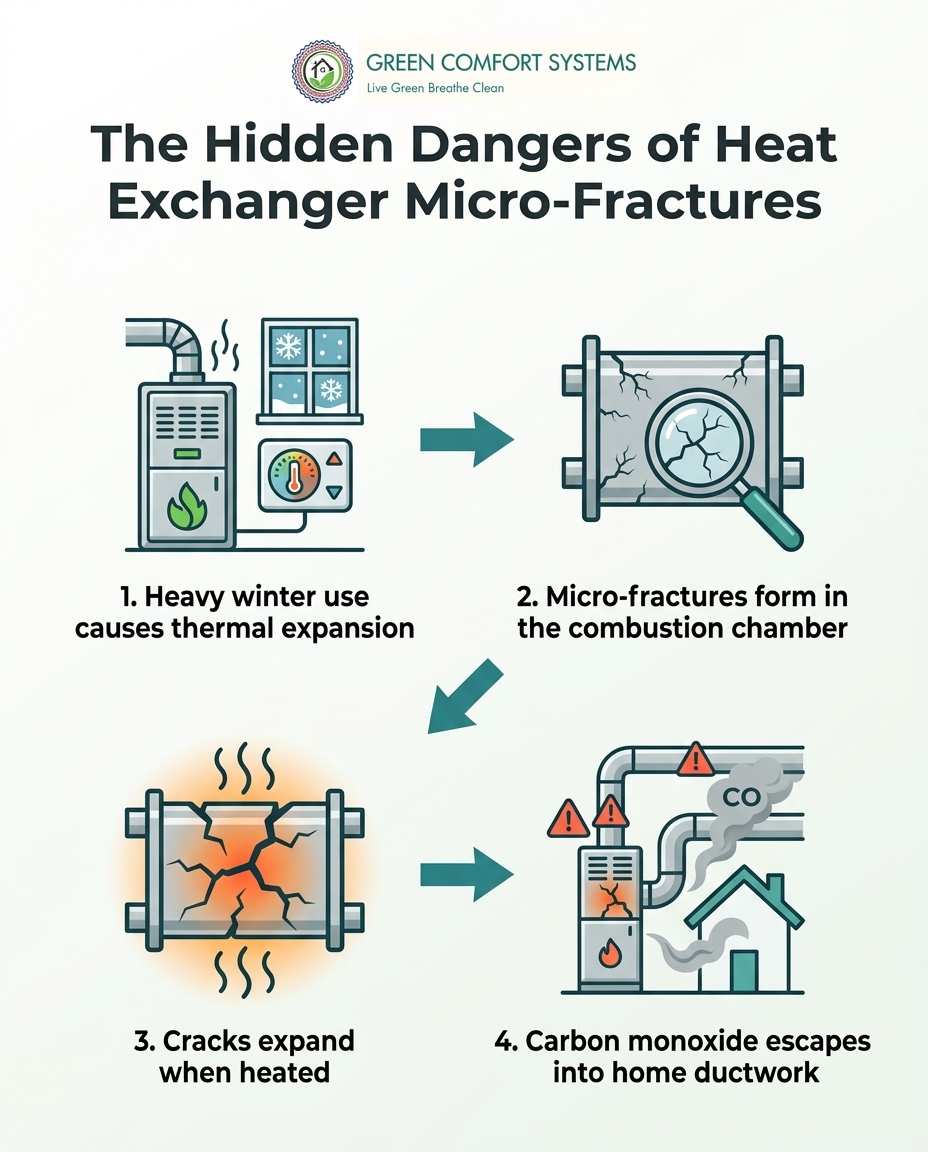
Freezing Maryland winters demand heavy, continuous use of gas heating systems. In our extensive experience inspecting aging furnaces throughout Rosedale, we frequently see how this constant demand creates a cycle of extreme thermal expansion and contraction. When your furnace kicks on, the metal heat exchanger heats up rapidly and expands. When the cycle finishes, the metal cools and contracts. Over thousands of cycles, this extreme thermal stress weakens the metal.
The Cause: Microscopic Cracking
Eventually, this constant expanding and contracting causes metal fatigue, leading to microscopic cracks—also known as micro-fractures. These cracks are incredibly dangerous because they are often completely invisible to a casual observer. When the furnace is cold, the metal is contracted, and the cracks pinch tightly shut. A technician shining a flashlight into a cold furnace will see absolutely nothing wrong.
The Solution: Heat-Activated Testing
The danger only reveals itself when the furnace gets hot. As the metal expands, those micro-fractures stretch open. This creates a direct pathway for deadly, odorless carbon monoxide to escape the combustion chamber and enter your ductwork. This physical reality is exactly why thorough combustion chamber micro-fracture testing cannot be rushed. The system must be running long enough to reach peak temperature so that any hidden cracks are forced open and exposed to our testing equipment.
Our Methodology for Combustion Chamber Micro-Fracture Testing
At Green Comfort Systems, our methodology is built around an uncompromising standard of safety. After years of diagnosing complex heating issues in the field, our team knows firsthand that skipping steps during a heating tune-up is a recipe for disaster. This is why our technicians take the time to follow a rigorous, multi-step standard operating procedure for every inspection in Rosedale MD. We make a deliberate choice to prioritize thoroughness over speed because we refuse to leave your family vulnerable to silent threats.
Here is exactly how we perform combustion chamber micro-fracture testing to ensure your system is completely safe:
1. Ambient Air Baseline Testing: Before we even open the furnace cabinet, we use a digital combustion analyzer to measure the ambient air around the unit. This establishes a safe baseline and alerts us to any immediate, severe gas leaks in the utility room.
2. The Full-Cycle Heating Phase: We turn the system on and let it run. The furnace must reach its maximum operating temperature. As we discussed earlier, this is the only way to force any existing micro-fractures to expand and open up. This step physically cannot be rushed.
3. Digital Flue Gas Analysis: Once the system is hot, we insert the probe of our digital combustion analyzer into the exhaust flue. We are looking for specific parts-per-million (PPM) readings of carbon monoxide, as well as checking oxygen levels and draft pressure. Abnormal readings here instantly tell us that the combustion process is compromised.
4. Visual Confirmation Cameras: Data is crucial, but visual confirmation is just as important. We use specialized, high-definition inspection cameras to snake through the heat exchanger tubes. We are looking for rust, soot buildup, and the telltale signs of expanding cracks that the naked eye would miss.
5. Comprehensive Gas Component Assessment: The heat exchanger is not the only risk area. We extend our thoroughness to all gas-carrying components. We check the manifold pressure, inspect the burners, and perform related furnace gas valve repair assessments to ensure there are absolutely zero leaks anywhere in the system.
A Crucial Safety Warning: We must emphasize that combustion chamber micro-fracture testing is strictly licensed professional work. Never attempt to dismantle your furnace, test gas valves, or inspect a heat exchanger yourself. Without the proper digital calibration tools and safety training, a DIY approach can easily cause a gas leak or damage the fragile components of your heating system.
Comprehensive FAQ: Carbon Monoxide and Furnace Tune-Ups
We know homeowners have a lot of questions about gas safety and heating maintenance. Below, we provide detailed answers to the most common questions we receive regarding furnace inspections and carbon monoxide risks.
How long should a thorough furnace inspection take?
A proper, comprehensive furnace inspection typically takes 60 to 90 minutes to complete. This timeframe allows the technician to perform all necessary safety protocols without cutting corners.
A significant portion of this time is dedicated to waiting for the heating system to reach its full operating temperature. As the furnace heats up, the metal components expand, which is necessary to reveal hidden micro-fractures in the heat exchanger. Contrast this full-hour process with a "15-minute quick check" offered by some contractors. A 15-minute visit is only enough time to change a filter and wipe down the cabinet; it completely misses the structural integrity testing required to ensure your family's safety.
Can a seemingly normal furnace leak carbon monoxide?
Yes, a furnace can sound perfectly normal, produce plenty of warm air, and still actively leak carbon monoxide into your home. Carbon monoxide is an odorless, colorless, and tasteless gas, making it entirely invisible to your senses.
Because micro-fractures often occur deep inside the combustion chamber, the external operation of the furnace remains unaffected. The blower motor will continue to push air, and the thermostat will still read the correct temperature, all while toxic gases are silently venting into your ductwork. This hidden danger is exactly why visual and digital testing is mandatory, not optional. You simply cannot rely on your ears or eyes to detect a carbon monoxide leak.
How do HVAC technicians test a furnace for carbon monoxide?
Technicians use a combination of highly sensitive digital combustion analyzers and specialized visual inspection cameras to test for carbon monoxide. The process relies on exact data, not guesswork.
First, the digital analyzer measures the exact gas levels in both the ambient air of the room and directly inside the exhaust flue. This tool detects carbon monoxide down to the single part-per-million (PPM). Next, technicians perform a meticulous visual inspection of the heat exchanger using flexible cameras to look for soot, rust, or stress cracks. Finally, they observe the burner flame itself; irregularities in the flame's color or movement often indicate draft issues or a cracked chamber altering the oxygen flow.
Why is my heating technician spending so much time on the heat exchanger?
The heat exchanger is the single most critical safety component in your entire furnace because it is the only barrier between toxic combustion gases and the air circulating in your home. If this barrier fails, your home is at risk.
Because the stakes are so high, the heat exchanger requires meticulous, inch-by-inch scanning. Technicians spend extra time here because micro-fractures are nearly invisible when the metal is cold. They must wait for the system to heat up, then carefully inspect every curve and joint of the metal tubing. Rushing through this specific part of the inspection is the most common way deadly cracks go unnoticed.
Do alternative heating systems require similar safety checks?
Yes, any heating system that burns combustible fuel requires rigorous, regular safety testing to prevent toxic gas exposure. The specific components may look different, but the core risks remain the same.
For example, proper tankless boiler maintenance also involves checking the venting systems and combustion efficiency to prevent carbon monoxide buildup. Even though boilers use water instead of forced air, a blocked flue can still push exhaust gases back into your utility room. While electric heat pumps do not produce carbon monoxide, they still require incredibly thorough electrical, refrigerant, and airflow checks to operate safely and efficiently.
Schedule Your Comprehensive Safety Inspection Today
As the early fall pre-heating season arrives, now is the time to prioritize your household's safety. The extra time spent during a rigorous inspection directly translates to peace of mind for your family. Catching combustion chamber micro-fractures before the heavy winter heating load begins is the best way to prevent dangerous carbon monoxide exposure. Do not settle for a rushed check-up. Talk to the experts at Green Comfort Systems today to schedule a comprehensive inspection with a team that will never compromise on your safety.
Book Expert Service Or Contact Us
Other Blogs


Get Financing Today
Get the comfort you deserve, without the financial stress.

Latest Blogs
Why We Insist on Carbon Monoxide Testing During Every Rosedale Heating Inspection
Upgrading to a Smart Thermostat in Glen Burnie: Navigating C-Wire Requirements

Introducing the Green Legacy Initiative: How Green Comfort Systems Gives Back to Maryland's Forests
