





How Late-Summer Humidity in Rosedale Forces Your AC to Work Overtime

That Sticky August Feeling: When Your AC Won't Stop Running
August in Maryland brings a distinct, heavy heat, and understanding exactly how late-summer humidity in Rosedale forces your AC to work overtime is the first step in protecting your system from premature failure. You step outside, and the air immediately feels thick and suffocating. You step back inside, and while the air is cooler, you notice a troubling sound: your air conditioner has been humming for hours without a break. For many homeowners, this constant operation triggers immediate anxiety. You start wondering if the system is on the verge of an end-of-season breakdown, right when you need it most.
This fear is completely understandable. When a mechanical system sounds like it is working overtime, our first instinct is to assume something is broken. However, cooling a home in Rosedale, MD, involves much more than just lowering the temperature. Your system is fighting a two-front war against both heat and moisture. If you are concerned about your system's performance, exploring professional air conditioning services can provide peace of mind. Knowing the difference between normal heavy operation and actual mechanical failure dictates your next steps and helps you avoid unnecessary panic.
The core challenge: Modern cooling is heavily dependent on moisture removal. When the air feels muggy and heavy, your equipment has to extract gallons of water from your indoor air before the house actually feels cool. Recognizing how this process works will help you determine if your system is just doing its job, or if it is crying out for professional help.
The Chesapeake Bay Effect on Rosedale's Late-Summer Climate
To understand why your cooling system struggles so much in August, you have to look at the local geography. Rosedale sits close enough to the Chesapeake Bay to feel the direct impact of its massive atmospheric moisture. By late summer, the water temperatures in the bay reach their peak, evaporating vast amounts of water into the surrounding air. Prevailing winds push this moisture inland, creating a dense, humid blanket over the region.
The Problem: This trapped moisture creates a massive "latent heat" load in the atmosphere. Even if the actual outdoor temperature drops a few degrees in late August, the trapped moisture makes the air feel significantly hotter and heavier on your skin. During these August muggy days, morning relative humidity frequently exceeds 70%.
The Cause: High humidity prevents your body's natural cooling mechanism—sweating—from working effectively. Because the air is already saturated with water, sweat cannot evaporate. Your house reacts the same way; the damp air holds onto thermal energy stubbornly, resisting your air conditioner's attempts to cool it down.
The Solution: Your HVAC system must operate differently during these highly saturated days than it does during a dry heatwave. It has to act as a massive dehumidifier before it can act as a cooler.
• Air Feel — Dry Heat (e.g., 90°F, 20% Humidity): Hot but breathable; sweat evaporates quickly. — Rosedale Late Summer (e.g., 85°F, 75% Humidity): Heavy, sticky, and suffocating; sweat stays on skin.
• AC Primary Job — Dry Heat (e.g., 90°F, 20% Humidity): Lowering the air temperature quickly. — Rosedale Late Summer (e.g., 85°F, 75% Humidity): Extracting heavy moisture from the air first.
• Cooling Cycle Length — Dry Heat (e.g., 90°F, 20% Humidity): Shorter cycles, turning on and off frequently. — Rosedale Late Summer (e.g., 85°F, 75% Humidity): Long, extended cycles to wring out the moisture.
• Energy Demand — Dry Heat (e.g., 90°F, 20% Humidity): Moderate, focused purely on chilling the air. — Rosedale Late Summer (e.g., 85°F, 75% Humidity): High, fighting both temperature and water weight.
Sensible vs. Latent Heat: The Hidden Workload Your Thermostat Ignores
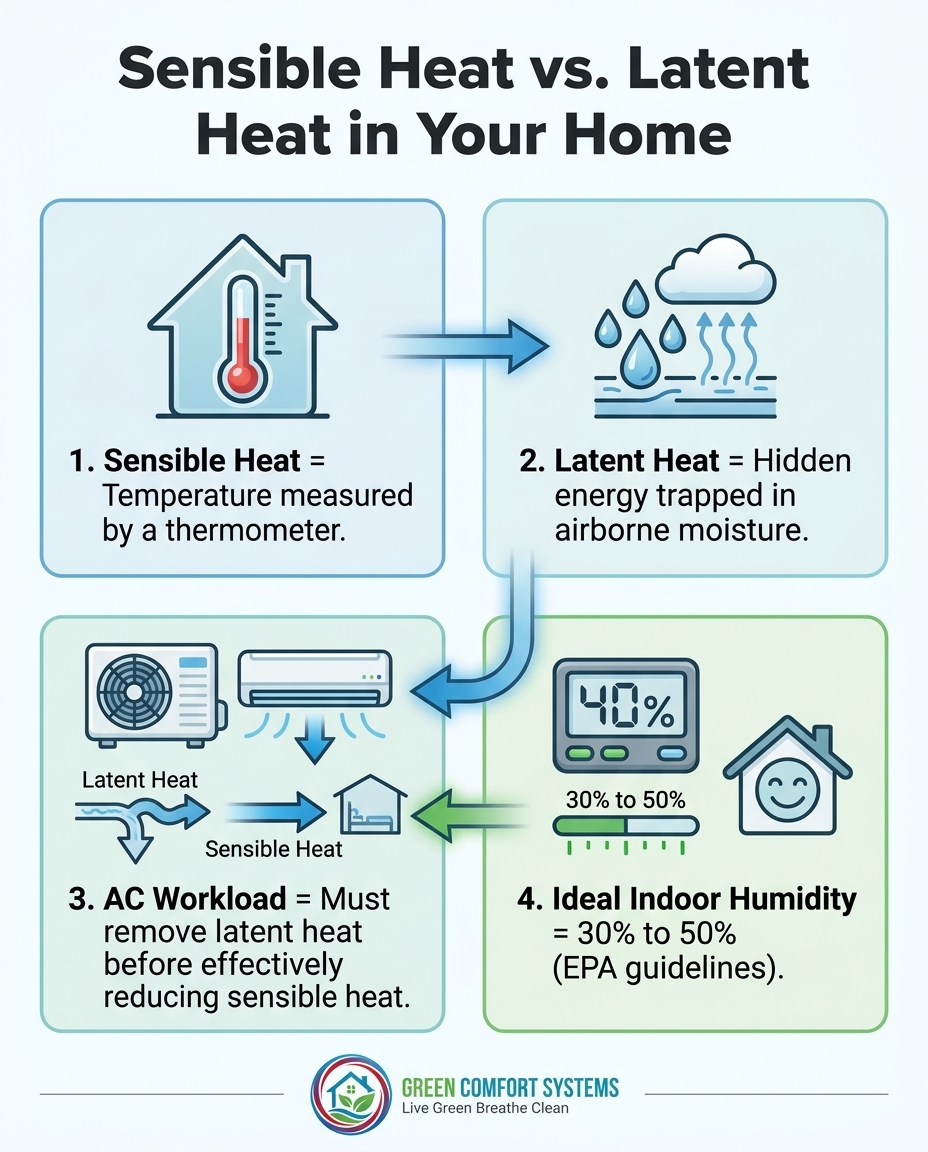
When you look at your thermostat, you are only seeing half the story. The science of home cooling is divided into two distinct categories: sensible heat and latent heat. Sensible heat is exactly what it sounds like—the actual temperature you can read on a thermometer and feel on your skin. If the room is 80 degrees and the AC cools it to 72 degrees, that is a reduction in sensible heat.
Latent heat, on the other hand, is the hidden thermal energy stored in airborne moisture. You cannot measure latent heat with a standard thermometer, but you certainly feel it when the air is thick and clammy. The mechanical reality of air conditioning is that the system must extract the latent heat (the moisture) from the air before it can effectively lower the sensible heat (the temperature). This dual-workload is the primary reason systems run for hours on end during muggy weather. If you want to dive deeper into this specific challenge, learning about managing indoor humidity during summer is a great next step.
Why the Thermostat Reading Can Be Misleading
A typical pattern we see is a homeowner staring at a moderate thermostat temperature vs. high indoor humidity and feeling completely confused. Your thermostat might read a perfectly reasonable 75 degrees, but you are still sweating on your couch. This happens because standard thermostats only measure sensible heat. They are completely blind to the latent heat burden your AC is currently fighting.
As the warm, humid air blows over your indoor evaporator coil, the coil must first condense that water vapor into liquid (which drips outside through the condensate drain). Only after a significant amount of water is removed does the air actually become crisp and cool enough to drop the sensible temperature reading in the room. This phase change—turning vapor into liquid water—takes massive amounts of energy and time.
Why Continuous Operation in High Humidity is Often Normal
Hearing your compressor run for hours on end can be stressful, especially when you rely on it to keep your family safe during extreme weather. However, long cooling cycles are often a feature of modern systems, not a bug. High-efficiency air conditioners are specifically designed to run in longer, slower cycles specifically to pull moisture out of the air.
During a recent summer heatwave, one local family with a baby at home grew deeply concerned when their system ran constantly to fight the muggy air. A technician was dispatched quickly, identified the heavy latent heat load, and provided professional service to ensure the home remained a cool, safe environment. In many cases like this, the system is simply doing exactly what it was engineered to do during August muggy days.
Contrast this long, steady operation with "short cycling." If an air conditioner turns on, blasts freezing air for ten minutes, and shuts off, it will lower the temperature quickly. However, ten minutes is not nearly enough time for the evaporator coil to wring the humidity out of the air. The result is a cold, clammy house that feels like a damp cave. If the air coming from your vents is cold and the indoor humidity is gradually dropping, your system's continuous operation is likely perfectly normal.
Red Flags: When Constant Cycling Means Your System is Failing
While long cycles are normal during heavy humidity, there is a clear line between managing a moisture load and suffering a mechanical breakdown. You should not ignore a system that runs 24/7 if it fails to actually improve your home's comfort. Recognizing the red flags can save you from a catastrophic compressor failure right before the season ends.
The Problem: The system runs continuously, but the air coming from the vents feels lukewarm, or the airflow is incredibly weak.
The Cause: This often points to a frozen evaporator coil or low refrigerant levels. When dirty air filters restrict airflow during heavy use, the coil gets too cold and the condensation freezes into a block of solid ice. Alternatively, a refrigerant leak forces the system to run constantly because it lacks the chemical capacity to absorb heat, no matter how long it operates.
The Solution: Check and replace your air filter immediately. If the filter is clean and the system is still struggling, you need a licensed professional. During the heart of a recent summer heatwave, a customer's ductless AC unit began throwing error codes while running non-stop. A technician quickly pinpointed the issue, recharged the unit with refrigerant, and performed a full diagnostic to get the system safely back online. Never attempt to handle refrigerant issues yourself.
The Danger of Undersized or Oversized Units
Sometimes the issue is not a broken part, but the size of the equipment itself. An undersized unit lacks the capacity to cool your square footage; it will run non-stop and still fail to reach the target temperature or humidity level. Conversely, an oversized unit cools the sensible temperature far too quickly. It satisfies the thermostat and shuts off before it has time to remove the latent heat, leaving you with a moderate thermostat temperature vs. high indoor humidity. Both scenarios require professional evaluation to correct.
Eco-Friendly Upgrades to Handle Heavy Moisture Loads
Relying solely on your primary air conditioner for extreme humidity control wastes electricity and accelerates wear and tear on your equipment. If your home consistently struggles with damp, heavy air every August, it may be time to look at targeted, energy-efficient solutions that take the pressure off your main cooling system.
Green Comfort Systems is committed to providing eco-friendly and energy-efficient cooling solutions that manage humidity without wasting excess energy. One of the most effective upgrades is a whole-home dehumidifier. These systems integrate directly into your existing ductwork, extracting gallons of water from the air before it ever reaches your AC coil. By handling the latent heat load independently, the dehumidifier allows your air conditioner to focus purely on sensible cooling. This means your AC runs less, consumes less electricity, and lasts longer, all while reducing your home's overall carbon footprint.
For problem areas like additions, sunrooms, or upper floors that trap heat and moisture, upgrading to advanced, highly efficient zoning solutions can make a massive difference. Adding ductless mini splits to these specific zones provides targeted cooling and dehumidification exactly where you need it, without overworking the central system. When one Rosedale, MD homeowner realized their aging equipment couldn't keep up with the heavy moisture load, they opted for a full AC and heater replacement. The efficient, professional installation was completed ahead of schedule, providing an immediate upgrade to a system designed to handle Maryland's toughest weather.
Keep in mind that high-efficiency equipment upgrades often qualify for generic federal tax credits or local utility incentives, making eco-friendly home comfort more accessible than ever.
End-of-Season AC Care to Prevent Premature Burnout
Surviving the final stretch of summer requires a bit of proactive care. By late August, your system has been running hard for months, and minor neglect can quickly turn into a major breakdown. Follow these steps to help your equipment survive the remaining August muggy days:
1. Change the air filter immediately: August filters are often heavily clogged with summer dust, pet dander, and pollen. A restricted filter forces the blower motor to work twice as hard and dramatically increases the risk of a frozen coil.
2. Clear the outdoor condenser unit: Late-summer storms blow leaves, twigs, and yard debris into the outdoor unit. Keep a two-foot clearance around the condenser so the system can properly exhaust the heat it pulls from your home.
3. Check the condensate drain line: Because your system is pulling so much moisture from the air, the drain line works overtime. Ensure it is dripping steadily outside. If water is backing up, it can trigger a safety switch that shuts the whole system down.
4. Monitor indoor humidity levels: Purchase an inexpensive digital hygrometer to track your indoor moisture. The EPA recommends aiming for 30% to 50% relative humidity for optimal health and comfort.
5. Schedule a professional inspection: If your system has struggled to keep up with the moisture all summer, do not wait for it to fail completely. Consider exploring indoor air quality solutions and having a technician assess the wear and tear before the season ends.
Expert Help for Your Home's Cooling and Humidity Challenges
While continuous operation can be perfectly normal during heavy Rosedale, MD humidity, you should never have to guess whether your system is functioning safely or failing quietly. Understanding the hidden workload of latent heat explains why your system runs so hard, but it does not fix underlying airflow issues, low refrigerant, or aging equipment.
Addressing your indoor air quality and humidity comprehensively is the best way to protect your investment and keep your family comfortable. If your AC is running non-stop but your home still feels sticky and warm, it is time to get a professional set of eyes on the problem. Reach out to schedule a thorough inspection or discuss eco-friendly system upgrades with a local expert today, ensuring your home remains a cool, dry sanctuary no matter how heavy the August air gets.
Frequently Asked Questions
Why is my AC running so much if it's not that hot outside?
Your air conditioner is likely working hard to remove high levels of indoor moisture, even if the actual temperature reading is moderate. In late summer, the latent heat trapped in humid air requires massive amounts of energy to extract. The system must run in long, continuous cycles to condense this moisture into water and drain it away before the house actually feels comfortable.
How does an air conditioner remove humidity?
An air conditioner removes humidity by pulling warm, damp indoor air across a very cold evaporator coil. As the warm air hits the cold metal, the moisture in the air condenses into liquid water, much like drops forming on the outside of a cold glass of iced tea. This water then drips into a pan and is channeled safely outside your home, leaving the resulting air drier and cooler.
Is it normal for my AC to run constantly in high humidity?
Yes, continuous operation is often normal when the outdoor air is heavily saturated with moisture. Modern, high-efficiency systems are specifically designed to run at lower speeds for extended periods to maximize dehumidification. As long as the air coming from your vents is cold and the indoor humidity is dropping, the continuous running is a sign the system is doing its job.
Does an air conditioner remove humidity or just cool the air?
A properly functioning air conditioner does both, but it actually has to process the humidity first. It removes latent heat (moisture) by condensing water vapor, and it removes sensible heat (temperature) by absorbing thermal energy. If a system is oversized, it may cool the air too quickly and shut off before it has a chance to remove the humidity, leaving the home feeling clammy.
At what humidity level does an AC begin to struggle?
Most standard air conditioners begin to work significantly harder when indoor relative humidity climbs above 55% to 60%. The Environmental Protection Agency (EPA) recommends maintaining indoor humidity between 30% and 50% for optimal comfort and to prevent mold growth. When levels exceed this range, the AC must dedicate most of its energy to moisture removal rather than temperature reduction.
Can a whole-home dehumidifier reduce my AC energy usage?
Absolutely. By installing a whole-home dehumidifier to handle the heavy moisture load, you relieve your primary air conditioner of its most energy-intensive task. With the humidity controlled independently, you can often set your thermostat a few degrees higher while feeling just as cool, which significantly reduces the electrical strain and wear on your AC unit.
Book Expert Service Or Contact Us
Other Blogs


Get Financing Today
Get the comfort you deserve, without the financial stress.

Latest Blogs
Why Your Rosedale Home's Addition Is Always Colder Than the Rest of the House
Retrofitting Modern Heating Solutions into Mid-Century Perry Hall Homes
The Danger of Closing Vents in Unused Rooms During the Rosedale Heating Season
