





Why Rosedale Homes Experience Dimming Lights When the AC Kicks On

Is It Normal for Your Lights to Dim When the AC Starts?
Have you ever noticed a sudden voltage drop in your living room, wondering exactly why Rosedale homes experience dimming lights when the AC kicks on? You are certainly not alone. At Green Comfort Systems, our team fields this question constantly, especially when the August heat pushes your cooling system to its absolute limits. If you are seeing your lamps flicker or your overhead lights dim for a split second every time the thermostat calls for cool air, you are witnessing a massive electrical draw happening in real time. The critical decision you face as a homeowner is determining whether that brief flicker is a harmless, momentary power draw or a glaring warning sign of a failing HVAC component.
To get to the bottom of this issue safely, you need professional HVAC services to properly diagnose the root cause. Attempting to test high-voltage components yourself is incredibly dangerous, which is why scheduling dedicated air conditioning service with our certified technicians is the smartest move you can make.
The Decision Point: Harmless Draw vs. Failing Equipment
A barely noticeable flicker: A very brief voltage drop that lasts less than half a second is often considered normal. This happens due to what engineers call "inrush current." When a heavy-duty motor starts from a dead stop, it demands a massive surge of electricity to overcome physical inertia. If your lights dim for just a fraction of a second and immediately return to full brightness, our team typically finds your system is operating within normal parameters.
Pronounced or prolonged dimming: If your lights dim significantly, stay dim for more than a second, or flicker repeatedly while the air conditioner runs, you have a struggling system on your hands. Ignoring prolonged dimming is a serious mistake. In our years of servicing local homes, we have seen this lead to total compressor failure, melted wires, or severe electrical hazards at the breaker panel. When the system struggles to start, it pulls excessive amperage for far too long, generating dangerous levels of heat in the electrical lines.
Because diagnosing this requires specialized multimeters and an understanding of high-voltage capacitors, professional intervention is mandatory. Touching the wrong component inside an AC condenser can result in severe electrical injury, even if the main power is turned off.
Why Does the AC Compressor Draw So Much Power?
To understand why your lights react to your air conditioner, you have to look at the sheer amount of energy required to jump-start a heavy mechanical motor. Your outdoor AC unit houses the compressor, which is the heart of the entire cooling process. It is responsible for pumping high-pressure refrigerant through your home, and it requires a monumental amount of torque to get moving from a standstill.
Understanding Locked Rotor Amps (LRA)
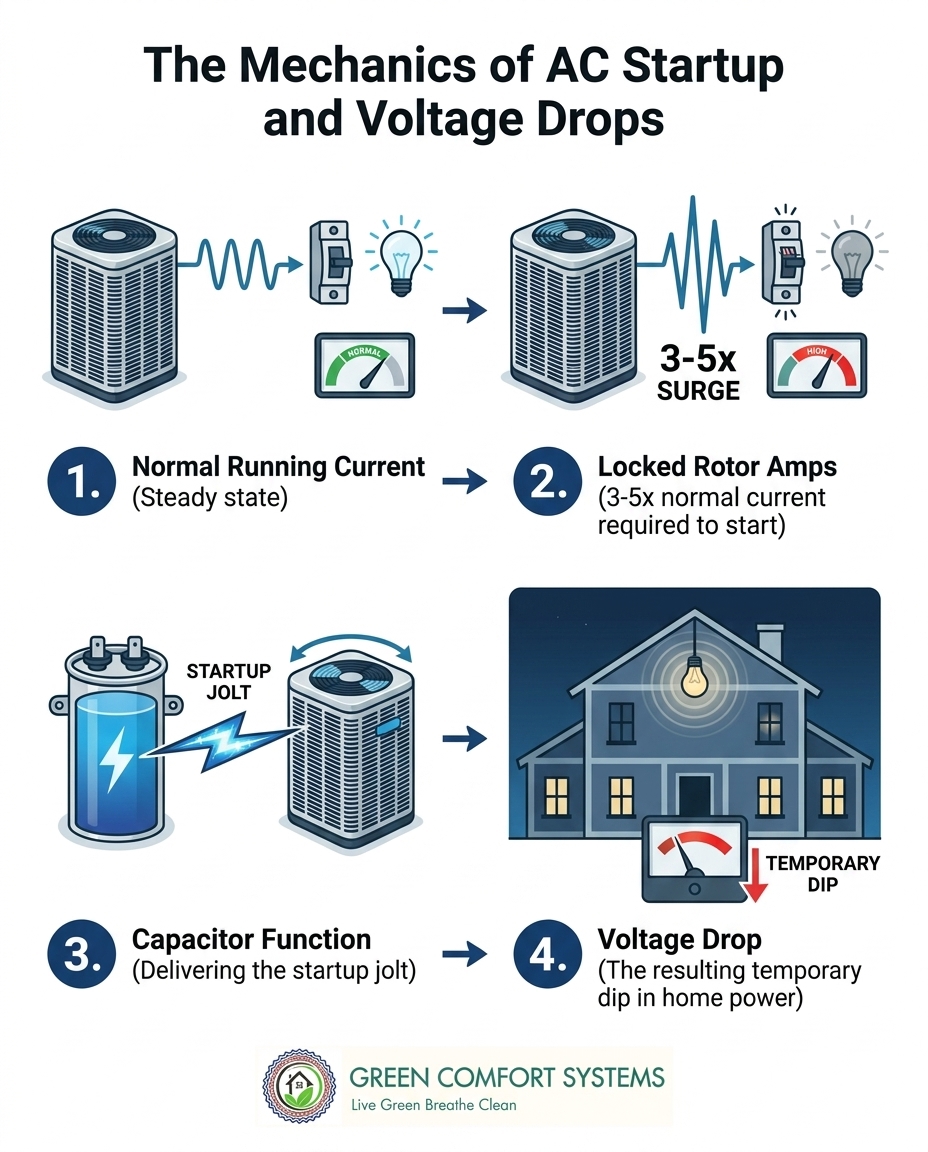
Every AC compressor has two distinct electrical ratings: Running Load Amps (RLA) and Locked Rotor Amps (LRA). RLA is the amount of electricity the unit needs to keep running smoothly once it is already turned on. LRA, however, is the amount of electricity required to break the physical inertia of the heavy internal components and start the motor.
The sudden demand: Compressors typically require three to five times their normal running current just to start. If your air conditioner uses 15 amps to run, it might demand 60 to 75 amps for a split second during startup. This massive, sudden demand pulls available amperage directly from your home's main electrical panel.
The resulting voltage drop: Your home's electrical grid has a finite amount of power available at any given millisecond. When the outdoor unit suddenly demands 70 amps, the electrical panel prioritizes that massive draw. As a result, other active circuits on the panel—such as the lighting circuit in your living room or kitchen—experience a temporary drop in voltage. Less voltage reaching the lightbulbs means less light output, which you perceive as a flicker or dimming effect.
Modern, healthy HVAC systems are designed to manage this massive draw incredibly quickly. A compressor in peak condition will pull that LRA surge and settle back into its normal running amperage in a fraction of a second. When the system is healthy, the voltage drop is so fast that you might not even notice it. However, as cumulative wear sets in by August and the back-to-school late-summer season, our technicians notice that this fraction of a second begins to stretch out, making the dimming much more obvious.
How Does a Failing Capacitor Cause Lights to Flicker?
While the mechanics of inrush current explain why a brief flicker happens, a failing run capacitor is usually the primary culprit when the dimming becomes severe or prolonged. The capacitor is one of the most critical, yet frequently replaced, components in your entire HVAC system.
The Problem: Overcoming Mechanical Inertia
Your AC compressor is essentially a heavy pump. Starting that pump requires more electricity than your home's standard 240-volt circuit can instantly provide. If the compressor had to rely solely on the electricity flowing directly from the breaker panel, it would struggle to start, pulling high amperage for several seconds and severely overheating the internal windings.
The Cause: Capacitor Degradation
To solve this, air conditioners use a run capacitor. You can think of the capacitor as a powerful, localized battery. It stores up electrical energy while the system is off, holding it in reserve. When the thermostat calls for cooling, the capacitor acts like a sprinter's starting block, delivering a massive, concentrated jolt of energy directly to the compressor motor. This helps the motor overcome inertia instantly.
Over time, capacitors lose their ability to store and discharge energy. They degrade due to heat, frequent cycling, and age. When a capacitor weakens, it cannot deliver that necessary jolt fast enough. As a result, the compressor is forced to pull all of its starting power directly from the home's electrical grid. Because the grid cannot deliver the power as efficiently as a healthy capacitor, the compressor struggles to start, remaining in that high-amperage Locked Rotor state for a longer duration.
The Solution: Professional Replacement
This directly connects to the symptoms we frequently see inside your Rosedale, MD home. The longer the compressor struggles to start because of a weak capacitor, the longer and more severe the voltage drop becomes, causing your lights to dim noticeably. If you are wondering what to do when your AC stops cooling efficiently due to these electrical struggles, the answer is to have our technicians test the capacitor's microfarad rating. Replacing a weak capacitor is a straightforward professional repair that restores normal startup times and stops the lights from flickering.
Why Do AC Electrical Issues Peak in Late Summer?
It is no coincidence that our dispatch board at Green Comfort Systems lights up with these exact calls in August. Your air conditioning system endures a tremendous amount of stress throughout the cooling season, and by the time the late summer heatwaves arrive, the components are suffering from severe cumulative wear.
The Impact of Cumulative Wear
By the time August rolls around, your AC capacitor has likely endured thousands of startup cycles. Every single time the unit turns on, the capacitor discharges its stored energy and recharges. This constant cycling leads to internal structural fatigue. The chemical composition inside the capacitor slowly breaks down, reducing its ability to hold a charge.
Furthermore, Greater Baltimore's intense late-summer humidity forces your air conditioner to work overtime. An AC unit does not just cool the air; it also dehumidifies it. When the humidity levels skyrocket, the compressor is forced to run in much longer cycles to remove the thick moisture from the indoor air. This continuous operation during peak heat waves prevents the system from properly resting and cooling down. The excessive ambient heat combined with the internal operating heat severely accelerates capacitor degradation.
A Final Cry for Help
An end-of-season lighting flicker is often the cooling system's final cry for help before a complete breakdown. We see the consequences of this cumulative wear frequently. Just recently, one local family experienced a severe cooling disruption during a brutal summer heatwave, which caused immense concern because they had a newborn baby at home. By reaching out to our responsive team immediately, a Green Comfort Systems technician was dispatched quickly to diagnose the struggling equipment. Because the issue was addressed promptly by our knowledgeable professionals, the system was stabilized and a safe, cool environment was restored before the home's temperature reached dangerous levels.
Rapid professional response is absolutely vital. If you ignore the dimming lights in August, the weakened capacitor will eventually fail completely. When that happens, the compressor will try to start, fail, and overheat, potentially destroying the compressor motor itself—a repair that is vastly more complex than swapping out a capacitor.
Electrical Panel or HVAC System: Where Is the True Root Cause?
When the lights dim, many homeowners immediately assume they have a problem with their home's electrical wiring. It is incredibly common for a homeowner to call an electrician for a lighting issue, only to discover that the root cause is actually sitting outside in the HVAC condenser.
At Green Comfort Systems, we specialize in comprehensive root-cause diagnostics. Over our years of providing HVAC solutions in Rosedale, we have learned that HVAC systems and home electrical grids are deeply intertwined. Rather than offering surface-level fixes or passing the buck to another contractor, our technicians are trained to pinpoint exactly how your cooling equipment is impacting your electrical panel, ensuring you get safe, accurate solutions.
Comparing the Symptoms
While overloaded electrical circuits, loose neutral wires, or a failing main breaker can certainly cause lights to dim, a failing AC capacitor is by far the most common culprit when the symptom perfectly aligns with the cooling cycle. Here is how professionals differentiate between the two:
• Timing of Dimming — Likely HVAC Issue (Capacitor/Compressor): Happens exactly when you hear the outdoor AC unit click on. — Likely Electrical Issue (Panel/Wiring): Happens randomly, or when using microwaves, vacuums, or hair dryers.
• Duration — Likely HVAC Issue (Capacitor/Compressor): Lasts 1 to 3 seconds, then returns to normal brightness. — Likely Electrical Issue (Panel/Wiring): Lights stay dim for long periods or flicker continuously.
• Accompanying Noises — Likely HVAC Issue (Capacitor/Compressor): A loud buzz or hum coming from the outdoor AC unit. — Likely Electrical Issue (Panel/Wiring): Sizzling, popping, or buzzing sounds at the indoor breaker box.
• Affected Areas — Likely HVAC Issue (Capacitor/Compressor): Usually affects the whole house or the main living areas simultaneously. — Likely Electrical Issue (Panel/Wiring): Often isolated to a single room or a specific circuit of lights.
A strong warning against DIY troubleshooting: Never attempt to open your electrical panel or your AC condenser to test these theories yourself. AC capacitors store lethal amounts of high-voltage electricity, even when the breaker is flipped off. Handling them without the proper tools and discharge procedures can result in severe injury. Always rely on a professional who understands the intersection of both systems.
Can a Hard Start Kit Fix Dimming Lights?
If a Green Comfort Systems technician tests your system in Rosedale, MD and finds that the capacitor is functioning properly, but the lights are still dimming heavily, it usually means the compressor itself is beginning to fail mechanically. As compressors age, the internal bearings wear down, and the motor requires even more torque to overcome the friction of startup. When this happens, our professionals may recommend installing a hard start kit.
What is a Hard Start Kit?
A hard start kit is a specialized, professional-grade component that gives an aging compressor an extra, massive boost of starting torque. It consists of a high-capacity start capacitor and a potential relay. While the standard run capacitor helps the system start and stay running, the hard start kit is designed purely for the first fraction of a second of operation.
How it mitigates voltage drops: By delivering a massive surge of stored energy instantly, the hard start kit dramatically reduces the duration of the inrush current. It helps the struggling compressor break inertia in a fraction of the time it normally would. Because the high-amperage draw is cut so short, the voltage drop on your electrical panel is minimized, effectively stopping your home's lights from dimming.
When is a System Too Far Gone?
It is important to clarify that we utilize hard start kits as a professional intervention designed to extend the life of an aging system, not a permanent cure for a dying motor. If a compressor's internal windings are shorted, or if the mechanical friction is too severe, even a hard start kit will not be able to force it to run.
In these scenarios, the system is simply too far gone for a band-aid fix. When the compressor fails completely, continuing to pour money into electrical modifications is a poor investment. At that point, moving forward with professional AC installation in Baltimore becomes the safer, more reliable long-term solution to keep your home cool and your electrical system safe during the sweltering late summer heat. Additionally, general federal tax credits and utility incentive programs frequently apply to qualifying high-efficiency AC or heat pump installations, and we always advise our customers to verify current programs with their utility provider or a tax professional when considering an upgrade.
Frequently Asked Questions About AC-Related Power Drops
Is it normal for lights to dim when the AC kicks on?
Yes, a slight, fraction-of-a-second dimming can be perfectly normal due to the high startup amperage required by the compressor. When the heavy motor starts, it temporarily pulls voltage away from other circuits. However, pronounced dimming that lasts more than a second is not normal and requires immediate professional inspection.
Can a bad AC capacitor cause lights to flicker?
Yes, a failing run capacitor is the most common cause of lights flickering when the air conditioner starts. The capacitor acts as a battery to help start the unit; when it weakens, the compressor is forced to pull excess power directly from your home's grid for a longer period, resulting in a noticeable voltage drop.
Why does my house power drop when the AC kicks on?
The AC compressor requires three to five times its normal running current just to overcome physical inertia and start up. This sudden, massive electrical draw pulls voltage away from other active circuits on your electrical panel. Healthy systems manage this draw instantly, while aging systems drag it out, causing a visible power drop.
Are dimming lights a fire hazard?
While dimming lights are often an HVAC issue related to the capacitor, severe and prolonged voltage drops can indicate overloaded circuits or loose wiring in the panel. If left unchecked, this electrical strain generates excessive heat and can pose serious safety risks, requiring evaluation by a qualified professional.
How do I know if my AC compressor is failing?
Signs of a failing AC compressor include prolonged light dimming, loud humming, buzzing, or clicking at startup, and warm air blowing from your indoor vents. Because these symptoms overlap closely with a bad capacitor, a professional diagnostic is required to distinguish between a simple capacitor replacement and a dying compressor.
Schedule Professional AC Diagnostics Before Your Compressor Fails
Dimming lights are much more than just a minor household annoyance; they are a clear warning sign from your cooling equipment. Whether it is the result of cumulative late-summer wear on your run capacitor or an aging compressor fighting mechanical friction, ignoring a prolonged voltage drop puts your entire system at risk. Allowing a failing capacitor to limp along will inevitably cause the compressor motor to overheat and fail entirely, turning a straightforward repair into a catastrophic breakdown.
Do not wait for your system to fail on the hottest day of the year in Rosedale, MD. Protect your equipment and your home's electrical grid by having our experts at Green Comfort Systems evaluate the true root cause of the power draw. Take action today and schedule your air conditioning service to ensure your system runs safely and efficiently all season long.
Book Expert Service Or Contact Us
Other Blogs


Get Financing Today
Get the comfort you deserve, without the financial stress.

Latest Blogs
What We Actually Inspect During a Fall Furnace Tune-Up (And Why It Prevents Mid-Winter Breakdowns)

Introducing the Green Legacy Initiative: How Green Comfort Systems Gives Back to Maryland's Forests
Home Maintenance Tips and Troubleshooting: Introducing the Green Legacy Initiative in Maryland
