





Why Waiting for Proprietary HVAC Parts Takes Longer (And How We Expedite Repairs)

Is Your System Down? The Frustration of the 'Special Order' Part
Are you wondering why waiting for proprietary HVAC parts takes longer (and how we expedite repairs) when your air conditioner suddenly shuts down on the hottest day of the year? You are not alone. At Green Comfort Systems, we see this frustration first-hand every August in Rosedale MD: the technician completes their diagnostic check, walks back in from the yard, and delivers the news that your system requires a special order component that isn't sitting on their service truck. Suddenly, you are facing days of sitting in a hot, stagnant house while waiting for a delivery.
This situation presents a critical decision point. When a technician diagnoses a failed proprietary component, the standard industry practice is to place a factory order and passively wait for it to arrive. However, protecting your home from late-summer August heat requires an active, expedited sourcing strategy rather than defaulting to a standard factory backorder. Whether you are exploring comprehensive HVAC services or need immediate air conditioning repair and replacement, understanding how parts are sourced—and what our team at Green Comfort Systems is doing to speed up the process—is the first step toward restoring your comfort.
Understanding Your System: Universal Components vs. Proprietary OEM Parts
In our years of servicing Rosedale homes, we find that to understand why certain repairs take longer, we first have to look at how modern air conditioners and furnaces are built. Not all parts are created equal. Your system contains a mix of generic, interchangeable hardware and highly specific, brand-exclusive technology. Knowing the difference explains why our technicians can fix some breakdowns in twenty minutes, while others require regional supply searches.
The Role of Universal Aftermarket Parts
Universal components are the standardized building blocks of the HVAC industry. These parts are designed to work across dozens of different brands and models. Because they are interchangeable, our technicians carry them in bulk on their service trucks, and local supply houses keep hundreds of them on the shelves.
• Capacitors: These act as large batteries that deliver the initial jolt of electricity needed to start your compressor and fan motors.
• Contactors: These are the mechanical switches that control the flow of high-voltage electricity to your outdoor unit.
• Standard Fuses and Relays: Basic electrical safety components that protect the system from power surges.
When a universal part fails, the repair is almost always completed on the same day. The technician simply pulls a compatible replacement from our vehicle inventory, wires it in, and restores your cooling immediately.
The Complexity of Proprietary OEM Parts
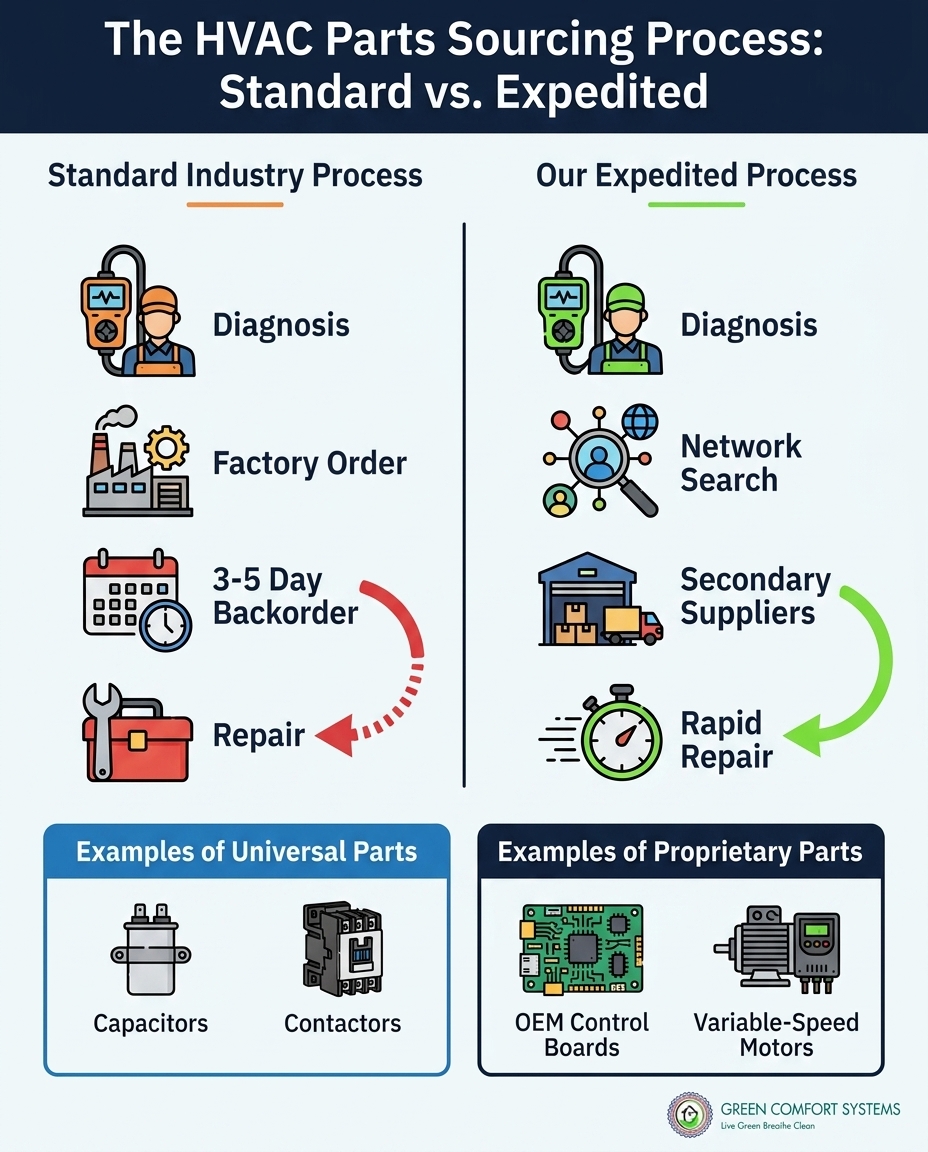
Proprietary OEM (Original Equipment Manufacturer) parts are entirely different. These components are engineered by the manufacturer specifically for a single brand, and often for a single specific model year. They cannot be swapped out for a generic alternative. Proprietary OEM control boards and variable-speed motors are prime examples of parts that must be ordered directly from authorized distributors.
• Interchangeability — Universal Aftermarket Parts: Works across many brands and models. — Proprietary OEM Parts: Exclusive to specific brands and model years.
• Availability — Universal Aftermarket Parts: Stocked heavily on technician trucks. — Proprietary OEM Parts: Requires authorized distributor or factory order.
• Functionality — Universal Aftermarket Parts: Basic mechanical or electrical tasks. — Proprietary OEM Parts: Complex communication and system logic.
• Warranty Impact — Universal Aftermarket Parts: Generally accepted for basic electrical fixes. — Proprietary OEM Parts: Using non-OEM substitutes voids factory warranties.
Why High-Efficiency Systems Require Exact Matches
Modern high-efficiency units rely on complex microprocessors to communicate efficiently. A variable-speed blower motor doesn't just turn on and off; it receives continuous data from a proprietary control board, adjusting its speed in one-percent increments to maximize energy savings and humidity control. Our team always warns homeowners that substituting these advanced components with generic parts compromises both energy efficiency and safety. In fact, attempting to wire a universal motor into a communicating system will usually result in immediate system failure and void the manufacturer's warranty entirely.
The Supply Chain Bottleneck: Why Factory Backorders Take 3 to 5 Days
If proprietary parts are so critical, why aren't they stocked on every corner? The answer lies in the massive scale of the HVAC manufacturing industry and the logistical realities of local warehousing. When a specific board fails, the standard industry practice involves a waiting period that typically spans 3 to 5 business days.
1. The Local Shelf Space Limitation: In our daily operations, we see that local supply houses in Rosedale MD simply cannot physically stock every single proprietary board, motor, or valve for every brand and model year. There are thousands of active SKUs (Stock Keeping Units) in the HVAC industry. Warehouses prioritize shelf space for the most commonly replaced parts.
2. The Just-In-Time Manufacturing Model: Manufacturers do not keep massive stockpiles of replacement parts for ten-year-old systems. They build parts based on projected demand. When a part is needed, it often ships directly from a central national hub rather than a local distributor.
3. Global Microchip Shortages: Modern HVAC control boards require the same microchips used in the automotive and computing industries. Global supply chain disruptions have created bottlenecks in the production of these specific electronic components, extending lead times for factory replacements.
4. The Standard Logistics Chain: When a contractor orders a part conventionally, the request goes to a local distributor, who routes it to a regional hub, who requests it from the national factory. The part is then shipped via standard commercial freight, processed at the local hub, and finally delivered to the contractor.
While this multi-day delay is standard across the industry, Green Comfort Systems believes it shouldn't be accepted as the only option when your family's comfort is on the line.
Why We Don't Let You Wait: The Urgency of Late-Summer Heat
Waiting for a part is often treated as an administrative delay by manufacturers, but for homeowners, it is a pressing safety concern. As families gear up for the back-to-school transition, Rosedale's late-summer August heat and extreme humidity create an environment where rapid repair is absolutely critical. This is not just about feeling slightly warm; it is about the physical reality of how homes handle extreme weather.
The Danger of High Humidity: Extreme summer humidity drastically reduces the human body's ability to cool itself. Sweat cannot evaporate effectively in damp indoor air. When an air conditioner fails, it stops removing humidity from the home. Within hours, the indoor heat index can climb significantly higher than the actual temperature reading on the wall, transforming a mechanical breakdown into a severe indoor safety hazard.
Thermal Mass and Heat Retention: Homes absorb heat throughout the day. The roof, the walls, and the furniture all store thermal energy. Once an AC unit goes offline, this stored heat radiates into the living space. By the second day of a breakdown, the house essentially acts as an oven, holding onto the heat even after the sun goes down.
Protecting Vulnerable Family Members: Rapid repairs are most critical for those who cannot easily regulate their body temperature. Recently, our team at Green Comfort Systems responded to a local homeowner during a brutal stretch of late-summer heat when their system began failing. With a new baby at home, the rising indoor temperature was an immediate concern. We prioritized the response, dispatching a knowledgeable technician quickly to diagnose the issue, stabilize the situation, and implement a solution before the home became dangerously hot. We treat these delays as urgent emergencies because we understand exactly what is at stake.
Our Sourcing Methodology: How We Track Down Obscure Parts Faster
Because we refuse to accept the standard 3-to-5 day factory backorder as the final answer, the Green Comfort Systems process involves a highly active sourcing methodology. We leverage strong vendor relationships and smart inventory strategies to source proprietary parts significantly faster than competitors. Here is exactly how we track down obscure parts to minimize your system's downtime.
Step 1: Immediate Diagnostic and Network Search
The process begins before our technician even leaves your driveway. Once the exact OEM part number is pinpointed, we do not simply submit a standard order and wait. Instead, our dispatch and inventory team immediately pings multiple regional supply networks simultaneously. We check authorized dealers across the state, looking for any warehouse that might have the specific control board or motor sitting on a back shelf.
Step 2: Leveraging Secondary Suppliers
If the primary manufacturer warehouse is out of stock or citing a long delay, we go beyond the standard channels. We utilize a vast network of verified secondary suppliers and regional buying groups. Because of our strong vendor relationships, we can often locate verified, in-stock OEM components that aren't visible in the standard local supply house database.
Step 3: Expedited Routing
Once the part is located, we actively bypass standard commercial freight timelines. Whether it means sending a runner to a distributor two hours away or coordinating overnight priority shipping directly to our facility, we actively pursue the part. This proactive methodology stands in stark contrast to the passive "wait and see" approach that leaves homeowners sweating through the weekend.
Handling Complex Repairs: From Rusted Fans to Gas Valves
Proprietary parts issues aren't limited strictly to electronic control boards. Mechanical components are just as susceptible to supply chain delays. When dealing with older units or highly specialized configurations, finding the exact physical match is critical for safe operation.
Fan Assemblies and Motor Mounts: Over time, outdoor condenser fans can rust, warp, or become unbalanced. Because the pitch of the fan blade and the specific mounting bracket are engineered for exact airflow requirements, you cannot simply bolt on a generic fan blade. We must source the precise OEM assembly to prevent vibration damage and ensure the compressor stays cool.
Complex Heating Components: This rigorous sourcing methodology applies to all equipment, whether we are troubleshooting an air conditioner in August or preparing a furnace for winter. For instance, our technicians frequently explain that troubleshooting and repairing furnace gas valves requires exact OEM replacements. Gas valves regulate combustible fuel; using an incorrect aftermarket valve is a severe safety hazard. During a recent maintenance visit, one local homeowner needed specific heating system components replaced. Our owner personally walked them through the exact diagnostic process and the parts required, ensuring the maintenance was completed thoroughly, safely, and transparently.
Partial Disassembly Requirements: Some complex repairs require partial disassembly of the unit to access the failed proprietary part. Whether it is removing an entire blower housing to extract a variable-speed motor or unmounting a rusted fan grate, having the correct, exact-fit replacement part on hand before our tear-down begins ensures that your system goes back together perfectly the first time.
Comprehensive Parts Logistics for All HVAC Systems
Our expedited sourcing at Green Comfort Systems applies to all major brands and system types across the entire home comfort ecosystem. As the seasons transition and we move out of late-summer cooling, the demand for specific parts shifts, but our methodology remains exactly the same.
Heating System Transitions: When the weather cools down, the focus shifts to heating system services. Furnace control boards, specialized igniters, and proprietary draft inducer motors often experience sudden failures during the first major cold snap of the year. Because every local contractor is suddenly ordering these parts at once, standard local supply houses run out immediately. Our regional network search allows us to pull from broader inventories to keep your home warm.
Year-Round Heat Pump Demands: Heat pumps present a unique logistical challenge because they operate 365 days a year. They provide both cooling in the summer and heating in the winter. This means their proprietary parts—such as reversing valves and specific electronic defrost control boards—endure double the wear and tear of a standard AC unit. Fast heat pump maintenance and repairs are heavily dependent on securing these exact OEM components quickly. Should a proprietary part be completely obsolete, we always remind our customers that federal tax credits or local utility incentives may apply to qualifying high-efficiency heat pump installations, helping offset the cost of a necessary upgrade (be sure to verify current programs with your utility or a tax professional). No matter the system, our primary goal at Green Comfort Systems is to bypass the administrative red tape of the supply chain and restore your comfort as quickly as possible.
Frequently Asked Questions
Why do OEM HVAC parts take longer to arrive?
Our team at Green Comfort Systems frequently explains that OEM HVAC parts take longer to arrive because they are specific to individual brands and models, meaning local warehouses cannot stock every variation. Instead of being held locally, these parts are usually kept at regional or national manufacturer hubs. When a proprietary component fails, it must be ordered, processed, and shipped via commercial freight, which typically creates a multi-day delay.
What is the difference between universal and proprietary AC parts?
The main difference is interchangeability and complexity. Universal parts, like capacitors and contactors, are generic components that work across dozens of different HVAC brands and are easily stocked on our technician trucks. Proprietary AC parts, such as specific control boards and variable-speed motors, are engineered exclusively for one specific system and cannot be safely substituted with aftermarket alternatives.
How can HVAC repairs be expedited when parts are out of stock?
HVAC repairs can be expedited by leveraging a broad network of secondary suppliers rather than relying solely on the primary manufacturer's warehouse. Proactive contractors like Green Comfort Systems will simultaneously check regional distributors, authorized buying groups, and secondary supply networks to locate the part elsewhere. Once found, expedited courier services or priority shipping can bypass standard commercial freight timelines.
Can I use a universal part instead of an OEM HVAC part?
You can use universal parts for basic electrical components like fuses or standard capacitors, but you cannot use them for complex, communicating components. Attempting to wire a generic control board or a universal variable-speed motor into a modern high-efficiency system will disrupt its communication logic. Doing so is a safety hazard and will almost always void the manufacturer's warranty.
What happens if an HVAC part is on backorder?
If an HVAC part is on a factory backorder, standard industry practice dictates waiting until the manufacturer produces or locates the item, which can take weeks. However, our team actively searches secondary markets and regional distributors to find the part sitting on another supplier's shelf. If the part is completely obsolete, we will discuss options for upgrading the system rather than leaving you without climate control indefinitely.
How do microchip shortages affect modern HVAC repairs?
Microchip shortages affect modern HVAC repairs because high-efficiency systems rely on advanced control boards that use the exact same microprocessors found in cars and computers. When global supply chains experience chip shortages, HVAC manufacturers cannot produce enough replacement boards to meet demand. This scarcity leads to longer factory backorders for proprietary electronic components across all major heating and cooling brands.
Restoring Your Comfort Without the Wait
Waiting for proprietary OEM control boards or specialized motors shouldn't mean enduring days of extreme indoor temperatures. While global supply chains and local inventory limits dictate standard delays, our proactive sourcing methodology at Green Comfort Systems actively bypasses the standard industry wait times. If your system is down and you need fast, reliable air conditioning repair and replacement, our team is ready to track down the right parts and restore your comfort immediately.
Book Expert Service Or Contact Us
Other Blogs


Get Financing Today
Get the comfort you deserve, without the financial stress.

Latest Blogs
Retrofitting Modern Heating Solutions into Mid-Century Perry Hall Homes
The Danger of Closing Vents in Unused Rooms During the Rosedale Heating Season
Understanding Your Heat Pump's Defrost Cycle During Early Frosts in Maryland
