





Whole-Home Humidifiers vs. Portable Units for Combating Dry Maryland Winters

Preparing for the Chill: Why September is the Time to Think About Humidity
September brings a welcome crispness to the air, but it also signals a fast-approaching decision for homeowners: weighing Whole-Home Humidifiers vs. Portable Units for Combating Dry Maryland Winters. Right now, the weather feels perfectly balanced. However, our team at Green Comfort Systems always reminds homeowners that the September pre-heating season is a narrow window. Before you know it, temperatures will drop, your furnace will kick on full-time, and the moisture inside your home will vanish almost overnight.
If you are looking to upgrade your home's Indoor Air Quality, now is the perfect time to explore your options.
Every year, we see homeowners trapped in the same frustrating cycle. You wake up with a scratchy throat, notice static shocks every time you touch a doorknob, and realize the house feels uncomfortably dry. The immediate reaction is usually a quick trip to the store to buy a temporary fix for the bedroom. But relying on multiple temporary devices creates a daily chore list that quickly becomes exhausting.
The core dilemma you face right now:
• The temporary route: Buying several small devices, carrying heavy water jugs through the house every night, and constantly scrubbing water tanks to prevent bacterial growth.
• The permanent route: Investing upfront in a system that integrates directly with your heating equipment, requiring zero daily effort while treating every room in the house automatically.
Addressing your home's moisture needs before the deep freeze sets in ensures you enjoy consistent, effortless comfort from the very first day the heating system turns on. Waiting until November usually means scrambling for a solution when our local technicians are already booked solid with emergency heating repairs.
The Reality of Maryland Winters on Your Indoor Air
To understand why a proactive approach matters, you have to look at what actually happens to the air inside your home when the seasons change. Maryland winters bring a specific type of aggressively dry, cold air that constantly strips indoor moisture, making your home feel much colder than the thermostat reading suggests. For homeowners in Rosedale MD and the surrounding areas, this creates a unique set of indoor comfort challenges. In fact, our technicians respond to countless calls every winter from local families whose homes feel freezing despite the furnace running constantly.
The science behind winter dryness comes down to how temperature and moisture interact. Here is exactly how your home loses its humidity:
1. Cold air holds less water: When the outdoor temperature drops below freezing, the air naturally contains very little moisture. Even if it is raining or snowing outside, the actual water vapor content in the cold air is minimal.
2. Heating expands the air: Your home constantly pulls in this cold, dry outdoor air through drafts, open doors, and normal ventilation. Your furnace then heats this air up to a comfortable 70 degrees.
3. Relative humidity plummets: Heating the air increases its capacity to hold moisture. Because no new water was added during the heating process, the "relative humidity" drops drastically. Air that was 60% humid at 30 degrees outside suddenly becomes 10% or 15% humid when heated to 70 degrees inside.
This creates an environment drier than a desert inside your living room. The American Society of Heating, Refrigerating and Air-Conditioning Engineers (ASHRAE) recommends keeping indoor relative humidity between 30% and 60% for optimal health. When your home drops below 30%, you start to feel the physical symptoms immediately. Your skin tightens, your sinuses dry out, and hardwood floors can even begin to shrink or crack.
While you might already know how to manage indoor humidity when it gets too high in July, managing the extreme lack of moisture in January requires a completely different strategy. In our experience, a localized approach simply cannot keep up with the constant influx of dry air throughout the entire house.
The Hidden Hassles of Portable Humidifiers
When the dry air hits, the most common reflex is to purchase a portable unit for the bedroom. A pattern we see often during our winter service calls is a primary bedroom cluttered with these standalone units. On the surface, this seems like a quick, low-cost solution. However, the reality of running these machines daily quickly turns into a frustrating, time-consuming chore.
The coverage problem: A standalone unit is designed to treat the air in a single, enclosed space. If you place one in the primary bedroom, it does absolutely nothing for the living room, the kitchen, or the kids' rooms down the hall. To achieve true comfort, you end up buying three or four different machines. Suddenly, your floor space is cluttered with bulky plastic towers, and you are tripping over power cords in every room.
The daily labor: Running multiple machines means you are now responsible for keeping them full. During peak heating season, a standard unit will easily burn through a gallon of water in a single night. This creates a relentless routine of carrying heavy, sloshing water tanks from the bathroom sink to the bedroom, wiping up inevitable spills, and waking up at 3 a.m. to the sound of a machine loudly beeping because it ran dry.
Maintenance and Mold Risks
The most significant drawback of a standalone unit is the strict maintenance required to keep it safe. Stagnant water sitting in a warm plastic tank is the perfect breeding ground for mold, mildew, and bacteria. If you fail to clean the unit thoroughly, the machine will aerosolize these contaminants, blowing them directly into the air you breathe.
• Daily rinsing: Manufacturers recommend emptying and rinsing the tank every single day.
• Weekly scrubbing: You must scrub the base and tank with white vinegar or bleach weekly to remove mineral scale and pink slime.
• Filter replacements: Many units require specialized wicking filters that must be purchased and replaced monthly, adding an ongoing hidden cost.
This high-maintenance routine is the exact opposite of a relaxing winter evening. The constant upkeep is why our team sees so many homeowners eventually unplug their units, shove them into a closet, and simply resign themselves to dry air for the rest of the season.
How Bypass Humidifiers Deliver Seamless, Whole-Home Comfort
If you want to eliminate the daily chores while achieving superior comfort, we consistently recommend a bypass system as the definitive answer. Rather than treating one room at a time, this system is permanently mounted directly to your central heating equipment. It works in tandem with your furnace to distribute perfectly balanced moisture evenly throughout your entire living space.
How the system works: A bypass humidifier relies on your existing blower motor to move air. When your furnace turns on, a portion of the warm air is routed through a bypass duct and passed over a water panel (or evaporator pad) inside the humidifier. The warm air absorbs moisture from the panel and is then pushed back into your home's air supply. Because the moisture is added directly to the airflow, every single room with a supply vent receives treated, comfortable air simultaneously.
The "set it and forget it" lifestyle: The greatest benefit of this permanent solution is the complete lack of daily maintenance. The system is plumbed directly into your home's water line, meaning it fills itself automatically. A built-in humidistat monitors the moisture levels in your home and turns the unit on and off as needed, just like your thermostat controls the temperature. You never have to carry a water jug again.
Professional installation is mandatory: Integrating a bypass system is not a weekend DIY project. When our Green Comfort Systems technicians handle proper HVAC ductwork integration, it requires calculating exact airflow pressures, cutting precise openings into your sheet metal plenums, tapping into your home's plumbing, and safely wiring a low-voltage humidistat to your furnace control board. A licensed professional ensures the system operates safely without restricting airflow or risking water leaks.
Once installed, the only maintenance required is a simple water panel replacement, which our team typically handles once a year during your routine fall heating tune-up.
Head-to-Head Comparison: Upfront Investment vs. Daily Convenience
When making your decision for the upcoming winter, it helps to look at the practical differences side-by-side. While a permanent system requires an upfront investment for professional installation, our Rosedale customers find that the long-term value and daily convenience heavily outweigh the hidden costs of temporary fixes.
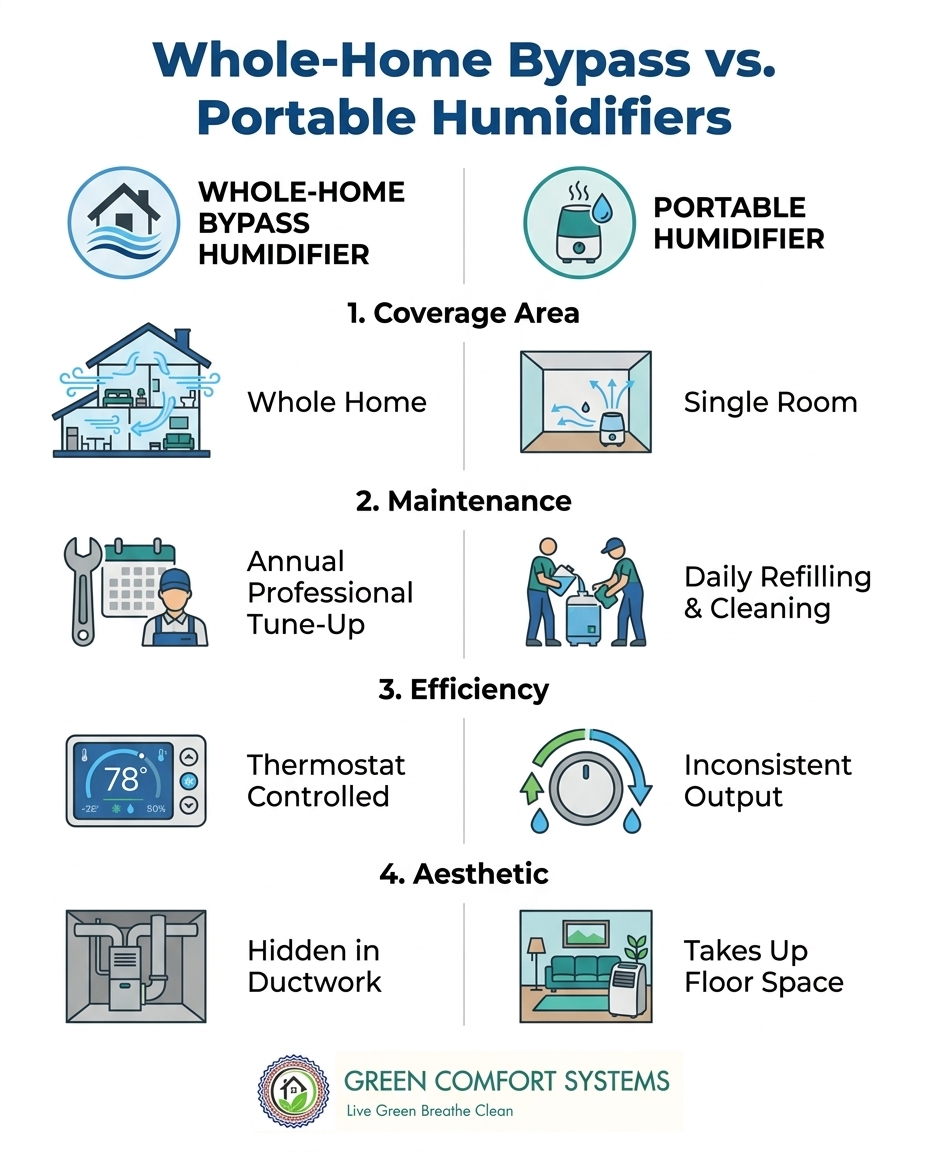
• Coverage Area — Whole-Home Bypass System: Entire home (every room with a vent) — Portable Bedroom Units: Single room only (requires multiple units)
• Water Supply — Whole-Home Bypass System: Automatic (plumbed into water line) — Portable Bedroom Units: Manual (daily carrying and refilling)
• Maintenance Schedule — Whole-Home Bypass System: Once a year (panel replacement during tune-up) — Portable Bedroom Units: Daily rinsing, weekly scrubbing, monthly filters
• Control Method — Whole-Home Bypass System: Automatic humidistat (set it and forget it) — Portable Bedroom Units: Manual dials (often inconsistent output)
• Aesthetics & Space — Whole-Home Bypass System: Hidden away in the basement or utility closet — Portable Bedroom Units: Takes up floor space, visible power cords
• Mold & Safety Risk — Whole-Home Bypass System: Extremely low (water flows, never sits stagnant) — Portable Bedroom Units: High (requires strict cleaning to prevent bacteria)
The true value proposition: The upfront cost of a permanent system pays dividends in time saved. During the busy holiday season and dark winter months, the last thing you want is another daily chore. A permanent system gives you back your evenings, protects your family from aerosolized bacteria, and ensures your home remains consistently comfortable without you having to lift a finger.
The Eco-Friendly Advantage: Feeling Warmer While Using Less Energy
Beyond convenience, proper moisture management plays a massive role in your home's overall energy consumption. Green Comfort Systems' focus on eco-friendly, whole-home efficiency means looking at how all your systems work together. In our experience, a bypass humidifier doesn't just improve air quality; it actively reduces the workload on your furnace.
The science of feeling warm: Human bodies perceive temperature largely through the evaporation of moisture on our skin. When the air in your home is bone-dry, it rapidly evaporates moisture from your body, creating a cooling effect. This is why a dry home feels chilly even when the thermostat says it is 72 degrees. Conversely, when the air has proper moisture levels (around 40% to 50%), evaporation slows down. This allows you to feel perfectly warm and comfortable at 68 or 69 degrees.
Lowering the thermostat: By maintaining consistent moisture, you can comfortably lower your thermostat by two to three degrees during the winter. According to energy experts, every degree you lower your thermostat can reduce your heating bill by a noticeable margin over the season. Additionally, certain high-efficiency HVAC upgrades may qualify for generally applicable energy rebates or tax credits—be sure to ask us or check with your utility provider for current programs.
Easing the burden on your furnace: When you lower the thermostat, your furnace runs shorter, less frequent cycles. This reduces wear and tear on blower motors and heat exchangers, extending the lifespan of your heating systems. Upgrading to a permanent moisture solution is a holistic approach to home comfort that keeps you cozy while actively lowering your winter energy consumption.
Frequently Asked Questions About Winter Humidification
Is a whole house humidifier better than a portable one?
Yes, for long-term comfort and convenience, a whole-house system is vastly superior. We highly recommend it because it treats every room in your home simultaneously by distributing moisture through your existing ductwork. You avoid the daily chores of refilling tanks and scrubbing plastic parts, enjoying a truly automatic, "set it and forget it" experience.
Does a whole home humidifier help with heating bills?
Properly humidified air feels warmer to the human body, allowing you to turn your thermostat down by a few degrees without feeling cold. Lowering your thermostat reduces the number of cycles your furnace has to run. Over the course of a long winter, this reduced energy consumption can help manage your monthly utility costs while reducing wear on your equipment.
Can one portable humidifier do a whole house?
No, a single portable unit is generally only capable of treating the specific room it is placed in. Even "large capacity" console units struggle to push moisture down hallways and through doorways to reach distant bedrooms. To treat a whole house with portable units, you would need to purchase, place, and maintain multiple machines throughout the property.
Do whole house humidifiers cause mold?
When professionally installed and properly maintained by our technicians, whole-house systems pose an extremely low risk for mold compared to portable units. Bypass systems use flowing water that drains away, meaning water never sits stagnant in a tank. As long as you change the water panel annually and your HVAC technician calibrates the humidistat correctly, your home stays safe and comfortable.
How much maintenance does a whole home humidifier need?
A permanent system requires very little ongoing maintenance. The primary task is replacing the internal water panel (or evaporator pad) once a year. This is typically handled by your HVAC technician during your annual fall heating tune-up. Beyond that, the system fills and regulates itself automatically throughout the season.
Is my existing furnace compatible with a bypass humidifier?
Most central forced-air heating systems can easily accommodate a bypass unit. The installation requires sufficient space on the supply and return ductwork near the furnace to mount the unit and route the bypass tube. A professional evaluation by our team is required to ensure proper sizing, airflow dynamics, and safe integration with your specific HVAC equipment.
Make the Smart Choice Before the Winter Freeze
The transition into fall is the ideal time to take control of your home's indoor environment. While temporary bedroom units offer a quick fix, they ultimately trap you in a cycle of endless daily maintenance, mold risks, and inconsistent comfort. A permanent, whole-home system eliminates the hassle entirely, protecting your family's health and your home's woodwork automatically.
Take advantage of the September pre-heating season to get ahead of the rush. Scheduling an evaluation now ensures your system is fully integrated and ready to perform the moment the cold weather hits. Reach out to our team at Green Comfort Systems to see how easily a permanent moisture solution can be integrated into your existing ductwork, and enjoy a warmer, healthier home all winter long.
Book Expert Service Or Contact Us
Other Blogs


Get Financing Today
Get the comfort you deserve, without the financial stress.

Latest Blogs

Introducing the Green Legacy Initiative: How Green Comfort Systems Gives Back to Maryland's Forests
Home Maintenance Tips and Troubleshooting: Introducing the Green Legacy Initiative in Maryland
Whole-Home Humidifiers vs. Portable Units for Combating Dry Maryland Winters
