




Is Your Late-Night AC Breakdown an Emergency? When to Call for 24-Hour Service in Forest Hill

Waking Up to the Heat: Assessing a Midnight AC Failure
Is your late-night AC breakdown an emergency? When to call for 24-hour service in Forest Hill depends heavily on a few specific safety factors. It is 2:00 AM in the middle of summer, the house is eerily quiet, and you suddenly realize you are sweating. You check the vents, and nothing but stagnant, warm air is barely trickling out. A sudden loss of cooling in the middle of the night immediately raises urgent questions about your family's comfort, your home's safety, and the potential necessity of paying premium after-hours dispatch fees.
If you are dealing with a cooling failure right now and need professional guidance, exploring professional HVAC services can help you determine the right next step for your home.
Not every system malfunction requires a technician to arrive in the dark. While a broken air conditioner is incredibly frustrating, the difference between a mechanical inconvenience and a true safety hazard dictates how quickly you need professional intervention. Understanding how HVAC dispatchers categorize incoming calls helps homeowners make informed, cost-effective decisions rather than panic-driven ones.
The ultimate goal is to restore your comfort quickly without paying premium emergency rates unless your safety or property is genuinely at risk. During the peak of summer, residential cooling systems work incredibly hard to manage the thermal load of your home. When that system stops, the indoor temperature begins to climb, but the rate of that climb—and the specific symptoms your equipment is showing—will tell you exactly what to do next.
The Triage Process: How Dispatchers Evaluate Late-Night Calls
When you call a professional heating and cooling company after hours, the person on the other end of the line is doing more than just taking your address. HVAC dispatchers use specific triage criteria to prioritize late-night calls. This assessment separates issues that pose an immediate risk to property or health from those that simply cause temporary discomfort.
At Green Comfort Systems, our transparent dispatch criteria are designed to protect both your safety and your wallet. Honest diagnostic practices mean our team will actively advise you to wait until morning if it saves you money without putting your household at risk. You should only pay for 24-hour service when it is absolutely necessary.
The Dispatcher's Mental Checklist
To understand how your call is evaluated, it helps to see the criteria professionals use to categorize a breakdown in Forest Hill. Dispatchers look for key indicators that elevate a standard repair to an emergency status.
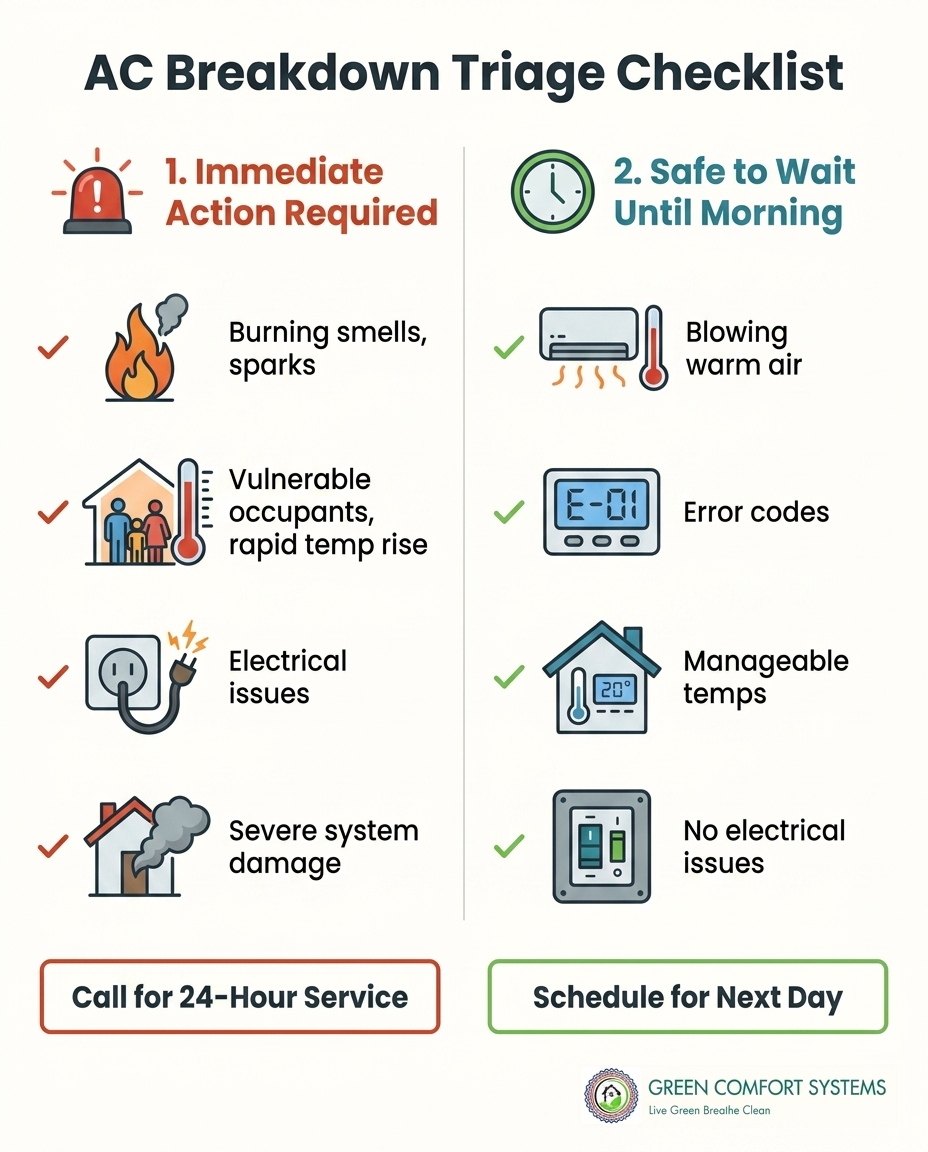
• Electrical Symptoms — Standard Priority (Next-Day): Thermostat is blank or unresponsive. — Emergency Priority (Immediate): Burning smells, visible sparks, or tripping main breakers.
• Occupant Health — Standard Priority (Next-Day): Healthy adults in the home. — Emergency Priority (Immediate): Infants, elderly, or individuals with severe medical conditions.
• Water and Leaks — Standard Priority (Next-Day): A small, manageable drip near the indoor unit. — Emergency Priority (Immediate): Massive leaking threatening drywall, ceilings, or electrical panels.
• Indoor Temperature — Standard Priority (Next-Day): House is warm but currently under 80°F. — Emergency Priority (Immediate): Rapidly climbing temperatures exceeding safe indoor thresholds.
By assessing these specific factors, a dispatcher can quickly tell you if a technician needs to be routed to your home immediately, or if you can safely turn the system off, get some sleep, and see a technician during standard business hours.
Definitive Signs Your Late-Night AC Breakdown is a True Emergency
If you are standing in front of your thermostat debating whether to make the call, look for specific symptoms that justify an immediate 24-hour dispatch. A true emergency always involves a threat to safety, health, or the structural integrity of your home.
One Forest Hill customer reached out during the intense summer heat when their AC unit failed with a baby at home. Because extreme heat poses a significant risk to infants, a technician was dispatched quickly and professionally assessed the problem. The issue was resolved promptly, keeping the home cool and safe for the vulnerable child. This is a textbook example of a situation that cannot wait.
If you observe any of the following signs, your breakdown is an emergency:
• Electrical burning smells: An acrid, fishy, or burning plastic odor coming from your vents, the indoor air handler, or the outdoor compressor indicates an overheating electrical component and an immediate fire hazard.
• Visible sparks or smoke: If you see sparking near the thermostat or the main unit, shut off the power at the breaker immediately and call for emergency service.
• Vulnerable family members: Homes with infants, elderly relatives, or individuals with respiratory and cardiovascular conditions cannot safely endure extreme summer temperatures.
• Significant water damage: While a little condensation is normal, a system that is actively pouring water onto your ceiling, drywall, or near electrical components requires immediate intervention to prevent severe property damage.
• Dangerously rapid temperature rise: If the indoor temperature has rapidly exceeded safe levels and continues to climb despite the sun being down, the home may become uninhabitable by morning.
When an AC Malfunction Can Safely Wait Until Morning
If your system is malfunctioning but you do not meet the emergency criteria above, deferring service to regular business hours is often the safest and most cost-effective choice. Many common cooling failures are mechanical inconveniences rather than catastrophic hazards.
For example, another local customer found their ductless system throwing error codes during the heart of a severe summer heatwave. Because the house was still at a manageable temperature and there were no electrical hazards, they scheduled an appointment for the next day. The technician arrived on time, quickly pinpointed the issue, recharged the unit with refrigerant, and even performed a diagnostic on a second unit. By waiting, they received comprehensive service without the stress of an after-hours premium.
Mechanical Issues That Do Not Require Midnight Service
Blowing warm air: If the system is running but blowing warm air, and there are no strange smells or massive water leaks, the compressor or refrigerant lines likely need attention. Turn the system off at the thermostat to prevent further damage and wait for morning.
Standard error codes: Modern thermostats and indoor units often display error codes indicating a need for maintenance, a dirty filter, or a sensor issue. These are routine fixes that a daytime technician can easily handle.
Manageable temperatures: If the breakdown occurs late enough at night that morning is only a few hours away, the indoor temperature is likely still manageable. Homes with decent insulation will hold their temperature reasonably well until the sun rises.
For homes utilizing alternative cooling methods or considering upgrades to more resilient systems, waiting for a next-day diagnostic is the smarter financial move. If you rely on specialized equipment, scheduling professional heat pump services during normal hours ensures the technician has full access to parts supply houses, which are typically closed at 2:00 AM.
Managing Overnight Heat and Humidity in Maryland
If you have determined that your breakdown can wait until morning, your next priority is staying safe and comfortable through the night. In the Baltimore and Forest Hill region, summer humidity levels frequently exceed 70%. This high ambient moisture drastically alters the indoor heat index, making an 80-degree house feel dangerous and severely disrupting sleep.
High overnight humidity prevents sweat evaporation, which is the human body's primary mechanism for cooling itself. Even without direct sunlight, a humid, stagnant house can quickly become uncomfortable. Managing this environment requires a strategic approach to airflow and moisture control.
• Keep windows closed strategically: It is tempting to throw open every window when the AC dies. However, if the outside temperature and humidity are higher than the conditions inside your home, opening windows will only draw thick, hot moisture indoors. Only open windows if a distinct, cool breeze is present and the outside temperature has dropped significantly.
• Create a wind-chill effect: Utilize ceiling fans and portable oscillating fans in the room where your family is sleeping. Fans do not lower the temperature of the room, but they move air across your skin, aiding in evaporation and creating a cooling wind-chill effect.
• Avoid heat-generating appliances: Do not use ovens, stoves, or incandescent lights. Even a large television or gaming console generates a surprising amount of ambient heat in a closed room.
• Focus on hydration: Drink plenty of ice water to regulate your core body temperature, even if you are just lying in bed.
Once your immediate cooling crisis is resolved, you may want to look into comprehensive indoor air quality solutions to help manage the heavy Maryland humidity year-round, making your home more resilient to sudden temperature shifts.
What to Check Before Requesting Service
Before you pick up the phone to request either emergency or next-day service, there are a few basic, safe troubleshooting steps you should perform. Empowering yourself with these checks can occasionally resolve a simple issue without the need for a technician, saving you time and money during the busy summer season.
1. Verify the thermostat settings: It sounds overly simple, but always check the thermostat first. Ensure it is explicitly set to "cool" and not "fan only" or "heat." If the screen is blank, change the batteries. A dead thermostat cannot communicate with your cooling equipment.
2. Check the electrical panel: Locate your home's main electrical panel and look for a tripped breaker labeled for the AC or HVAC system. If it is tripped, flip it entirely off, then back to the on position. Important safety note: Only reset a tripped breaker once. If it immediately trips again, leave it alone. This indicates a serious electrical short, and repeatedly resetting it is a fire hazard.
3. Inspect the air filter: A severely clogged air filter restricts airflow so dramatically that the evaporator coil can freeze solid into a block of ice, causing the system to stop cooling entirely. If the filter is caked in dust, replace it immediately and leave the system off for a few hours to thaw.
4. Ensure vents are unobstructed: Walk through your home and ensure all supply vents and return grilles are open and unblocked by heavy furniture, rugs, or thick curtains. Starving the system of air will cause it to shut down to protect its internal components.
If you have run through these basics and the system is still unresponsive, it is time to call in the professionals. For a deeper dive into what might be going wrong, review these troubleshooting steps if your AC is not cooling to better communicate the symptoms to your dispatcher.
Frequently Asked Questions About AC Emergencies
What is considered an AC emergency?
An AC emergency is any situation involving electrical hazards, burning smells, extreme indoor temperatures, or vulnerable occupants. If you see sparks, smell melting plastic, or have an infant or elderly family member in a rapidly heating house, you need immediate 24-hour service. Standard mechanical failures without these risk factors are generally not emergencies.
Can a broken AC wait until morning?
Yes, if there are no safety hazards, the house is not dangerously hot, and occupants are healthy adults, waiting is often more cost-effective. Turning the system off and utilizing fans overnight allows you to schedule a standard diagnostic visit. This avoids premium after-hours dispatch fees and ensures technicians have access to parts supply houses.
Should I turn off my AC if it is blowing warm air?
Yes, continuing to run a malfunctioning system can cause further damage to the compressor or blower motor. If the unit is blowing warm air, it is wasting electricity and potentially burning out expensive internal components. Turn it off completely at the thermostat until a professional can assess it.
How fast does a house heat up without AC?
Depending on your home's insulation and the outdoor conditions, a house can gain 1 to 3 degrees per hour, accelerating rapidly once the sun rises. During a humid Maryland summer night, the temperature rise might be slow, but the increasing indoor humidity will make the home feel significantly hotter much faster.
Is a lack of AC considered a medical emergency?
It can become one for infants, the elderly, or those with respiratory and cardiovascular issues during peak heatwaves. Extreme heat causes dangerous stress on the body. If someone in the home is vulnerable to heat-related illness, a broken air conditioner should be treated as an immediate priority.
Schedule Your Diagnostic and Restore Your Comfort
Whether your late-night situation demands a 2:00 AM emergency dispatch or a scheduled morning visit, getting a professional diagnostic is essential to protecting your home and your equipment. By reviewing the triage criteria carefully, you can make the best, most cost-effective decision for your family in Forest Hill.
When you know the definitive signs of a true emergency versus a standard mechanical failure, you take control of the situation. If you are ready to get your system running efficiently again, reach out to local experts for reliable air conditioning repair and service. A clear assessment will restore your peace of mind and, most importantly, your comfortable home.
Book Expert Service Or Contact Us
Other Blogs


Get Financing Today
Get the comfort you deserve, without the financial stress.

Latest Blogs
Decoding the Clanking and Banging Noises from Your Rosedale Radiators This Fall
Addressing Drafty Windows and Heating Inefficiencies in Older Forest Hill Homes
Managing the September Swing: Keeping Your Rosedale Home Comfortable When Days Are Hot and Nights Are Cold
