





What We Actually Inspect During a Fall Furnace Tune-Up (And Why It Prevents Mid-Winter Breakdowns)

The Myth of the 'Quick Visual Check' for Winter Heating Prep
A pervasive myth among homeowners is that preparing a heating system for cold weather only requires a quick visual walkthrough and a fresh air filter, but understanding What We Actually Inspect During a Fall Furnace Tune-Up (And Why It Prevents Mid-Winter Breakdowns) reveals a much deeper reality. A superficial glance completely misses the underlying component drift that occurs during the long off-season. True professional maintenance goes far beyond wiping down the cabinet; it requires precise diagnostic tools to measure internal metrics like electrical draw, gas flow, and airflow resistance. Choosing a comprehensive technical tune-up over a basic walkthrough is the definitive key to preventing sudden December breakdowns.
For comprehensive support, explore our HVAC Services or learn more about our Professional Heating Services.
During the September pre-heating season, the goal is to catch mechanical degradation before the system is forced to run continuously. When a furnace is evaluated superficially, the technician might confirm that the burners ignite and the blower spins, but they fail to measure how hard those components are working to achieve that result. This false sense of security often leads to catastrophic failures just when the system is needed most.
• Looking at the flame color to guess combustion quality. — The Comprehensive Technical Diagnostic: Using a digital manometer for precise gas pressure calibrations.
• Listening to the blower motor for unusual noises. — The Comprehensive Technical Diagnostic: Measuring electrical voltage and amperage draw with a multimeter.
• Shining a flashlight at the front of the heat exchanger. — The Comprehensive Technical Diagnostic: Conducting a thorough, sometimes camera-assisted inspection for hairline cracks.
• Feeling the air from the vents to gauge airflow. — The Comprehensive Technical Diagnostic: Measuring static pressure to verify the ductwork is not choking the system.
By relying on hard data rather than visual guesswork, professional diagnosticians can pinpoint exactly which components have drifted out of factory specifications. This proactive approach ensures that every part of the heating cycle is operating safely, efficiently, and reliably.
Why Off-Season Component Drift Causes December Breakdowns
Furnaces sit idle for months during the spring and summer. During this extended downtime, the mechanical and electrical components are not completely static. Lubricants within motors begin to settle and separate, causing metal-on-metal friction when the system finally starts up. Dust and airborne particulates accumulate on sensitive sensors, acting as an insulating layer that disrupts electrical signals. Furthermore, the natural thermal expansion and contraction of the home throughout the summer can cause tiny micro-expansions in electrical connections, slowly loosening wires that were perfectly tight the previous winter.
In Rosedale, the rapid transition from crisp autumn weather to unpredictable, freezing winter temperatures puts sudden, extreme stress on uncalibrated heating systems. A furnace that has drifted out of calibration might seem perfectly fine during a mild October evening when it only runs for ten minutes at a time. However, when the first major freeze hits and the thermostat demands continuous heat for hours on end, the sudden heavy load exposes every single weakened component.
Unaddressed minor drifts in calibration cascade into major mechanical failures once the system runs continuously. For example, a slightly loose electrical connection creates resistance, which generates heat. Under a heavy winter load, that excess heat can quickly fry a delicate control board. Similarly, a blower motor fighting against settled lubricants will draw more electricity than it should, eventually causing the motor's capacitor to fail.
Catching these drifts early stops the domino effect before emergency repairs are needed. By performing electrical voltage checks and gas pressure calibrations before the severe cold arrives, technicians reset the system to its baseline. This meticulous recalibration ensures that when the Rosedale winter demands maximum output, the furnace has the structural and mechanical integrity to deliver without failing.
Beyond the Surface: Measuring Electrical Voltage and Amperage
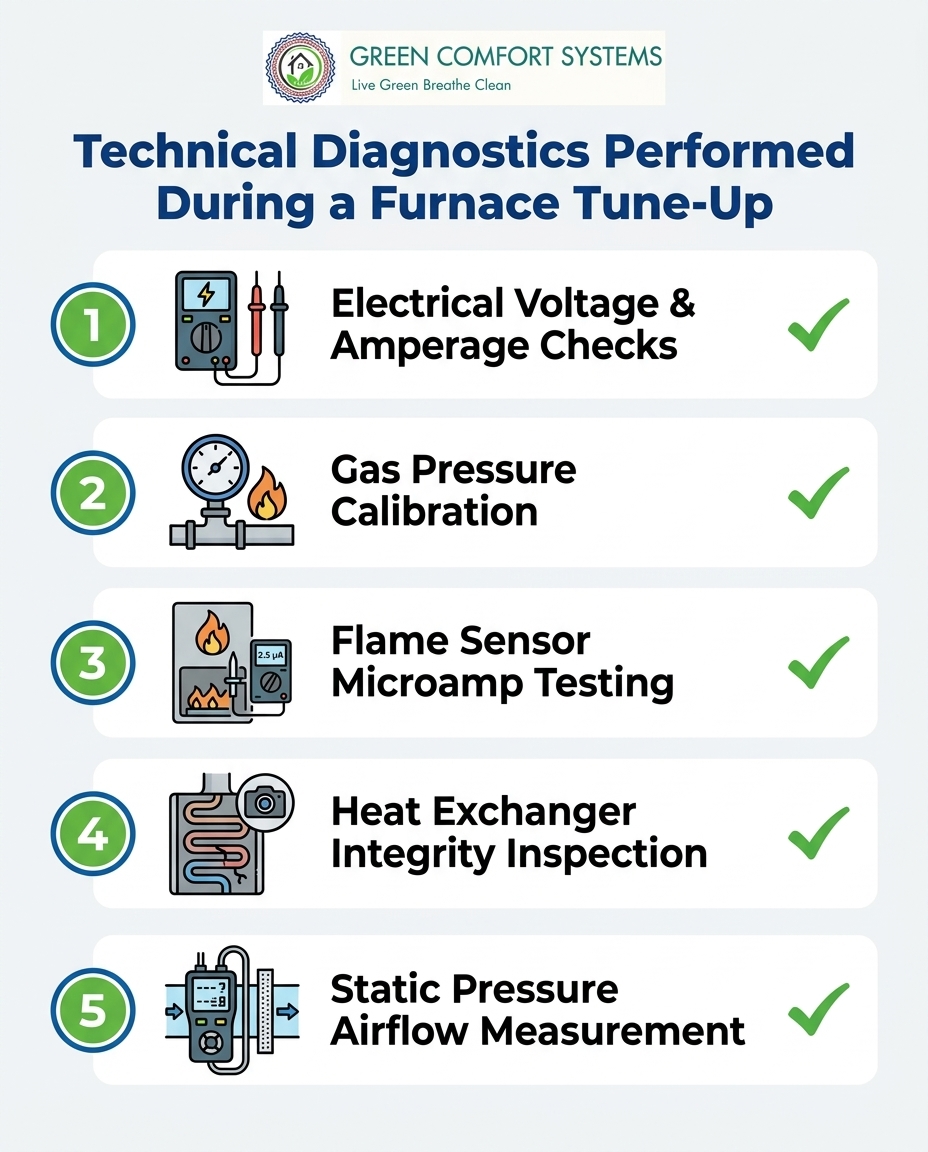
The first major technical diagnostic step in a true furnace tune-up involves taking precise electrical measurements. Modern heating systems rely heavily on complex electrical sequences to operate safely. If any part of this sequence receives too much or too little power, the entire system is at risk of shutting down.
• Multimeter Diagnostics: Technicians use advanced multimeters to measure the exact voltage and amperage draws of the blower motor and the draft inducer motor. These readings are compared directly to the manufacturer's data plate on the unit.
• Identifying Friction and Wear: A motor drawing too many amps is a clear warning sign of impending failure. This excessive power draw is often due to failing run capacitors or internal friction from worn bearings. Catching high amp draws early allows for a simple part replacement rather than a total motor failure.
• Securing Connections: Tightening loose electrical connections prevents voltage drops. When a connection is loose, the resulting voltage drop forces the system to pull more current, which can easily overload and permanently damage the main circuit board.
• Preventing Sudden Loss of Heat: These specific electrical measurements prevent the sudden loss of heat during a winter storm. When electrical components fail, the shutdown is immediate. One local homeowner reached out during winter when they needed parts and assistance with their heat. Because a technician was able to provide the exact parts and help quickly, the issue was resolved efficiently—but discovering and correcting these electrical weak points in the fall prevents this exact type of mid-season emergency.
Testing the Flame Sensor and Ignitor
Beyond the main motors, the smaller ignition components require exact electrical testing. The flame sensor is a critical safety device that proves to the control board that a fire has successfully ignited. Technicians measure the microamp signal of the flame sensor; if the reading is too weak, usually due to microscopic carbon buildup, the furnace will shut off the gas valve as a safety precaution, leaving the home cold.
Similarly, the hot surface ignitor is tested for electrical resistance. Ignitors degrade over time, and a resistance reading that falls outside the acceptable range is a strong predictor that the ignitor will crack and fail under the stress of continuous winter cycling. Measuring these components rather than just looking at them is the essence of preventative maintenance.
Precision Combustion: Gas Pressure Calibrations
One of the most critical, yet frequently overlooked, aspects of a professional inspection is the calibration of the gas pressure. When a furnace is installed, the gas valve is set to deliver a specific amount of fuel to the burners. Over time, variations in the municipal gas supply and internal wear on the valve springs can cause this pressure to drift. Electrical voltage checks and gas pressure calibrations are the twin pillars of a safe heating system.
To correct this, technicians use a highly sensitive tool called a manometer to test the exact gas pressure being delivered to the manifold. This is not a visual check of the flame; it is a precise numeric measurement measured in inches of water column (in. w.c.). If the reading does not match the manufacturer's exact specifications, the technician must manually adjust the gas valve to restore the correct flow.
The dangers of incorrect gas pressure: Incorrect gas pressure leads to incomplete combustion. If the pressure is too low (under-firing), the furnace will struggle to heat the home. More dangerously, under-firing lowers the temperature of the exhaust gases, causing them to condense inside the heat exchanger. This condensation is highly acidic and will quickly rust out the metal components from the inside.
Conversely, if the pressure is too high (over-firing), the furnace produces too much heat. Over-firing forces the system to run dangerously hot, which can warp and eventually crack the heat exchanger. It also causes soot buildup and wastes a significant amount of fuel. Calibrating this pressure ensures optimal heat output and protects the internal components from premature wear. If a valve is found to be completely unresponsive to adjustment, it may require professional furnace gas valve repair to restore safe operation.
Safety and Airflow: Heat Exchangers and Static Pressure
A furnace does not just generate heat; it must safely separate the toxic byproducts of combustion from the breathable air circulating through the home. This separation happens at the heat exchanger, making its inspection the most critical safety check performed during the September pre-heating season.
• Heat Exchanger Inspection: Technicians conduct a thorough visual, and sometimes camera-assisted, inspection of the heat exchanger. They are looking for microscopic hairline cracks or rust spots. Even a crack the width of a human hair expands when the metal heats up, creating a pathway for exhaust gases to enter the home's airstream.
• Carbon Monoxide Testing: Testing for carbon monoxide leaks ensures the combustion exhaust is safely venting outside. Professionals check the draft of the flue pipe to guarantee that all toxic gases are being pulled up and out of the house, rather than spilling back into the utility room.
• Static Pressure Measurement: Just as blood pressure measures the health of a human circulatory system, static pressure measures the health of an HVAC system. Technicians measure static pressure to verify that ductwork and filters are not choking the blower motor. High static pressure means the system is struggling to push air through the home.
• Preventing Overheating: Addressing airflow restrictions prevents the furnace from overheating. When airflow is blocked by a restrictive filter or undersized ducts, the heat generated by the burners cannot escape into the home. This causes the internal temperature of the furnace to spike, repeatedly tripping the high-limit safety switch and eventually cracking the heat exchanger. Resolving these airflow issues often ties directly into optimizing your home's Indoor Air Quality Solutions.
How Diagnostic Transparency Protects Your Home
The ultimate benefit of a technical diagnostic tune-up is the elimination of uncertainty. A true diagnostic tune-up leaves no room for guesswork about the furnace's condition. Homeowners no longer have to cross their fingers and hope the system survives the winter; they have concrete data proving that the unit is ready for the cold.
When one customer required maintenance on their heating system during the winter, the responding technician arrived on time and thoroughly explained the entire process before starting. The maintenance was completed exactly as expected, demonstrating that clear communication is just as critical as the mechanical work itself. Homeowners receive clear explanations of what was measured, what those measurements mean, and what was adjusted to bring the system back into alignment.
This level of transparency is a cornerstone of the Green Guardian Club maintenance program. By emphasizing thorough, transparent reporting and specific eco-friendly efficiency checks, the program provides concrete proof of value. Members know exactly how their electrical voltage checks and gas pressure calibrations are protecting their investment.
1. Baseline Establishment: By recording the exact voltage, amperage, and gas pressure readings, technicians establish a baseline. If an issue arises years later, this historical data is invaluable for diagnosing the root cause.
2. Proactive Adjustments: Proactive adjustments made in the fall are significantly less invasive than emergency replacements in freezing temperatures. Replacing a weak capacitor takes minutes; replacing a seized blower motor takes hours and leaves the home without heat.
3. Lifespan Extension: Consistent, measured maintenance extends the operational lifespan of the heating system. When a furnace is perfectly calibrated, it experiences less mechanical stress, less thermal fatigue, and less energy waste, allowing it to serve the home reliably for years longer.
Frequently Asked Questions About Furnace Tune-Ups
What is included in a furnace tune up?
A comprehensive furnace tune-up includes precise technical measurements and safety checks, rather than just a visual inspection. Technicians will perform electrical voltage checks, calibrate the gas pressure, measure the microamp signal of the flame sensor, and test the static pressure of the airflow. They also conduct a rigorous inspection of the heat exchanger to ensure there are no carbon monoxide leaks, preparing the system for the heavy loads of winter.
Is a furnace tune up really necessary?
Yes, a furnace tune-up is absolutely necessary to prevent sudden mid-winter breakdowns. Over the spring and summer, idle components experience drift—lubricants settle, electrical connections loosen, and gas valves lose their exact calibration. Having a professional measure and reset these components during the September pre-heating season ensures the system can handle the continuous stress of freezing temperatures without failing.
How long does a furnace inspection take?
A thorough, technical furnace inspection typically takes between 60 and 90 minutes to complete. This timeframe allows the technician to connect their diagnostic tools, measure the electrical and gas inputs, inspect the heat exchanger, and make any necessary micro-adjustments. If the inspection is completed in just 15 minutes, it was likely a superficial visual check rather than a true diagnostic tune-up.
How often should a gas furnace be serviced?
A gas furnace should be professionally serviced once a year, ideally in the early fall before the first freeze. Annual servicing is required by most manufacturers to keep the equipment warranty valid. Consistent yearly maintenance catches minor component drift before it cascades into major mechanical failure, ensuring safe and efficient operation throughout the heating season.
Can I just change the filter instead of getting a full tune-up?
While changing the air filter is a critical homeowner task that protects airflow, it cannot replace a full technical tune-up. A clean filter will not correct incorrect gas pressure, tighten loose electrical connections, or detect a microscopic crack in the heat exchanger. Both a clean filter and professional diagnostic measurements are required to keep a heating system running safely and efficiently.
What does gas pressure calibration actually do for my furnace?
Gas pressure calibration ensures that the exact, manufacturer-specified amount of fuel is delivered to the burners. If the pressure is too high, the furnace will over-fire, which wastes fuel and can crack the heat exchanger from excessive heat. If the pressure is too low, the system will under-fire, causing acidic condensation that rusts the internal components. Proper calibration maximizes both safety and energy efficiency.
Secure Your Winter Comfort With a Comprehensive Inspection
Don't wait for the first freezing night to find out if your furnace's internal components have drifted out of calibration over the summer. A superficial visual check is simply not enough to guarantee your system will withstand the heavy demands of a sudden winter freeze. Rely on professional diagnosticians to thoroughly measure, adjust, and secure your heating system during the September pre-heating season. Schedule your comprehensive fall maintenance today to ensure reliable, safe, and efficient heat all winter long.
Book Expert Service Or Contact Us
Other Blogs


Get Financing Today
Get the comfort you deserve, without the financial stress.

Latest Blogs
What We Actually Inspect During a Fall Furnace Tune-Up (And Why It Prevents Mid-Winter Breakdowns)

Introducing the Green Legacy Initiative: How Green Comfort Systems Gives Back to Maryland's Forests
Home Maintenance Tips and Troubleshooting: Introducing the Green Legacy Initiative in Maryland
